In Arlington, MA, we meet a lot of homeowners in the same spot. They like their brown cabinets, they don't want a full gut renovation, but the backsplash still makes the kitchen feel dated, dark, or too busy. That's where the right tile choice matters. A backsplash can brighten the room, make the cabinet color feel intentional, and clean up the whole look without replacing every cabinet box.
If you're sorting through kitchen backsplash ideas for brown cabinets, the best options usually come down to three things: balance, light, and daily usability. That lines up with what we see in the field and with broader design guidance that prioritizes brightening the space, adding texture, or using controlled contrast to work with brown cabinetry rather than fight it, as noted by The Cozy Spoon's guidance on backsplash choices for brown cabinets. If you're also debating whether to refinish or replace cabinets entirely, this cabinet painting guide for Melbourne homes shows how much finish color changes the final look.
In Greater Boston homes, especially in Cambridge, Newton, Belmont, and Somerville, we also have to think about practical remodeling issues. If your backsplash project is part of a larger kitchen remodel that moves plumbing, rewires lighting, opens walls, or changes ventilation, that typically triggers permits, trade inspections, and MA State Building Code compliance under 780 CMR. We handle that coordination every day as a Massachusetts licensed general contractor, and it's a big part of getting a kitchen to look good and close out cleanly.
Table of Contents
- 1. Subway Tile Backsplash with Contrasting Grout
- 2. Marble or Natural Stone Hexagon Tiles
- 3. Textured or 3D Tile Backsplash
- 4. Herringbone or Chevron Patterned Tile
- 5. Glass Tile Backsplash with Metallic Accents
- 6. Brick or Faux Brick Backsplash
- 7. Mixed Metal or Ceramic Tile Mosaic
- 8. Penny Round or Circular Tile Mosaic
- 8 Backsplash Ideas Compared for Brown Cabinets
- Final Thoughts
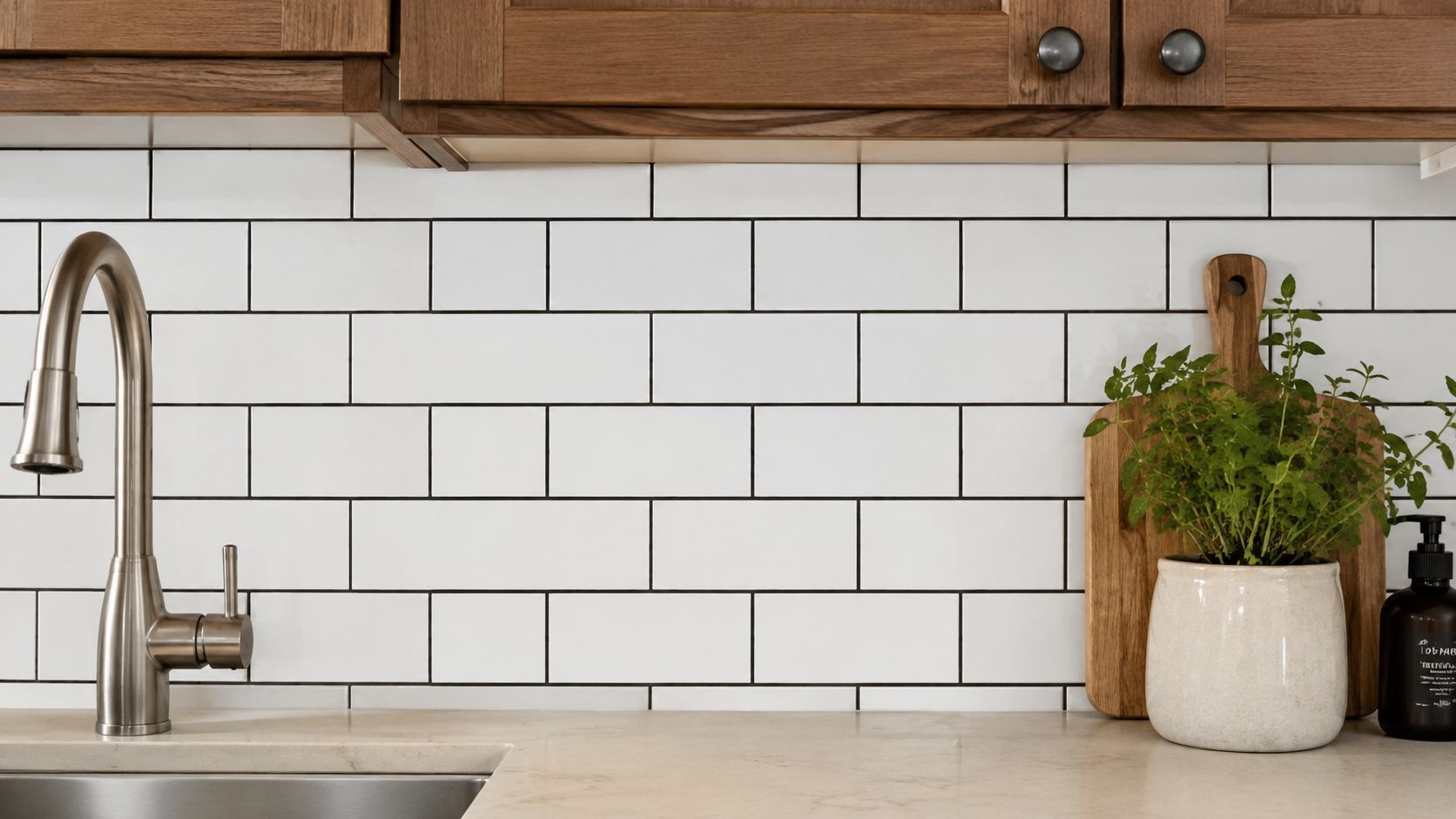
1. Subway Tile Backsplash with Contrasting Grout
White is still the safest and strongest answer for brown cabinets. Industry guidance consistently points to white backsplashes as the top choice for balancing darker brown cabinetry and making the kitchen feel brighter and more open, especially compared with gray, which can read heavier in these spaces, according to this design analysis of white backsplashes with brown cabinets.
That's why we install a lot of subway tile in Arlington, Belmont, Medford, and Lexington kitchens. It works with older wood cabinets, newer shaker fronts, and transitional remodels where the homeowner wants a clean look without making the room feel cold.
Why This Still Works in Greater Boston Kitchens
A cream subway tile with charcoal grout can sharpen medium-brown cabinets without overcomplicating the room. In a Medford kitchen renovation, that combination usually feels more current than beige-on-beige. In a Newton kitchen remodel, white subway tile with espresso grout can tie into darker flooring or hardware and keep cherry-brown cabinetry from dominating the room.
If you want softer contrast, we'll steer you toward warm white or off-white tile with a grout color that picks up the countertop. If you want stronger definition, darker grout gives you that grid pattern and a more refined look.
Practical rule: Pick the grout after you've finalized the countertop and floor samples. Brown cabinets already carry visual weight, so the grout either calms the room down or makes the backsplash the main event.
A few things matter on install:
- Use stain-resistant grout: In splash zones near the range and sink, epoxy or comparable high-performance grout makes cleanup easier.
- Finish the edges cleanly: Bullnose, metal profiles, or a well-planned return at the end of a run keeps the tile from looking tacked on.
- Waterproof the wall properly: Behind sinks and cooktops, we treat prep and substrate seriously. Good tile over bad prep still fails.
For homeowners planning a broader remodel, this style fits well into kitchen backsplash ideas with dark cabinets, especially when you're trying to brighten an older layout without stripping out every finish.
2. Marble or Natural Stone Hexagon Tiles
You see this choice a lot in older Greater Boston homes where the cabinets are staying, but the kitchen still needs to feel finished and current. Hexagon tile gives brown cabinets a cleaner, more refined look than many square or stacked layouts, and natural stone keeps that pattern from feeling sharp or overdesigned.
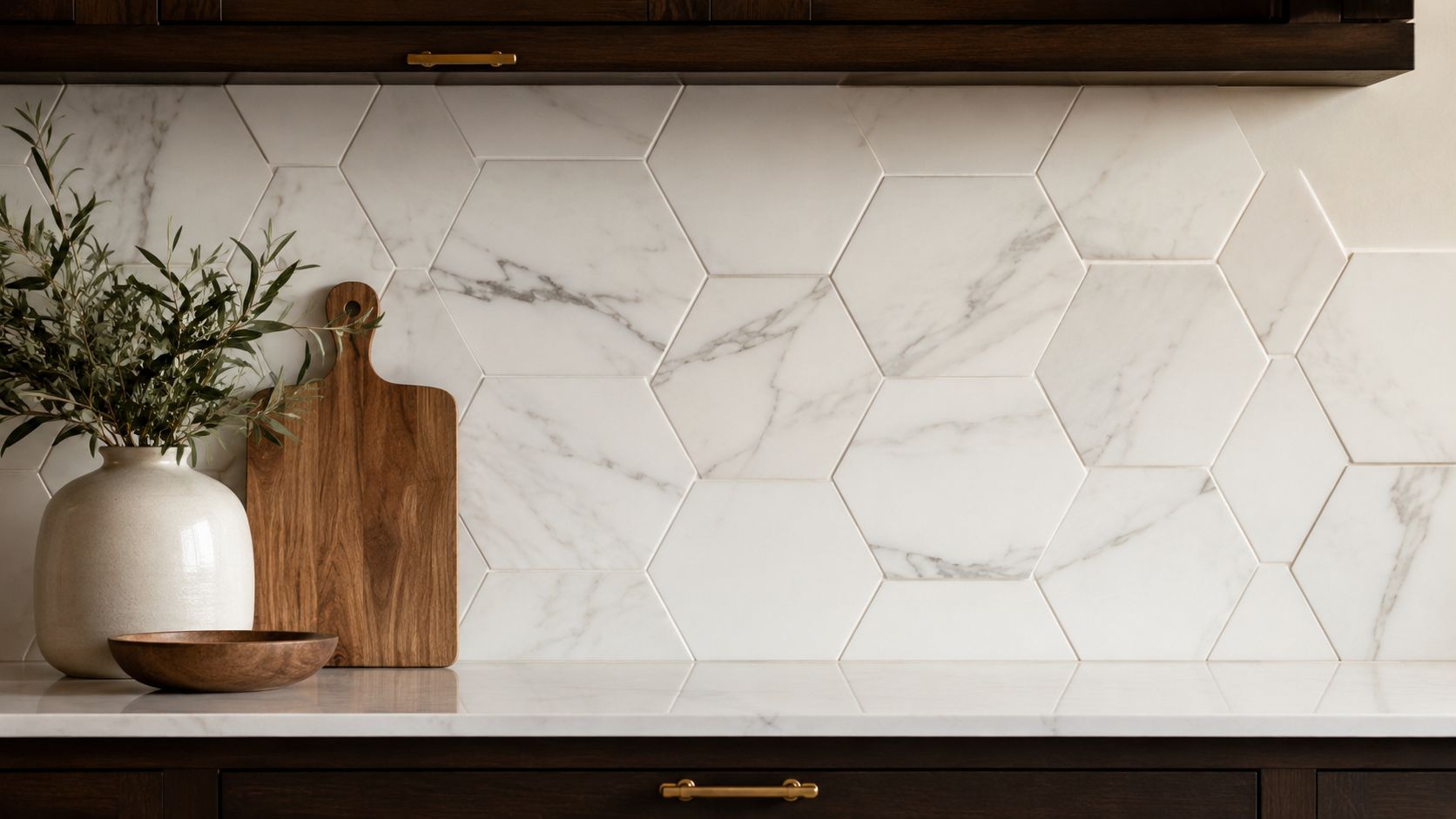
In Cambridge, Newton, and Arlington, this is usually a good fit when the homeowner wants an upgrade that reads custom without changing every finish in the room. Marble hexagons pair well with walnut, cherry, and espresso cabinets because the stone brings variation and lightness, while the shape adds movement. The result feels more intentional than a basic field tile, but it still respects traditional wood cabinetry.
The trade-off is installation. Small hex tile takes more layout time, more cuts, and more care around outlets, window stools, and cabinet ends. If the wall is out of plane, the pattern shows it fast. We check substrate condition early, especially in older houses where plaster repairs, patched drywall, or uneven walls can telegraph right through the finished tile. If the project includes electrical changes at the backsplash, outlet spacing and box extensions also need to be handled correctly under 780 CMR and the electrical code, not buried after the tile is set.
Where Stone Hexagons Make Sense
In a Wellesley kitchen with espresso cabinets and brass hardware, polished marble hexagons can look sharp. In a family kitchen that sees real cooking every day, honed stone is usually the better call because it shows fewer smudges, water marks, and light scratching. That matters behind the range and around a prep sink.
For honey-brown cabinets, lighter limestone or marble hexagons usually work better than anything too yellow or too gray. Warm white stone keeps the cabinets grounded without making the room muddy. Cooler gray marble can work too, but only if the countertop and floor support it. If the counters already run cool and the cabinets run red or orange, the whole kitchen can start fighting itself.
Budget matters here. Natural stone hex mosaics usually cost more than standard ceramic subway tile, and labor is higher because the sheets need careful alignment. Sealing adds one more maintenance step. Homeowners who want the stone look should know what they are buying into before the install starts.
A few practical rules help:
- Pick the finish based on use: Honed stone is easier to live with in busy kitchens.
- Keep grout close to the tile color: High-contrast grout can make small hexagons look busy fast.
- Plan outlet locations before tile day: Small-format tile looks best when cuts around devices are balanced.
- Use the right wall prep: Stone is heavy enough that poor substrate work shows up later.
Natural stone can look expensive because it takes real prep and careful setting to get it right.
If you want to compare marble, limestone, and other natural options, our guide to stone backsplash ideas for kitchens lays out where each material works best.
3. Textured or 3D Tile Backsplash
Textured tile is one of the best ways to keep a neutral kitchen from looking flat. Brown cabinets already bring warmth and depth, so a rippled, wave, or lightly embossed backsplash can add interest without introducing another dominant color.
We see this work especially well in Cambridge, Somerville, and Melrose kitchens where the homeowner wants a contemporary update but still has classic wood cabinetry, oak flooring, or traditional trim elsewhere in the house.
What to Expect from a Kitchen Remodel in Cambridge MA
A textured backsplash is usually a straightforward finish upgrade. But if the project includes new receptacles, under-cabinet lighting, venting changes, or moving walls, that's no longer just cosmetic. In Massachusetts, that can involve building, electrical, and plumbing permits, plus rough and final inspections depending on scope under 780 CMR and local building department requirements.
Our process is simple. We check wall condition, confirm the tile thickness works at outlet locations, plan transitions at windows and cabinets, and make sure the lighting supports the tile. Textured tile can look great under the right fixture and flat under the wrong one.
A cream 3D wave tile behind espresso-stained cabinetry works well when the room already has enough contrast. A subtle white ripple tile in a Reading or Cambridge kitchen can also echo the wood grain without competing with it.
- Stick with restrained texture: Too much relief behind a cooktop can become a cleaning annoyance.
- Use samples under real light: A showroom sample and your actual kitchen can read very differently.
- Balance with smoother finishes: Textured wall tile pairs better with simpler counters and cabinet fronts.
For homeowners comparing local contractors, this is the kind of detail that separates a clean install from a kitchen that always feels a little off. If you're planning kitchen remodeling in Somerville or a custom kitchen in Medford, tile thickness, trim details, and lighting coordination should all be discussed before materials are ordered.
4. Herringbone or Chevron Patterned Tile
Pattern does a lot of the work here. Herringbone and chevron can take a basic white, cream, taupe, or gray tile and make it feel custom.
In Brookline, Belmont, and Arlington kitchens with standard-height ceilings, that directional layout can help pull the eye across the wall and make the backsplash feel more intentional than a straight stack or brick pattern.
Layout Matters More Than Color Here
A cream-and-white herringbone backsplash with dark-brown shaker cabinets works because the movement is in the layout, not the color. That's usually the right call with brown cabinetry. The cabinets already provide the weight. The backsplash should introduce rhythm, not chaos.
In our experience, homeowners underestimate the labor on this pattern. Herringbone and chevron require more planning, more cutting, and more attention at edges, outlets, and corners. If the wall isn't reasonably flat, the install gets tougher fast.
Here's a good visual example to study before choosing this pattern:
A few practical calls we make on these jobs:
- Keep the field tile simple: Monochromatic or low-contrast tile holds up better over time.
- Plan the starting point: The centerline and cut locations matter. You don't want tiny slivers showing at the ends of a focal wall.
- Use waterproof prep where needed: Especially behind sinks and range areas.
If you're doing a larger kitchen remodeling Arlington or kitchen remodeling Belmont project, this is also where permit scope can creep up. New backsplash alone usually doesn't trigger much. Once you add wiring, relocate appliances, or open walls, inspections come into play.
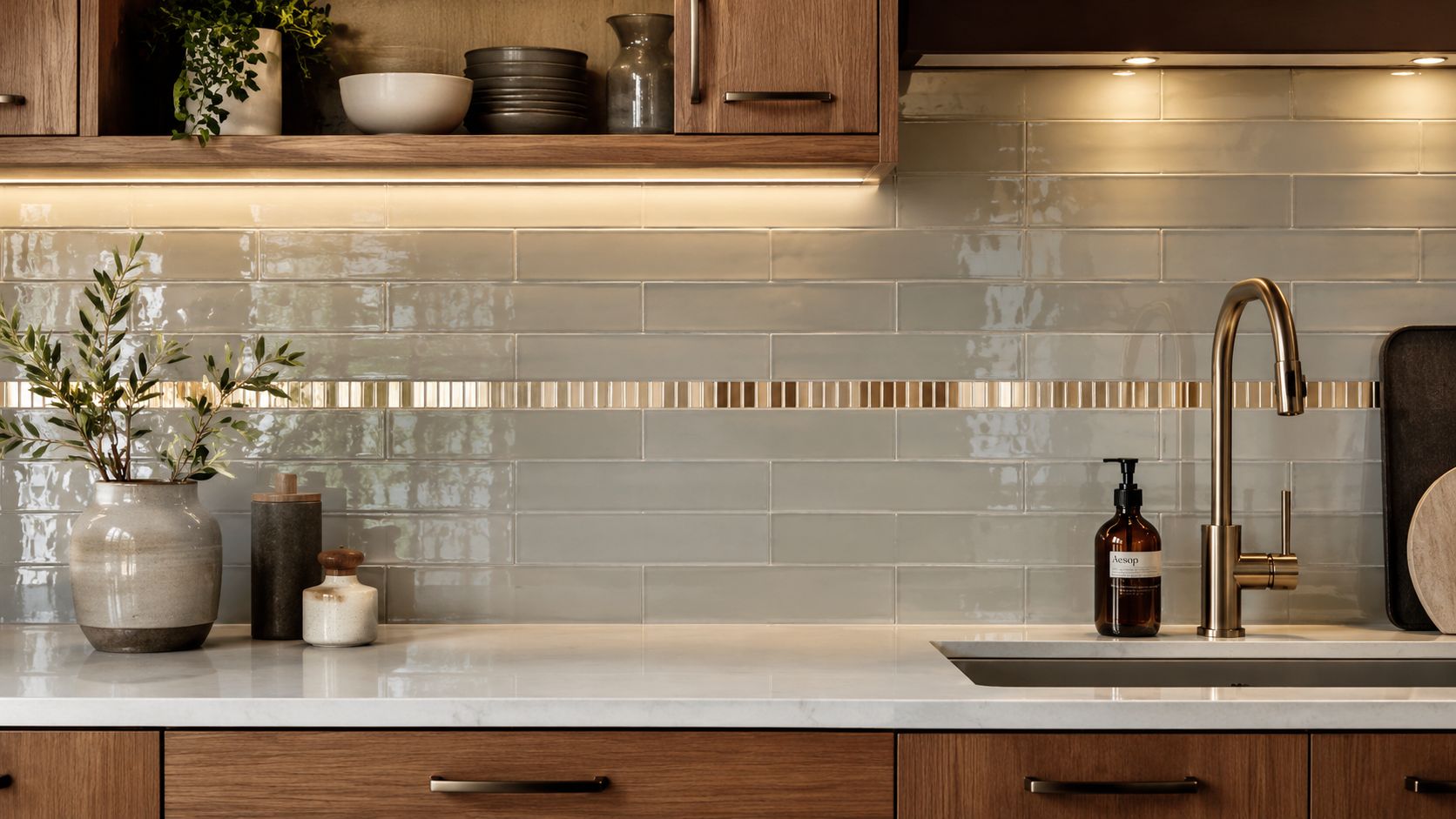
5. Glass Tile Backsplash with Metallic Accents
Glass tile helps dark kitchens because it throws light around. That's one reason glass sheet backsplashes and related glass configurations keep showing up as popular choices with brown cabinets, especially when the goal is a brighter, cleaner look, as noted in this overview of backsplash pairings for brown cabinets and black countertops.
In Somerville, Medford, and Cambridge, where some kitchens don't get a ton of natural light, that reflective quality can make a real difference.
How We Use Reflective Materials Without Making the Room Feel Smaller
The limitations of much online advice become evident. Metallic and reflective finishes can help. They can also make a brown kitchen feel tighter if the wrong finish goes on the wrong wall. Recent design commentary around bold textural materials points out that reflective surfaces need more careful handling with dark cabinetry, particularly where natural light is limited, as discussed in this piece on backsplash ideas for brown cabinets.
We deal with that by controlling the amount of shine. Frosted or softly textured glass usually works better than fully clear tile. Metallic accents should stay accents. They shouldn't take over the whole wall.
In darker kitchens, reflective tile works best when it brightens the room without turning every splash mark and under-cabinet shadow into a feature.
A Cambridge kitchen with frosted white glass in a simple grid can feel crisp and current. A Somerville kitchen with champagne-toned metallic inserts can work too, but only if the field tile stays quiet and the lighting is warm. We often pair this look with under-cabinet LED lighting because direct task light helps glass read clean instead of patchy.
If you're exploring this finish direction, our guide to glass backsplash ideas for kitchens gets into where glass makes sense and where it doesn't.
6. Brick or Faux Brick Backsplash
You buy an older place in Arlington or Newton, keep the brown cabinets because they're solid, and start looking for a backsplash that doesn't feel slick or overdesigned. Brick usually comes up fast. It adds age, texture, and a little grit, which is exactly why it works better in some kitchens than others.
With brown cabinets, brick brings warmth in a different way than stone or ceramic. The surface has more movement. The grout lines read heavier. That can be a real plus in a farmhouse, transitional, or older colonial kitchen. In a flat, modern kitchen with slab doors, glossy counters, and sharp metal finishes, it often looks out of place.
Real Brick Versus Faux Brick in Massachusetts Kitchens
Real brick can look excellent, but it asks more from the wall and more from the homeowner. The face is uneven, the joints collect grease, and sealing matters near a range. We also check substrate condition before we install it, because older plaster walls in Cambridge and similar towns are not always ready for the weight or thickness of a true masonry product.
Faux brick tile is usually the smarter choice for an active kitchen. You still get the texture and color variation, but installation is more predictable, cleaning is easier, and the wall buildup is easier to manage around outlets, window trim, and cabinet returns. Under 780 CMR, any electrical changes around that backsplash area still need to be handled correctly, especially if receptacles need box extenders or repositioning to sit flush with the finished surface.
A reclaimed-look brick backsplash with medium-brown stained cabinets can feel right at home in an older house. Cream, sand, or soft terracotta faux brick also pairs well with honey-brown shaker cabinets, especially if the counters are quiet and the hardware stays warm.
What usually goes wrong is scale. Some brick-look products are too busy for a small kitchen, especially once you add wood grain, countertop pattern, and floor variation. We steer homeowners toward a softer color blend and a thinner texture if the room already has a lot happening.
- Choose faux brick for easier maintenance: It handles everyday cooking mess better and usually costs less to install.
- Watch the wall thickness: Brick-look material can affect outlet depth, trim details, and the fit at the bottom of upper cabinets.
- Keep the surrounding finishes simple: Warm hardware, plain counters, and restrained paint colors let the backsplash do its job.
For budgeting, faux brick tile is typically more practical than true brick once labor is included, especially in towns where older walls need prep before tile goes up. If the scope grows beyond the backsplash into a full kitchen remodeling Stoneham or kitchen remodeling Wakefield job, we review venting, electrical, and inspection requirements before work starts.
7. Mixed Metal or Ceramic Tile Mosaic
Mosaic is where homeowners get into trouble fastest. It can look custom and smart, or it can look like five sample boards got pushed together.
Used well, mixed ceramic, glass, and metal can add personality to brown cabinets. Used badly, it competes with the cabinet grain, the countertop pattern, the hardware finish, and the floor all at once.
Where Homeowners Usually Go Wrong
The most common mistake is too many materials in equal proportion. Brown cabinets already have visual movement because wood grain and stain variation are part of the look. If the backsplash also has a lot of contrast, shimmer, and pattern, the kitchen loses focus.
We keep mosaics tighter than most homeowners expect. Cream ceramic with small frosted-glass accents can work. Brushed metal can work. But we use it in controlled amounts and we make sure the undertones all live in the same family.
Field note: If every sample looks good by itself but chaotic together, trust that reaction. The wall will only feel busier once grout lines, outlets, and under-cabinet shadows are added.
A Belmont custom kitchen might use a mostly ceramic field with a restrained metallic accent near a focal area. An Arlington renovation can mix taupe and gray ceramic with a little champagne-toned glass if the counters and hardware are kept simple. In Brookline, handmade ceramic with a few warm metallic touches can work in older homes where some texture already exists elsewhere.
For homeowners who want a more luxurious brown-on-brown look instead of a multicolor mosaic, there's another route worth considering. Full-height slab backsplashes in brown stone with warm veining, including materials such as Fantasy Brown marble or Velvet Taupe limestone, are recommended by designers as a stronger way to make brown feel intentional and current rather than dated, as described in this discussion of updated backsplash choices for brown kitchens.
8. Penny Round or Circular Tile Mosaic
Penny round tile softens a kitchen. That's what makes it useful with brown cabinets, which often have a lot of straight lines and visual weight.
In Cambridge, Somerville, and Newton, this is a good fit when the homeowner wants something more playful than subway tile but still wants the color palette to stay controlled.
Best Use Cases for Penny Round Tile
Cream or white penny rounds look good with dark espresso cabinets because the shape breaks up the heaviness. Soft gray penny rounds can also work with medium-brown shaker cabinets if the room already has enough light and the counters are simple. A two-tone penny round pattern can be beautiful, but only if the color change is subtle.
This style also benefits from current backsplash trends that favor larger visual continuity, extended runs, and decorative tile with texture and personality. Projections for 2025 to 2026 point toward larger backsplash tiles, reduced grout emphasis, extended backsplashes, dramatic veining, and strong demand for decorative hand-painted and Zellige-style surfaces, according to this report on kitchen backsplash trends for 2025. Penny round isn't large format, but it fits the same desire for a backsplash that feels decorative instead of purely utilitarian.
A few guardrails make this one work:
- Stick to calm color choices: Brown cabinets and bold penny-round color mixes usually become too much, too fast.
- Watch the grout color closely: Grout changes the entire read of circular tile.
- Use it where detail makes sense: Full-height installs can look great, but only if the rest of the room stays quiet.
For local homeowners comparing kitchen remodeling Cambridge MA options or planning a kitchen renovation Newton, this is one of those materials that deserves a mock-up before anyone places a full order.
8 Backsplash Ideas Compared for Brown Cabinets
| Option | 🔄 Implementation complexity | ⚡ Resource requirements | ⭐ Expected outcomes | 📊 Ideal use cases | 💡 Key advantages / tips |
|---|---|---|---|---|---|
| Subway Tile Backsplash with Contrasting Grout | Low–Medium 🔄 (standard tile work) | Low cost; widely available materials; moderate labor ⚡ | ⭐⭐⭐⭐, Timeless, clean backdrop | Transitional kitchens; resale-focused renovations | Affordable, easy to repair; pick grout to define or soften look |
| Marble or Natural Stone Hexagon Tiles | High 🔄 (stone handling, precise layout) | High cost; skilled installer; ongoing sealing & care ⚡ | ⭐⭐⭐⭐⭐, Luxurious focal point | High-end remodels; luxury homes wanting standout backsplash | Elegant veining; use honed finish in high-use areas; annual sealing |
| Textured or 3D Tile Backsplash | Medium–High 🔄 (pattern alignment, grout care) | Medium cost; careful installation; lighting enhances effect ⚡ | ⭐⭐⭐⭐, Adds depth & sculptural interest | Contemporary/transitional kitchens with good lighting | Great dimension w/o color; requires regular dusting and careful grouting |
| Herringbone or Chevron Patterned Tile | High 🔄 (precision layout and cuts) | Medium–High cost; skilled labor increases timeline ⚡ | ⭐⭐⭐⭐, Architectural, elongates space | Design-forward kitchens; spaces needing visual height | Timeless pattern; confirm installer experience and layout beforehand |
| Glass Tile Backsplash with Metallic Accents | Medium 🔄 (glass-specific techniques) | Medium–High cost; epoxy grout recommended; installer experienced with glass ⚡ | ⭐⭐⭐⭐, Bright, reflective, modern | Dim or small kitchens; contemporary/transitional designs | Non-porous and easy to clean; prefer frosted/ textured glass to hide spots |
| Brick or Faux Brick Backsplash | Medium–High 🔄 (masonry for real brick; tile for faux) | Variable cost; real brick = higher labor & sealing; faux = lower maintenance ⚡ | ⭐⭐⭐⭐, Warm, rustic, authentic character | Farmhouse, industrial, cottage or transitional kitchens | Faux brick for durability; seal real brick and plan mortar color |
| Mixed Metal or Ceramic Tile Mosaic | High 🔄 (design planning & custom sourcing) | High cost and lead time; may need designer/installer coordination ⚡ | ⭐⭐⭐⭐⭐, Highly personalized, artisanal impact | Statement kitchens; eclectic or bespoke renovations | Limit palette (3–4 materials); build full-scale mock-up before install |
| Penny Round or Circular Tile Mosaic | Medium 🔄 (sheet-mounted but many grout joints) | Medium cost; pre-mounted sheets speed install but grout maintenance higher ⚡ | ⭐⭐⭐, Distinctive, soft, contemporary | Transitional and modern farmhouse kitchens wanting playful texture | Monochromatic schemes age best; use sheet-mounts to simplify installation |
Final Thoughts
Most homeowners don't need a flashy backsplash. They need one that fixes the room. With brown cabinets, that usually means one of three moves. Brighten the kitchen with white, cream, beige, or ivory. Add controlled texture with stone, 3D tile, brick, or penny rounds. Or create contrast carefully with glass, geometric patterns, or a restrained mosaic.
If we're giving direct advice as a contractor, white and warm light neutrals are still the easiest recommendation for most brown-cabinet kitchens. They make the room feel larger, cleaner, and less dated. That's especially true in Greater Boston homes where kitchens can be narrow, ceiling heights can be modest, and natural light isn't always generous. A white or cream subway tile, a soft stone hexagon, or a lightly textured neutral tile solves more problems than it creates.
The second point is practical. The backsplash doesn't live by itself. It has to work with the countertop, cabinet undertone, floor tone, lighting, outlet layout, and vent hood design. We've seen homeowners in Cambridge, Arlington, Belmont, and Newton choose a beautiful tile sample that looked completely different once it sat under warm under-cabinet lighting next to brown wood. That's why we push for sample review in the actual space before final approval.
The third point is scope. If your backsplash update is part of a larger kitchen remodel, planning work starts before tile day. New lighting, venting, wall changes, appliance relocation, and plumbing work can trigger permit requirements, rough inspections, and final inspections under 780 CMR and local municipal procedures. That applies across the towns we work in, including Arlington, Belmont, Brighton, Brookline, Burlington, Cambridge, Lexington, Medford, Melrose, Newburyport, Newton, Reading, Somerville, Stoneham, Wakefield, and Wellesley. We handle that process as part of our remodeling work so the finished kitchen isn't just attractive. It's built properly and signed off correctly.
For budgeting, backsplash-only pricing in Greater Boston varies a lot by tile and prep. A straightforward ceramic or porcelain backsplash install is usually far different from a stone hexagon, a full-height feature wall, or a glass tile install that needs tighter layout work. Once the backsplash is wrapped into a broader kitchen renovation with electrical, finish carpentry, counters, and cabinet work, budgets move much higher. That's why we price by actual scope, not rough national averages that don't reflect Massachusetts labor, permitting, and material conditions.
If you're comparing kitchen backsplash ideas for brown cabinets, keep the decision simple. Start with the cabinet tone. Check the room's light. Decide whether the backsplash should brighten, soften, or sharpen the space. Then choose a material your household will want to clean and live with.
Ready to get started? Contact Aureli Construction for a free estimate. We handle kitchen remodel planning, material coordination, permitting, and construction across Greater Boston, including Cambridge, Arlington, Belmont, Lexington, Medford, Melrose, Wakefield, Stoneham, Burlington, Newton, Wellesley, Brookline, Somerville, Reading, and nearby communities.