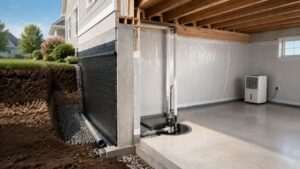
In Arlington, MA, a finished basement usually does not count in the home's official square footage if any part of that level is below grade, but it still adds real value and usable space. That's the answer homeowners need before they start arguing with a listing, a tax record, or an appraisal.
People get tripped up because they're looking at three different numbers and expecting one truth. A basement can be finished, heated, and beautiful, and still not show up as gross living area on the paper that matters for many loans and appraisals.
Table of Contents
- Why Greater Boston Homeowners Ask About Basement Square Footage
- Finished, Above-Grade, and GLA Explained in Plain English
- How ANSI Z765 and the Above-Grade Rule Decide What Counts
- Why Appraisers, MLS, and Assessors Report Different Numbers
- Ceiling Height, Egress, and the Wellesley 25% Rule
- How a Finished Basement Actually Affects Home Value
- Permits, Inspections, and the 780 CMR Path in Massachusetts
- Your Game Plan and the Right Way to Finish a Basement in Greater Boston
Why Greater Boston Homeowners Ask About Basement Square Footage
In Belmont, Newton, and Somerville, we see the same situation over and over. A homeowner finishes the basement into a family room, home gym, guest suite, or office, then the question comes up the minute they think about refinancing or selling, does finished basement count in square footage?
The short answer is no in most cases, not in the official figure that appraisers use for GLA, and not in many listing systems either. That doesn't mean the work was wasted. It means the basement is usually treated as valuable additional finished space, not primary above-grade living area.
Three numbers, one house
People often encounter confusion in this situation. The MLS square footage, the tax assessor's number, and the appraisal GLA can all describe the same house differently, and they're not supposed to match in every town or every system. A finished basement may be shown separately, folded into a local reporting method, or left out of the primary square footage total entirely.
Practical rule: If the space is below grade, treat the headline square footage number with caution. The basement can still help the sale, even when it doesn't change the official GLA.
That's why a 1,800-square-foot house with a 600-square-foot finished basement may be marketed as 1,800 square feet plus 600 square feet of finished lower-level space, not 2,400 square feet of GLA. The basement still matters, especially in Greater Boston where buyers pay attention to usable space, but the measurement rules stay strict.
If you're comparing homes in Cambridge, Medford, or Brighton, don't just ask how big the house is. Ask how the basement is being reported and who's doing the reporting. That's the difference between a number that helps the listing and a number that holds up in underwriting.
Finished, Above-Grade, and GLA Explained in Plain English
Finished means usable, not just pretty
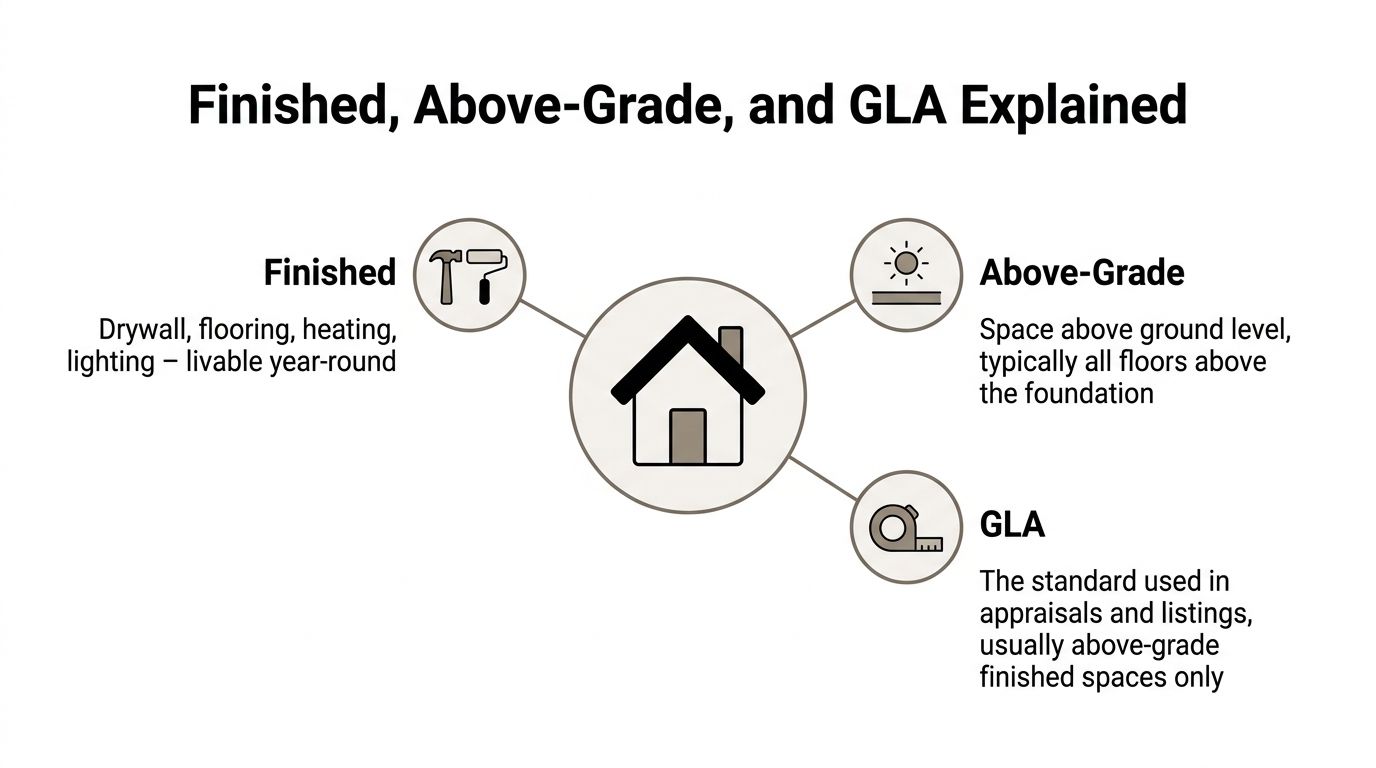
A space is finished when it is built for everyday living, not just for storage. Drywall, flooring, heat, lighting, and a layout that functions like part of the house all matter. HomeLight says a basement needs drywall, flooring, heating, and proper egress to qualify as livable space, and it should line up with the rest of the home in quality and standard in practical terms (HomeLight on basement livable space).
A basement with fresh paint and a couch still does not automatically count. If it lacks real living features, buyers and appraisers treat it as improved space, not true finished space.
Above-grade means the level sits above the ground line
Above-grade is the rule that causes the most confusion. If any portion of a level is below grade, many appraisal systems treat that level as below-grade, even if part of it opens to a walk-out. Fannie Mae's guidance says only finished above-grade areas count toward above-grade room count and square footage, and a level is below grade if any part of it sits below grade (Realtor.com summary of Fannie Mae guidance).
That matters in real houses, especially around Greater Boston where split entries, walk-outs, and partially exposed lower levels are common. A space can feel bright and useful and still fail the above-grade test.
GLA is the official figure people quote
GLA, or gross living area, is the number appraisers and many listing systems use for the main living area of the home. Finished basement space can still add value, but it is usually tracked separately from GLA. ANSI Z765 also keeps below-grade finished areas separate from above-grade GLA and leaves garages and unfinished space out of finished square footage calculations (ANSI Z765 standard).
A clean way to read the numbers is this. GLA tells you the main house size that sits above grade. The basement is still part of the property's appeal, but it belongs in its own bucket. That is the number that keeps sales talk honest when buyers, appraisers, and lenders all look at the same house.
How ANSI Z765 and the Above-Grade Rule Decide What Counts
ANSI Z765 is the measurement framework most appraisers use in the U.S., and it is the reason a finished basement does not get treated like the main floors. The standard measures finished square footage to the exterior finished surface of the outside walls, but it keeps below-grade finished areas separate from above-grade GLA. That is the clean split that keeps the numbers honest, even when the basement is fully built out and easy to live in.
What the appraiser is looking for
An appraiser is not counting drywall and calling it done. They are checking whether the space is finished, whether it sits above grade, and whether the ceiling height meets the standard. In older Boston-area basements, low joists, ducts, and beams can make that test tougher than homeowners expect.
The ceiling height rule matters because a basement can look polished and still fail the measurement test. Finished space needs enough headroom to qualify under the standard, and that is where a lot of lower levels fall short.
Here is the practical part. A home with a large finished lower level will usually be sketched with the main house as GLA and the basement as separate finished below-grade space. A house with a 900-square-foot main level and a 450-square-foot finished basement does not become 1,350 square feet of GLA. It stays a 900-square-foot above-grade home with 450 square feet reported in the lower level.
How it gets drawn on the worksheet
On the appraisal worksheet, the above-grade floors carry the main living area total. The basement gets its own line if it qualifies as finished lower-level space. That is why a finished basement can help value without changing the core GLA number.
If you want to see how those measurements show up on paper, read how to read property appraisals the same way a contractor reads a scope sheet, line by line. That is the fastest way to see where the appraiser drew the lines, what got counted, and what got set aside.
Bottom line: Good finishes do not override the grade line. The measurement rules control the square footage, then the market decides how much the basement adds.
Why Appraisers, MLS, and Assessors Report Different Numbers
The biggest mistake homeowners make is assuming one house should have one square-footage number. That's not how the system works. Appraisers, listing agents, and assessors often use different rules, and the same basement can be counted, separated, or excluded depending on which system is doing the reporting.
| Reporting System | Includes Finished Basement in Primary Square Footage | Common Reporting Method |
|---|---|---|
| Appraiser | Usually no | Finished below-grade space is measured separately from GLA |
| MLS listing | Sometimes | May show additional finished area or lower-level space separately |
| Municipal assessor | Depends on the town | Local rule may allow some finished basement area to count |
Massachusetts makes this especially messy because local rules vary. In Wellesley, a basement may count toward square footage only if it's finished and at least 25% of the exterior basement walls are above ground (LowerMyBills on basement square footage). That's a very local rule, and it shows why the same finished basement can show up differently in neighboring towns.
Some appraisal-oriented guidance also values finished basement space separately and often lower than above-grade space, which is why the measurement and the value aren't the same thing. Redfin notes that a finished basement may be listed as additional living space instead of being counted in total square footage, and appraisal guidance says the finished portion is measured separately and usually valued lower than above-grade space (Redfin on basement square footage).
The market convention is simple, even if the paperwork isn't. Buyers may love the basement, but the official square footage figure usually stays anchored to above-grade living area.
Ceiling Height, Egress, and the Wellesley 25% Rule
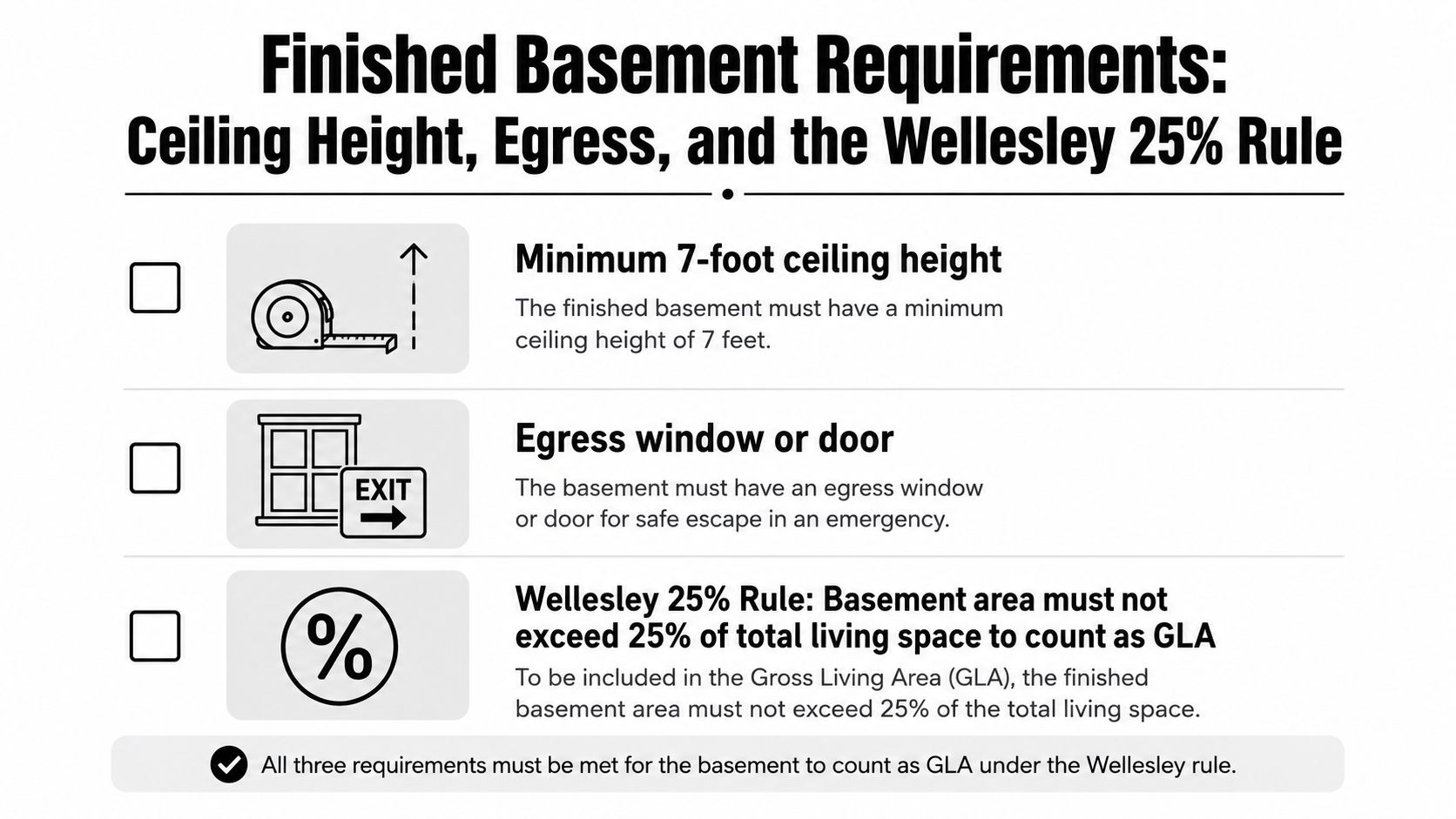
A finished basement doesn't earn trust just because it has carpet and recessed lights. It has to work as a livable space, and that starts with the basics, ceiling height, safe exit, heat, and moisture control. Massachusetts homeowners also have to keep local code and zoning expectations in mind under the Massachusetts State Building Code, 780 CMR.
The checklist that matters in real life
- Minimum 7-foot ceiling height: Low ceilings kill both comfort and appraisal appeal. ANSI and code-driven practice both care about usable headroom.
- Egress window or door: If you're building a bedroom-like space, you need a real exit route. That's not optional.
- Heating and finishes: Drywall, flooring, and heat need to feel like part of the house, not a basement patch job.
- Moisture control: A damp basement is a value problem, no matter how nice the trim looks.
Massachusetts code also matters because finished basement bedrooms, offices, or in-law uses need to satisfy safety and habitability rules under 780 CMR. If you're adding sleeping space, the egress issue is not a minor detail. It's the difference between a legal room and a future headache.
Wellesley's local rule is a good reminder that even a beautiful basement may not count the way you expect. If the exterior walls aren't exposed enough, the town may not treat it like counted living area the same way another community might.
For homeowners planning basement exits, this local resource is worth a look: basement egress window requirements.
A basement that clears ceiling height, egress, and moisture issues usually sells better than one that just looks finished. Buyers can feel the difference immediately.
How a Finished Basement Actually Affects Home Value
A finished basement usually adds value even when it doesn't add to the official square footage number. That's the part homeowners care about, and they should. Buyers in Greater Boston pay for usable space, not just the number printed on the flyer.
The best way to think about it is by separating resale value from square footage. An unfinished basement adds little besides storage. A finished basement can make a house feel bigger, more flexible, and more livable, which is why it helps with buyer appeal even when it stays out of GLA.
Here's a useful way to think about the financial side. The finished basement is commonly valued lower than above-grade living area, which lines up with the appraisal convention described in the section above. For homeowners who want to understand how contractors and remodelers think about pricing, cost per square foot formulas can help frame the conversation without pretending the basement is the same as a main-floor addition.
In Belmont, we've seen buyers pay more attention to the finished lower level than to a fresh paint color upstairs. In a tight market, a dry, permitted basement family room or guest suite often becomes the feature that tips the scales. The value shows up in utility and marketability first, then in the final price conversation.
For planning costs, this local guide is the better place to start: how much to remodel a basement. It's the right question before anyone starts tearing out walls.
When the basement pulls its weight
- Extra daily living space, especially for families working from home.
- Guest flexibility, which buyers notice quickly.
- Better perceived square footage, even if the official number stays the same.
- Cleaner appraisals, if the work is permitted and documented.
Permits, Inspections, and the 780 CMR Path in Massachusetts
A finished basement in Massachusetts is not a weekend paint project if you want it to pass under 780 CMR. Finishing basement space usually calls for a building permit, and once you add a bathroom, wet bar, or laundry changes, separate electrical and plumbing permits often come with it. Skip that paperwork and you invite problems later.
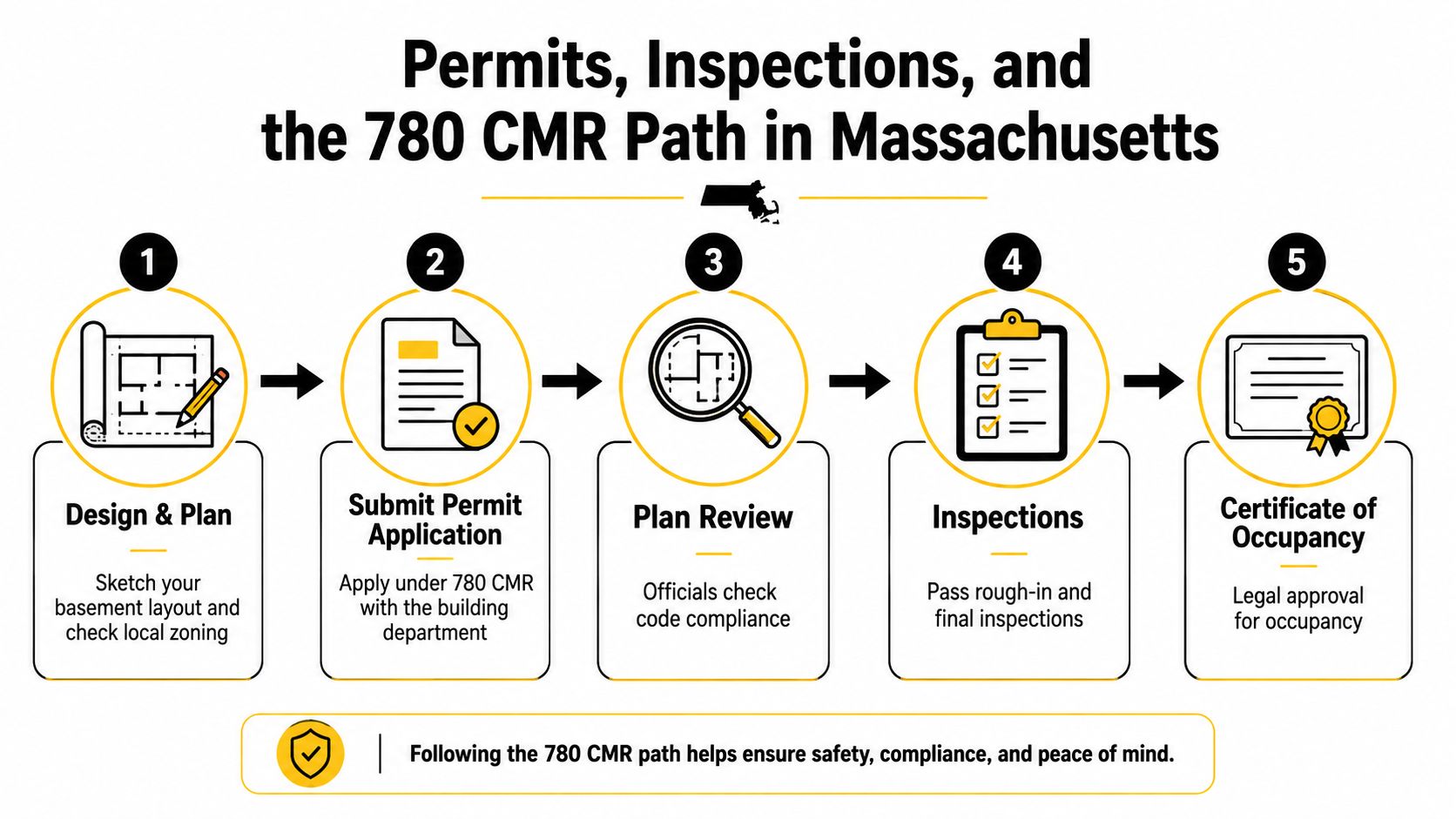
The sequence that keeps you out of trouble
- Design and plan. Check layout, headroom, and local zoning before you frame anything.
- Submit the permit application. The building department reviews the plans under 780 CMR.
- Plan review. Officials look for code compliance.
- Inspections. Rough framing, electrical, and plumbing get checked before drywall.
- Final approval. The last inspection closes the job out legally.
Do the work out of sequence and you pay for it twice. A basement that skips permits can create trouble at sale time, trigger insurance issues, and raise questions during an appraisal. Buyers, lenders, and inspectors trust documented space, not a room that only looks finished.
For homeowners who want a clearer look at the permit path and how it plays out on real projects, basement finishing in Greater Boston lays out the local process in plain language.
Build it once, build it right, and let the paperwork protect the value.
Your Game Plan and the Right Way to Finish a Basement in Greater Boston
Start with the job the room has to do. A basement that will hold a home office, playroom, gym, guest room, or future ADU-style layout needs different decisions from day one, and those decisions affect ceiling height, egress, storage, and plumbing. Pick the use first, then build around it.
Moisture comes first. If the basement is damp, stop and solve that before you put up drywall or lay flooring. A pretty finish over a wet basement is money wasted.
Build to code, not around it. Plan for headroom, egress, insulation, and heat early, because those items shape the whole project and they are hard to fix later. Match the finished space to the rest of the house too, because a basement that feels like a real extension of the home appraises and shows better than one that feels pieced together.
Permits are part of the job, not an afterthought. In Massachusetts, trying to clean it up later usually costs more, and passing inspections cleanly helps with resale, financing, and peace of mind.
The way we'd handle it in Arlington, Brookline, Cambridge, Lexington, Medford, Newton, Somerville, Wellesley, and the rest of our service area is simple. Set the layout, fix the moisture, pull the permits, and finish it to the same standard you'd expect on the main floors. If you want a closer look at the planning side, basement finishing in Greater Boston breaks down the local design-build approach in plain language.
Aureli Construction is a Massachusetts licensed general contractor with deep experience in basement finishing, additions, kitchens, bathrooms, and ADUs across Greater Boston.
FAQ
How long does a basement finish usually take?
It depends on the scope, permit review, and whether plumbing or structural work is involved. A simple finish moves faster than a basement with a bathroom or bedroom.
Can I live in the house during the project?
Usually, yes. Most basement projects are built so the household can stay put, though dust, noise, and access changes are part of the deal.
How are change orders handled?
The only sane way is to document them before the work changes. If you add a bathroom, move walls, or upgrade finishes midstream, put it in writing.
Do I need permits for a basement playroom or office?
If you're framing, wiring, adding heat, or changing plumbing, assume yes and check with the local building department.
Will finishing the basement guarantee a higher resale price?
No guarantee. It does improve usability and market appeal, and that's what usually supports stronger offers.