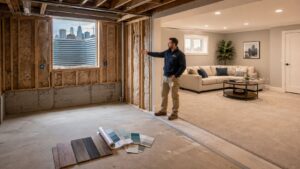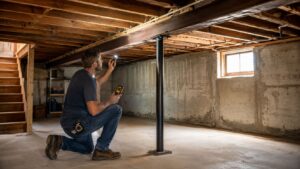
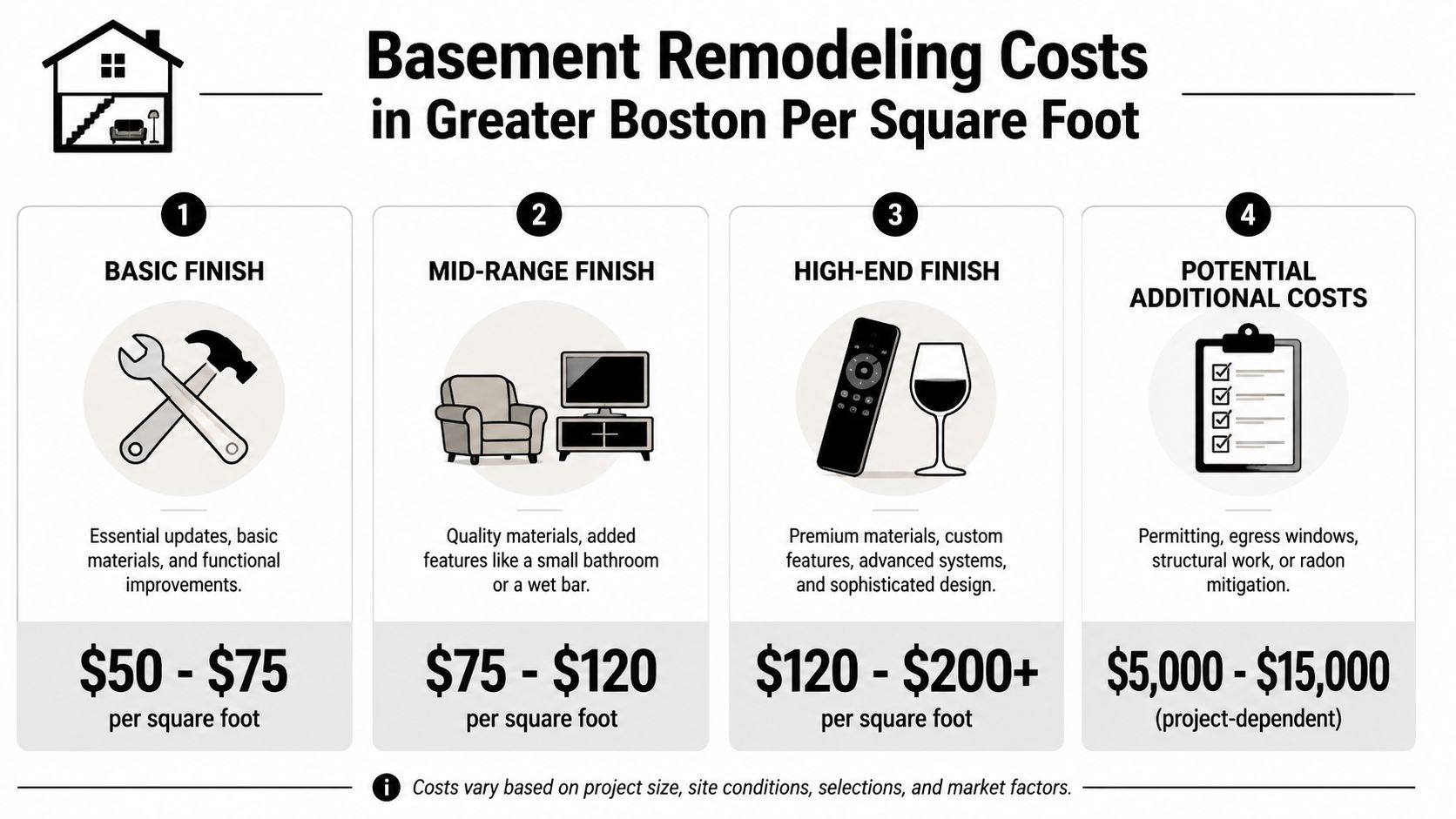
A professionally finished basement usually starts around $50 to $75 per square foot in the Greater Boston area, and more complex projects with a bathroom, wet bar, or heavier code work often move into $75 to $120 per square foot or higher. If you're trying to answer how much to remodel a basement, that range is the right starting point, but in older Boston-area homes the actual cost depends heavily on moisture, ceiling height, electrical capacity, and whether the space needs to become legally habitable.
In Arlington, Brookline, Cambridge, and the other older towns we work in, the basement is often the part of the house with the most unrealized value. Homeowners walk downstairs and see a concrete floor, exposed framing, old mechanicals, maybe a fieldstone wall, and they can already picture the playroom, office, guest space, gym, or media room. The challenge is that below-grade remodeling in Massachusetts isn't priced like repainting a spare bedroom upstairs.
In Greater Boston, basement work is usually part finish project and part problem-solving project. That's why internet pricing often feels off. A basement can look simple at first glance, then require drainage upgrades, insulation changes, permit coordination, and egress planning before the first piece of drywall goes up.
Table of Contents
- Your Basement Remodel Project Starts with One Question
- Basement Remodeling Costs in Greater Boston Per Square Foot
- What to Expect A Detailed Basement Cost Breakdown
- Critical Code Requirements for Basements in Massachusetts
- Three Sample Basement Remodel Budgets
- FAQ About Basement Remodeling in the Boston Area
- Start Your Basement Remodel in Greater Boston
Your Basement Remodel Project Starts with One Question
In Brookline or Arlington, the conversation usually starts the same way. A homeowner stands at the bottom of the basement stairs, looks around at the exposed pipes and concrete walls, and asks us what it would take to make the space feel like part of the house.
That question is never really about drywall alone. It's about whether the space can become warm, dry, bright, code-compliant, and worth the investment. A widely used baseline for a basement remodel is $25 to $65 per square foot, or $12,500 to $37,500 total with labor, and a 500-square-foot basement often falls around $12,500 to $32,500 according to HomeGuide's basement remodel cost guide. In Greater Boston, that baseline is useful, but it often understates what happens once older-home conditions enter the picture.
We see that all the time in Cambridge, Belmont, Newton, and Somerville. A basement that seems ready for finishes may still need waterproofing, better insulation, upgraded lighting, or a plan for legal egress before it can serve as real living space.
Practical rule: The right first question isn't just "How much will this cost?" It's "What condition is the basement actually in before we finish it?"
If you're still shaping the layout, it helps to look at specific uses instead of vague inspiration. For homeowners thinking about entertaining space, these basement bar ideas are a good example of how program choices quickly change the scope, especially when a sink, cabinetry, and electrical upgrades enter the plan.
Basement Remodeling Costs in Greater Boston Per Square Foot
A basement in Arlington or Newton can look straightforward at first glance. Then you open a wall, find old moisture damage, low duct runs, or a fieldstone foundation that needs a different finish approach than a poured-concrete basement in a newer house. That is why Greater Boston basement pricing usually lands above generic national averages.
Why Boston pricing runs higher
National cost guides put basement finishing in tiers. Angi places basement remodels at about $7 to $23 per square foot for a lighter remodel and notes that full renovations can reach much higher depending on layout, plumbing, and finish level, in its basement remodeling cost guide. In Greater Boston, those lower ranges often stop being useful once an older home needs waterproofing, insulation upgrades, electrical work, or egress changes to make the space legal and comfortable.
Labor costs drive part of that. So do permits, inspection standards, and the age of the housing stock. A 700 square foot basement with good ceiling height and dry conditions may be a straightforward finish project. The same size basement in a 1920s house may need a sump system, slab repair, new framing details against masonry walls, and careful HVAC rerouting before finish work even starts.
That is why square-foot pricing works best as a starting range, not a final contract number.
For a broader look at the same regional cost pressures, many homeowners compare basement pricing with overall cost of construction in Massachusetts, since the same labor market and permitting realities affect larger renovation work across the state.
Three useful pricing tiers
Here is the practical way to read basement cost tiers in the Boston area.
Basic finish
Usually a family room, playroom, gym, or simple office with standard flooring, drywall, paint, basic lighting, and minimal layout changes. This tier works best in basements that are already dry, have decent ceiling height, and do not need major mechanical relocation.Mid-range finish
This category includes many real Boston-area projects. Add a bathroom, enclosed office, laundry improvements, or a small wet bar, and the price moves fast because plumbing, ventilation, electrical capacity, and finish coordination all expand.High-end finish
This tier includes custom millwork, entertainment areas, guest suites, premium flooring, stronger sound control, and layouts that require structural or mechanical changes. In older New England homes, high-end pricing also reflects the cost of solving hidden conditions before the room looks finished.
One basement might finish cleanly. Another needs work that never shows in the final photos.
That is the biggest pricing mistake homeowners make. They compare basements by square footage alone, when actual cost differences usually come from conditions and use. A dry open basement planned as a playroom prices very differently from a guest suite with a bathroom, code-compliant egress, and upgraded heat. For homeowners who want another outside comparison point, this complete guide to basement budgets is a useful reference, but Boston-area homes usually need more allowance for old-house conditions than national articles suggest.
What to Expect A Detailed Basement Cost Breakdown
A basement budget in Greater Boston usually shifts for one reason. The finishes are easy to price. The basement itself is not.
In an older Arlington, Cambridge, or Medford house, the first cost question is simple: what is the basement's condition before any finish work starts? A poured concrete basement with decent headroom is one job. A fieldstone foundation with past water entry, exposed pipes, and an undersized electrical panel is another. Both may be the same square footage, but they do not cost the same to remodel.
Where the budget usually goes
Most basement remodel budgets break into three groups: pre-finish work, core construction, and finish selections. Pre-finish work is the part homeowners tend to miss when they compare quotes. That includes moisture correction, leveling problem areas, cleaning up old framing, and figuring out whether the planned use triggers added code work such as a bedroom egress opening. If you are planning sleeping space, review these Massachusetts basement egress window requirements early, because that single item can change the budget fast.
Here is the way we usually explain a typical basement budget in Greater Boston.
| Line Item | Approximate Percentage of Total Budget |
|---|---|
| Design, planning, and permits | Varies by scope |
| Moisture control and prep work | Varies by basement condition |
| Framing and carpentry | Part of core construction cost |
| Electrical and lighting | Part of core construction cost |
| Plumbing and bath or bar rough-ins | Higher when fixtures are added |
| HVAC adjustments | Project-dependent |
| Insulation and drywall | Major finish-stage cost |
| Flooring, doors, trim, and paint | Major visible finish cost |
| Contingency for hidden conditions | Separate reserve recommended |
Those categories stay fairly consistent. The dollars inside them move around from house to house.
A dry basement in Burlington with an open rec room may spend more on finish materials and less on prep. A basement in Cambridge or Somerville with stone walls, low-hanging ductwork, and a new bathroom often spends more before the walls are even closed up. That is normal in this market.
What drives costs up
The biggest cost drivers are usually the parts you do not see in the final photos.
Moisture correction and air sealing
If water has been getting in, or if old masonry walls are holding moisture, the fix comes before insulation, flooring, or trim.Mechanical rework
Boilers, water heaters, drain lines, and duct trunks are often located right where homeowners want headroom or a finished ceiling.Electrical upgrades
Older panels and limited basement circuits are common in New England homes. Adding a bathroom, office, media area, or mini-split can push the project beyond a simple wiring package.Bathroom or wet bar plumbing
Below-slab plumbing, ejector systems, and venting requirements add cost quickly.Foundation and framing irregularities
Fieldstone and older concrete walls are rarely straight. That affects framing depth, insulation approach, and finish alignment.
The practical way to budget is to separate the project into two buckets early.
Habitable-space work
Dryness, code compliance, headroom, insulation strategy, and mechanical planning.Finish work
Flooring, trim, doors, paint, lighting fixtures, and built-ins.
That approach keeps the budget honest. If the basement needs drainage improvements, a panel upgrade, or an egress cut, those decisions set the number before anyone chooses paint colors.
For homeowners who want another plain-English overview before meeting contractors, this complete guide to basement budgets is a helpful reference for rough planning assumptions. In Greater Boston, I would still carry extra room in the budget for old-house conditions, especially in prewar homes and basements with a history of moisture.
Critical Code Requirements for Basements in Massachusetts
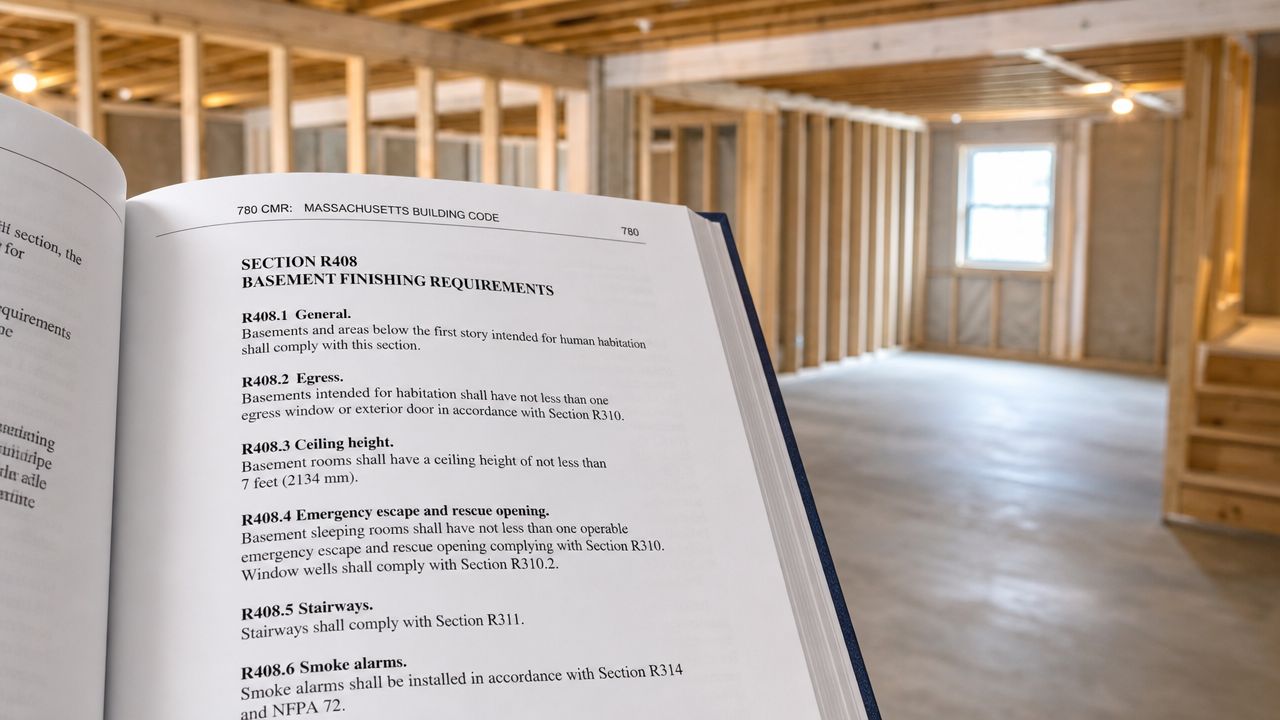
A basement only adds lasting value if it's legal, dry, and safe to occupy. In Massachusetts, that means the project has to work within 780 CMR, local permit requirements, and the inspection process your town enforces.
Moisture and habitability come first
Below-grade work is different because the shell of the space can be the biggest risk. Industry guidance commonly advises homeowners to keep an additional 20% contingency for unexpected conditions, and notes that structural changes, plumbing, and permits can add roughly 15% to 25% to project cost. The same guidance points out that seepage, low headroom, and other below-grade issues can push a project toward the high end of the $50 to $100 per square foot range, as explained in this basement renovation budgeting article.
In older New England homes, the practical problems are usually obvious once work begins. We find painted masonry trapping moisture, fieldstone walls with irregular surfaces, outdated wiring, low duct runs, and basements that were never intended to function as conditioned living areas.
That is why we treat moisture control as construction work, not as an optional add-on. If the foundation seeps, if the slab is damp, or if the mechanical room is spilling unconditioned air into the finished area, the project needs to address those issues before trim and paint.
Spending money on moisture management first usually saves money later. It protects flooring, insulation, drywall, and air quality.
Permits inspections and 780 CMR requirements
Most basement remodels in Massachusetts need a building permit. If the project includes wiring, plumbing, or HVAC work, those trades usually need their own permits and inspections as well. Towns such as Cambridge, Newton, Arlington, and Belmont may also have their own procedural requirements for plan review and sign-off.
For sleeping rooms, egress matters. If the basement will include a legal bedroom, the layout must account for code-compliant emergency escape and rescue openings. Homeowners planning that type of space should review the basics of basement egress window requirements early, not after the design is already fixed.
A typical permit path includes:
- Building review for framing, insulation, and general code compliance
- Electrical and plumbing permits when fixtures, outlets, panels, or rough-ins are added
- Rough inspections before walls are closed
- Final inspections before the space is signed off for use
A short walkthrough on code issues can also help if you're still trying to understand the sequence of rough inspections and finish approvals.
The mistake we see most often is treating code as paperwork. It isn't. Ceiling height, means of egress, insulation, ventilation, smoke and carbon monoxide protection, and moisture control all affect whether the basement feels like a proper extension of the home or a compromised lower level that never performs the way it should.
Three Sample Basement Remodel Budgets
Numbers become easier to use when you attach them to real scope. In Medford, Melrose, and Wellesley, we see three common project types come up again and again.
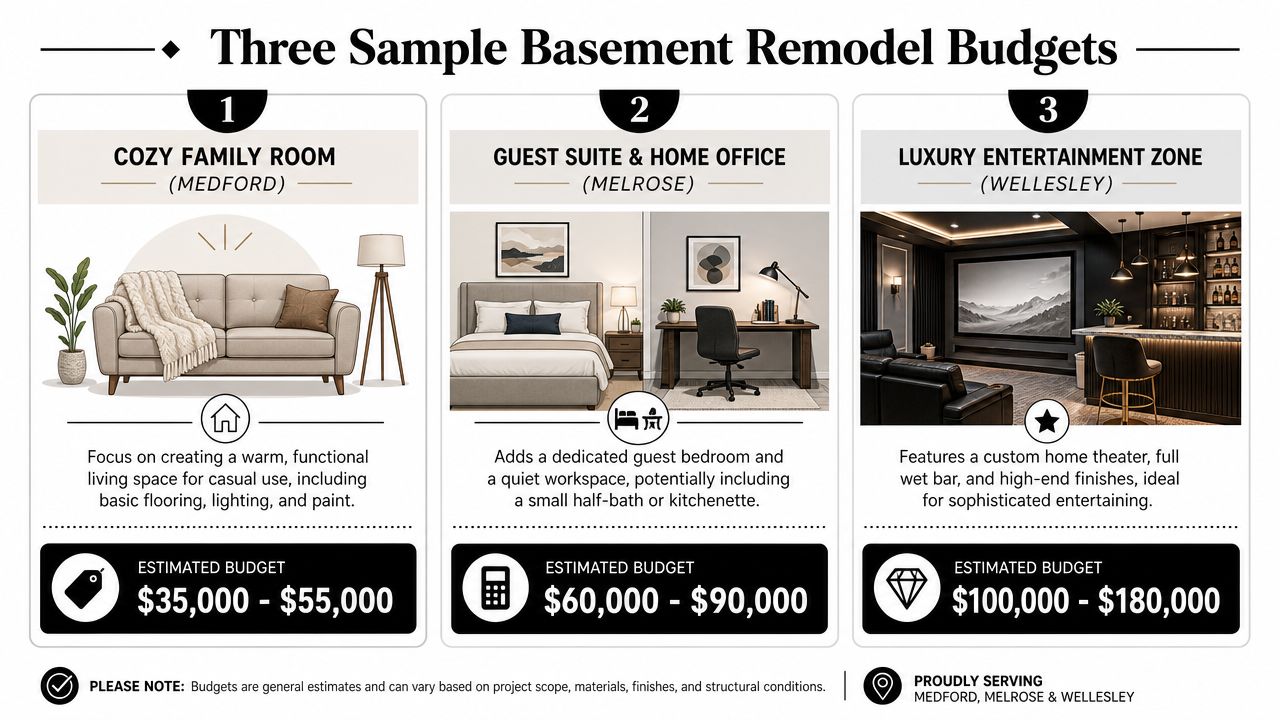
Basic family room finish
This is the classic lower-level upgrade. Open layout, durable flooring, recessed lights, drywall, trim, fresh paint, and maybe a storage closet. In a basement that is already dry and doesn't need major mechanical relocation, this is the most efficient path to added living space.
Guest suite with a bath
This scope changes the project materially. Once you add a bedroom area, bathroom fixtures, and more privacy in the floor plan, the remodel starts behaving more like a true interior conversion. Angi reports a full basement remodel typically costs $20,000 to $50,000, while cosmetic renovation is usually $10,000 to $25,000, and most homeowners spend about $22,872 according to Angi's basement remodeling cost guide. In high-cost areas like Greater Boston, a guest suite with a bath can move beyond that range because of code, plumbing, and finish demands.
Entertainment basement with custom features
Homeowners opt for elements that make a basement feel purpose-built, including a wet bar, media wall, custom cabinetry, upgraded lighting scenes, better sound separation, and sometimes a home office corner or workout area integrated into the layout.
The fastest way to increase a basement budget is to add water, custom millwork, or a layout that cuts one open space into several enclosed rooms.
What matters most is matching the design to the house. A simple, durable family room may be the smartest use of a basement in Reading or Stoneham. In Wellesley or Newton, a more complete lower-level program often makes sense because families want space that functions like a real second living floor.
FAQ About Basement Remodeling in the Boston Area
How long does a basement remodel usually take
The timeline depends on scope, permits, and whether the basement needs corrective work before finishes begin. A straightforward finish moves faster than a project with a bathroom, egress changes, or moisture remediation. In Greater Boston, permitting and inspections also affect the schedule.
Do I need an architect for a basement remodel
Not always. Some projects can be handled through a design-build process, especially if the layout is straightforward. If the work includes structural changes, major reconfiguration, or a more complex habitable conversion, design and engineering become more important.
Can we live in the house during the project
Usually, yes. Basement work is often easier to live through than a kitchen renovation because the main living level stays functional. The trade-off is noise, dust control, worker access, and occasional utility interruptions.
How are change orders handled
They should be handled in writing, with clear scope and pricing before the added work moves forward. That's especially important in old basements where hidden conditions may appear after demolition.
Is DIY worth it for part of the work
Painting or simple finish tasks may be manageable for some homeowners. Waterproofing, framing, electrical, plumbing, permit work, and code compliance are where DIY decisions usually become expensive.
Start Your Basement Remodel in Greater Boston
In Cambridge, Belmont, Lexington, and across Greater Boston, the best basement projects start with honest scoping. The lowest number isn't always the true figure, and the smartest investment usually comes from solving the underlying conditions first, then building a space that fits how your family will use it.
We recommend starting with three decisions. Define the purpose of the space, confirm whether it needs to be legally habitable, and inspect the basement for moisture, headroom, and service limitations before selecting finishes. That sequence avoids a lot of wasted design time.
If you're still planning, our basement finishing guide for Greater Boston homeowners gives a good overview of layout, permitting, and design-build expectations in this market. Aureli Construction handles basement finishing, remodeling, permitting coordination, and related interior renovation work across Arlington, Belmont, Brighton, Brookline, Burlington, Cambridge, Lexington, Medford, Melrose, Newburyport, Newton, Reading, Somerville, Stoneham, Wakefield, and Wellesley.
Ready to get started? Contact Aureli Construction for a free estimate.