The most popular choice for **garage additions** in Greater Boston is often the one that creates the most regulatory headaches for homeowners in 2026. While an attached structure seems like the default solution for avoiding our 40 plus inches of annual snowfall, it often triggers strict setback rules that a detached design could easily bypass. A strategically planned addition can increase your home’s market value by up to 20 percent; however, choosing the wrong footprint can lead to costly delays with local building departments. You don’t have to sacrifice your backyard or clash with historic boards to get the storage you need.
You likely agree that the lack of secure parking and organized storage is the biggest hurdle to fully enjoying your home. This article promises to simplify the permit process and help you select the ideal layout that adds both function and significant equity to your property. We will analyze the specific differences between attached and detached models, focusing on New England weather resilience and architectural harmony.
Key Takeaways
- Determine the best fit for your property by weighing the winter convenience of attached structures against the architectural flexibility of detached designs in dense urban lots.
- Identify critical structural requirements, from frost line depth to roof pitch, necessary to ensure your new build withstands the rigors of the Massachusetts climate.
- Explore how garage additions can be transformed into legal Accessory Dwelling Units (ADUs) or master suite expansions to significantly boost your home’s equity and functionality.
- Gain clarity on navigating local zoning hurdles, such as setbacks and lot coverage ratios, to ensure your project meets the strict regulatory standards of Greater Boston.
- Learn how a turnkey design-build approach simplifies the construction journey by providing expert management from the first architectural drawing to the final walkthrough.
Attached vs. Detached: Choosing the Right Garage Addition for Your MA Home
Deciding between an attached or detached structure is the first major hurdle for Massachusetts homeowners planning garage additions. In high-density areas like Somerville or Cambridge, where the average lot size often sits below 4,500 square feet, your property’s footprint dictates the design. You must balance local zoning setbacks with the functional need for vehicle storage. While an attached model offers seamless entry, a detached unit provides architectural freedom that won’t compromise the historical profile of a 19th-century New England home.
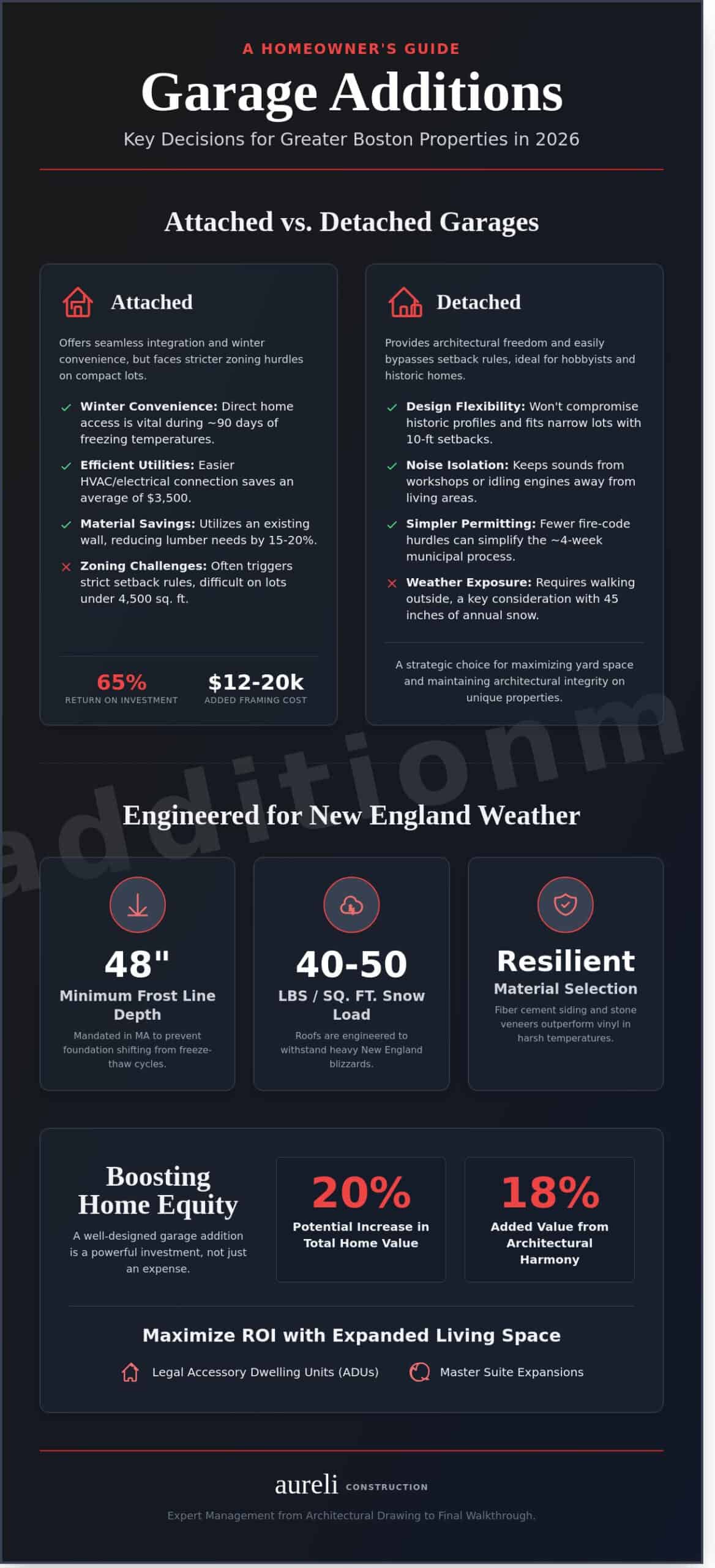
Cost structures differ significantly between the two styles. Attached units require complex structural tie-ins to the existing foundation and roofline, which typically adds $12,000 to $20,000 to the framing budget compared to a standalone build. However, this investment often yields a 65% return on investment according to regional real estate data, as Massachusetts buyers prioritize protected access during the 45 inches of average annual snowfall. We focus on ensuring your addition feels like a natural extension of the original build rather than an afterthought.
The Case for Attached Garages
Direct access to your mudroom is a vital luxury during Lexington and Belmont winters, where temperatures stay below freezing for roughly 90 days a year. Connecting HVAC and electrical systems is more efficient when the garage shares a wall with the main house, often reducing utility trenching costs by $3,500. Utilizing an existing exterior wall can also lower your total lumber requirements by approximately 15% to 20%.
The Case for Detached Garages
These units offer greater flexibility on narrow lots where a side-load attached garage would violate 10-foot side-yard setbacks common in older neighborhoods. Separating the structure keeps the sound of power tools or idling engines away from primary living quarters; it’s a practical choice for hobbyists. Detached buildings also face fewer fire-code hurdles regarding shared ceiling joists, which can simplify the 4-week permitting process in most MA municipalities.
Engineering for New England: Structural Requirements and Snow Loads
Building garage additions in the Greater Boston area requires a deep understanding of the local climate and geological conditions. Massachusetts building codes mandate a foundation depth of at least 48 inches to reach below the frost line. This depth prevents the annual freeze-thaw cycles from causing structural shifting or foundation cracks. For 2026 projects, we design roof systems to handle a minimum snow load of 40 to 50 pounds per square foot. This ensures your investment stays safe during heavy February blizzards that can dump several feet of snow in a single weekend.
Material selection is a long-term financial decision. Fiber cement siding and stone veneers offer superior resistance to the moisture and temperature swings common in Medford and Winchester. Vinyl often cracks or warps when temperatures drop below 10 degrees Fahrenheit; however, fiber cement remains stable and holds paint longer. If you’re planning a project, it’s helpful to consult with a local expert about which materials suit your specific microclimate.
Connecting new frames to 100-year-old homes presents unique technical hurdles. Older structures in Lexington often feature balloon framing or foundations that have settled over a century. We use laser-leveling and custom structural headers to bridge the gap between historic craftsmanship and modern engineering.
Foundation and Site Prep in Middlesex County
Soil composition in the Mystic Valley often includes dense clay or hidden ledge. Proper site prep involves more than just digging. We install perimeter drainage systems to redirect runoff, which protects your existing basement from the 45 inches of average annual rainfall we see in Arlington and Melrose. On sloped lots, we engineer reinforced concrete retaining walls to provide a level building pad for your garage additions.
Architectural Harmony: Matching Your Existing Home
A successful addition shouldn’t look like an afterthought. In Belmont, we source reclaimed brick or custom-milled cedar to match original 1920s exteriors. We align rooflines and match window proportions precisely. This attention to detail ensures the new structure respects the neighborhood’s historic character. It also increases your property’s total market value by an average of 12% to 18% by maintaining a cohesive aesthetic.
Maximizing ROI: Adding Living Space or an ADU Above the Garage
In 2026, the most significant shift in garage additions involves the evolution of the “bonus room” into a fully legal Accessory Dwelling Unit (ADU). This change reflects a strategic response to the Massachusetts housing market. In high-value areas like Newton, where property values reached an average of $850 per square foot in 2025, a 600-square-foot addition above a garage represents a $510,000 increase in equity. We often see homeowners combine these projects with master suite expansions, creating a private retreat that balances luxury with structural efficiency.
Modern professionals are prioritizing detached sanctuaries. Whether it’s a soundproofed home office or a high-end gym, separating work from living space is a top priority for 45% of our clients in the Greater Boston area. These spaces offer a quiet environment that an interior renovation cannot match. By adding habitable square footage, you aren’t just building storage; you’re making a strategic investment that pays dividends during resale. For homeowners seeking year-round comfort in their additional living space, four-season sunrooms provide an alternative approach to maximizing natural light while maintaining climate control throughout Massachusetts winters.
Building an In-Law Suite or Guest Apartment
Converting the space above your garage into an in-law suite requires meticulous planning of mechanical systems. In Medford, connecting a second-story addition to existing sewer lines often requires a macerating pump system if the gravity feed is insufficient. Privacy is another critical factor. We design separate exterior entrances that comply with local egress codes while maintaining the home’s architectural aesthetic. Towns like Salem and Newton have recently streamlined their zoning bylaws to encourage ADUs, making it easier for families to build multi-generational housing solutions without the red tape common in previous years.
The Ultimate ‘Flex Space’: Workshops and Studios
A high-performance workshop requires more than just extra space. We typically upgrade homes to 200-amp electrical service to support heavy machinery and modern EV charging stations simultaneously. Climate control is essential for New England’s variable weather. We install ductless mini-split systems that provide targeted heating and cooling with an average SEER2 rating of 22. For art studios or professional workshops, we prioritize 5000K color-accurate LED lighting and reinforced floor joists to handle the weight of specialized equipment. These technical details ensure your garage additions serve your lifestyle for decades.
Ready to explore how a custom addition can increase your home’s value? Our team is here to guide you through the local zoning and design process.
Navigating the Permit Process in Lexington, Somerville, and Beyond
Planning garage additions in Massachusetts requires more than just a blueprint. It involves a deep dive into local bylaws that vary significantly from Lexington to Somerville. Most residential zones in Greater Boston require a minimum side-yard setback of 10 to 15 feet. If your lot is narrow, this rule often dictates whether your addition must be attached or detached. You can’t simply build to the property line; doing so risks costly fines or a legal order to halt construction.
Lot coverage ratios are equally critical. In towns like Somerville, you might be limited to 35% or 40% total impervious surface coverage. If your existing home and driveway already approach that limit, your garage plans may need a smaller footprint or permeable paving solutions to meet drainage requirements. These calculations must be precise to pass the initial building department review.
If you live in a historic district in Cambridge or Concord, the aesthetic oversight is rigorous. These commissions often require specific materials, such as cedar clapboards instead of vinyl siding, to maintain the neighborhood’s 19th-century architectural integrity. Aureli Construction provides a design-build advantage by managing these complex filings for you. We act as your single point of contact, handling every permit and board appearance to ensure your project moves forward without administrative delays.
Working with the Zoning Board of Appeals (ZBA)
You need a variance when your project cannot meet standard zoning bylaws due to lot shape or size. This process involves a public hearing where neighbors within a 300-foot radius receive official notification. Common red flags include blocking a neighbor’s natural light or increasing stormwater runoff. We improve your chances of approval by presenting professional site plans that demonstrate how your project respects the local landscape.
The 2026 Building Code Updates
The 2026 Massachusetts building codes introduce stricter energy efficiency for heated garage additions. If you plan to use the space as a year-round workshop, you’ll need R-20 wall insulation or higher to meet the latest Stretch Code standards. Fire separation is also a primary focus; attached garages must have 5/8-inch Type X gypsum board installed on the garage side of the common wall. Additionally, new state mandates now require at least one Level 2 EV-ready outlet in all new residential garage constructions to support the transition to electric vehicles.
The Aureli Construction Approach: A Turnkey Garage Addition Experience
Building a home extension requires more than just labor; it demands a partnership based on transparency and technical skill. Aureli Construction manages every phase of your project from the initial architectural sketches to the final municipal inspection. We bring 30 years of Massachusetts building experience to the table, ensuring your project adheres to the specific 2026 structural requirements and local zoning bylaws. We apply the same rigorous standards of craftsmanship to garage additions as we do to custom home builds. This focus on quality protects your property value and ensures the new structure stands the test of time.
Our team treats your garage with the same care as a high-end kitchen renovation. We understand that a garage is often the primary entry point for a family, so we prioritize both durability and aesthetic integration. By matching existing siding, rooflines, and trim details, we ensure the new addition looks like an original part of your home’s footprint rather than an afterthought.
Our Design-Build Methodology
Our process centers on a unified design-build model. This system eliminates the frequent communication gaps between independent architects and contractors that often lead to budget overruns. By keeping design and construction under one roof, we provide homeowners with fixed-price contracts. This is a critical advantage in a market where building material costs have seen shifts of up to 15% in a single year. You’ll have one dedicated point of contact throughout the entire build. This streamlined communication ensures that your questions are answered promptly and the project stays on its 12 to 16-week schedule.
Ready to Build Your New Garage?
We’ve spent three decades refining our craft across the Greater Boston area. Our team has completed dozens of successful garage additions in Medford, Winchester, and Arlington, navigating the unique lot restrictions and historical considerations of these neighborhoods. We know the local building inspectors and the specific permit requirements for each municipality, which helps prevent unnecessary delays during the approval phase.
Your project starts with a comprehensive on-site feasibility study. During this visit, we evaluate your land’s topography, soil conditions, and utility layouts to identify the most cost-effective construction path. We believe in providing clear data and realistic timelines before you sign a contract. Schedule your garage addition consultation with Aureli Construction today to secure your spot on our 2026 build calendar and begin the process of adding functional, high-value space to your home.
Investing in Your Greater Boston Property for 2026
Building a garage in Massachusetts requires more than just a foundation and a frame. It demands a deep understanding of local zoning laws in towns like Lexington and Somerville, where specific setbacks and historical preservation rules apply. Whether you choose an attached structure for daily convenience or a detached unit to house a modern accessory dwelling unit, your investment should focus on structural integrity. For 2026, engineering for snow loads exceeding 40 pounds per square foot remains a critical safety standard for all garage additions in the region.
Aureli Construction brings 30 years of local expertise to every build. We handle the entire turnkey design-build process, ensuring your new space integrates seamlessly with the unique architecture of your historic home. Our team manages every detail from the first permit application to the final inspection. This approach eliminates the stress of coordinating multiple contractors while maximizing your property’s long-term value. We’ve spent three decades perfecting the balance between modern functionality and New England charm.
Start Your Custom Garage Project with Aureli Construction
We’re ready to help you build a space that serves your family’s needs for decades to come.
Frequently Asked Questions
How much does a garage addition cost in Massachusetts in 2026?
Expect to pay between $125 and $215 per square foot for garage additions in 2026. A standard 576 square foot two-car attached garage typically costs between $72,000 and $124,000 depending on your choice of finishes and site conditions. These figures include the cost of a reinforced concrete slab, professional framing, and standard electrical wiring that meets current Massachusetts building codes. For a comprehensive breakdown of all project costs, including regional variations and material selections, our detailed guide to home addition prices in Greater Boston provides transparent pricing information for Massachusetts homeowners.
Do I need a special permit for a detached garage in Newton or Belmont?
Yes, you’ll need a building permit from your local department, and you may require a zoning variance if your lot is small. Newton requires a site plan review for any accessory structure exceeding 250 square feet in area. In Belmont, strict setback rules often require detached buildings to be at least 10 feet from the rear property line and 5 feet from side lines to avoid a Special Permit process.
Can I build a bedroom or apartment above my new garage?
You can build a living space or Accessory Dwelling Unit (ADU) above your garage thanks to the 2024 Affordable Homes Act. This state law allows ADUs up to 900 square feet by right in many residential zones across the Commonwealth. We design these foundations to handle the 40 pound per square foot live load requirement, ensuring your new structure is safe and legally compliant for tenants or family members.
How long does it typically take to complete a garage addition project in the Boston area?
A typical project takes 10 to 16 weeks from the day we break ground to the final inspection. The first 4 weeks focus on excavation and foundation curing, while framing and roofing usually occupy the following 3 weeks. We dedicate the final month to exterior siding, door installation, and electrical work, providing a turnkey service that minimizes disruption to your daily routine and neighborhood traffic.
Will a garage addition significantly increase my property taxes in Middlesex County?
A new garage addition will likely increase your annual property taxes by 6% to 11% based on the added assessed value. If your home in Middlesex County is valued at $900,000, adding a $100,000 garage might increase your tax bill by approximately $1,150 annually. This is a strategic investment because a well-built garage typically retains 80% of its value during a home resale in the local market.
What is the minimum size for a functional two-car garage addition?
The minimum functional size for a two-car garage is 20 feet wide by 20 feet deep, but we recommend 24 feet by 24 feet for modern vehicles. This 576 square foot footprint provides 3 feet of clearance around your cars, which is necessary for opening doors and walking safely. Choosing the larger footprint ensures you have adequate space for trash bins, bicycles, or a small workbench without crowding your primary parking area.
Is it better to build up or build out for a garage addition on a small lot?
Building up is the better choice for small lots because it maximizes your square footage without violating 15-foot side-yard setback requirements. Vertical expansion allows you to add a home office or storage loft while keeping your existing backyard space intact. While a second story requires a 25% stronger foundation, it prevents the need for costly zoning variances that often delay projects on narrow Greater Boston properties.
How do I ensure my new garage matches my 100-year-old home’s siding and character?
We match historic character by sourcing custom-milled cedar clapboards or fiber-cement boards that replicate the 4-inch exposure common on 1920s homes. Our craftsmen mirror your home’s original roof pitch and use historically accurate trim profiles to ensure the new structure looks original. We analyze your home’s existing architectural details to select windows and doors that preserve the aesthetic integrity of your historic Massachusetts neighborhood.