What if you could double your living space in Medford or Arlington without sacrificing a single square foot of your backyard? You’ve likely spent hours searching for a clear breakdown of the cost of two story addition projects, only to find generic national averages that don’t account for the unique structural demands of century-old Massachusetts homes. It’s a common frustration for homeowners in towns like Winchester and Belmont who want to expand but feel overwhelmed by the lack of transparent local pricing and complex zoning laws.
We understand that a project of this scale is a significant financial and emotional commitment. This 2026 guide provides the real-world insights you need to move forward with confidence, from navigating Massachusetts building codes to understanding how we ensure structural integrity in high-end builds. You’ll gain a clear roadmap of the design-build process and learn how a strategic investment in your current home can be a smarter choice than navigating the competitive Greater Boston real estate market. We’ll walk you through the essential variables that define a successful, high-quality expansion so you can plan your family’s future with total peace of mind.
Key Takeaways
- Learn why building “out and up” has become the preferred strategy for Greater Boston homeowners looking to expand their living space without leaving their neighborhoods.
- Gain clarity on the cost of two story addition projects by comparing full second-story expansions with partial builds tailored to your specific property.
- Navigate the complexities of New England structural requirements, including how local soil conditions and staircase integration in towns like Winchester or Stoneham affect your layout.
- Discover how the design-build model streamlines your project from permits to construction, ensuring your vision aligns with your financial expectations and provides a single point of accountability.
- Identify the long-term ROI and property value benefits of transforming your current house into a “forever home” in communities like Medford, Reading, or Arlington.
Evaluating the Cost of a Two-Story Addition in Greater Boston
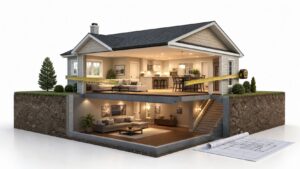
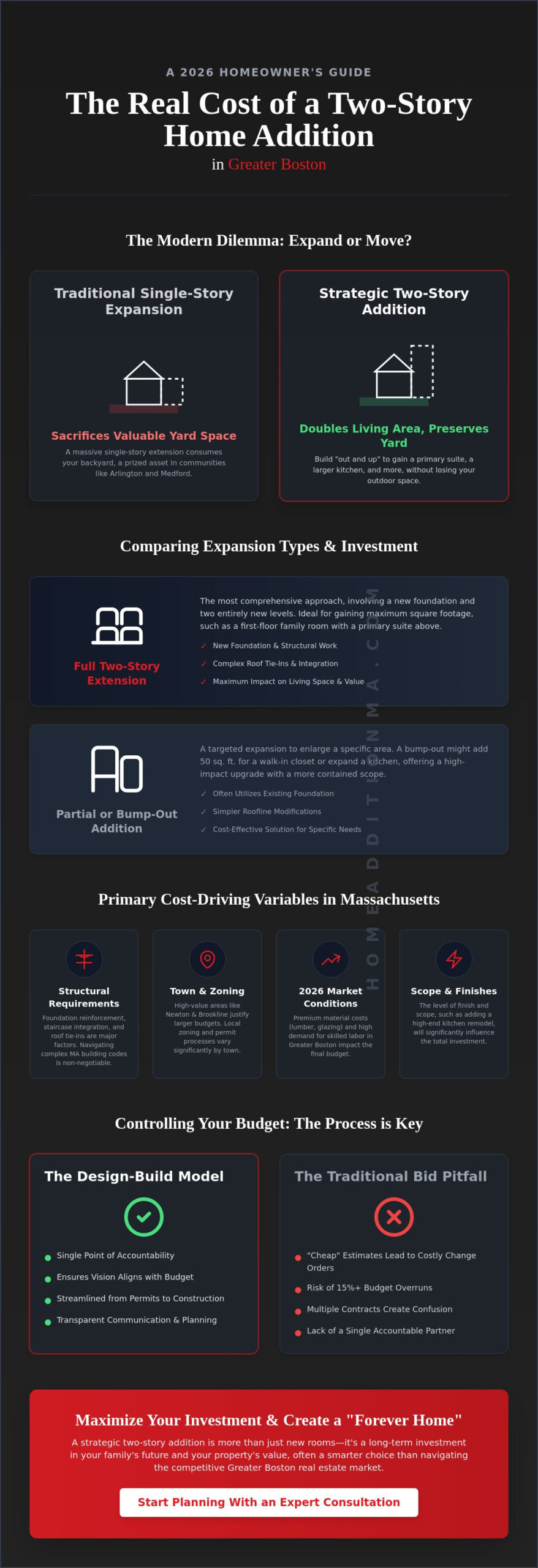
A two-story addition represents a significant evolution for your property. We define this as extending the home’s footprint while simultaneously adding two full levels of living space. In 2026, we see more families in towns like Lexington and Winchester choosing to build out and up rather than facing the competitive real estate market. This approach allows you to double your square footage without sacrificing the yard space that a massive single-story extension would require. It’s a strategic way to gain a primary suite and a larger kitchen simultaneously.
Embarking on these types of home improvement projects requires meticulous planning. The cost of two story addition work is influenced heavily by whether you choose a minor bump-out or a full-scale structural expansion. A bump-out might only extend a room by 50 square feet to accommodate a walk-in closet. In contrast, a full-scale expansion involves new foundations, complex roof tie-ins, and entire new rooms. Your home’s original style dictates the starting point; for example, converting a Ranch into a two-story home is a different engineering feat than adding a wing to a traditional Colonial in Arlington.
We specialize in high-quality room additions that integrate perfectly with your existing structure. Whether you own a Cape in Medford or a Victorian in Melrose, the goal is a seamless transition between the old and the new.
Why Investment Varies by Town
In Newton and Brookline, property values often exceed the state average by 40 percent. This high valuation justifies larger construction budgets because the return on investment remains strong. Homeowners in Wellesley must also consider the neighborly factor. Maintaining architectural harmony in established communities is a requirement for both aesthetic value and local zoning boards. We understand the specific permit requirements in these high-demand areas, ensuring your project meets local standards while increasing your home’s equity.
The 2026 Massachusetts Construction Market
The 2026 Massachusetts construction market presents unique challenges. High-end material costs for lumber and custom glazing have stabilized but remain at a premium. Labor availability in the Greater Boston area remains tight; skilled tradespeople are in high demand across Cambridge and Somerville. We’ve seen that “cheap” estimates from inexperienced contractors often lead to expensive mid-project change orders that can derail a budget by 15 percent or more. To avoid these pitfalls, we focus on detailed planning and transparent communication from day one.
Building a cost of two story addition that lasts requires a commitment to craftsmanship and structural integrity. We invite you to contact us for a consultation to discuss how we can transform your current house into your forever home.
Typical Price Ranges: Full vs. Partial Second-Story Expansions
Calculating the cost of two story addition requires looking beyond a simple price per square foot. While that metric provides a rough baseline for initial planning, your final investment depends heavily on whether you’re expanding your home’s footprint or building upward. In communities like Newton and Arlington, the complexity of the structural work often dictates the budget more than the raw materials themselves. We see that homeowners who prioritize a seamless transition between the old and new structures often find better long-term value than those who focus solely on the lowest initial bid.
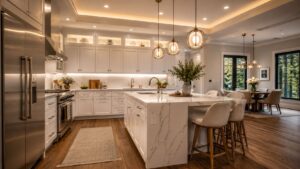
Your choice of finishes also plays a major role. If your project includes high-end kitchen remodeling on the first floor to create a modern, open-concept flow into the new space, the total investment will reflect those premium upgrades. We help you balance these aesthetic desires with the practical necessities of a 2026 home expansion.
The Full Two-Story Footprint Extension
This approach involves digging a new foundation and building two entirely new levels of living space. It’s a frequent choice for Medford and Belmont homeowners who have the yard space to accommodate a larger building footprint. A common use case involves adding a spacious family room on the first floor with a luxurious master suite directly above it. Because this requires excavation, foundation pouring, and a completely new roofline, it’s a comprehensive structural change that essentially adds a small, custom-built house to your existing residence.
The “Pop-Top” Addition: Building Up
In urban areas like Somerville and Cambridge, tight lot lines often make outward expansion impossible. A “pop-top” addition involves removing the existing roof and adding a full second level onto the current structure. The primary cost driver here is structural reinforcement. Our team must ensure that the original first-floor walls and foundation can support the additional weight according to the Massachusetts State Building Code. This often requires adding steel beams or reinforcing the basement footings to meet modern safety standards.
Beyond the visible walls and floors, you must budget for “invisible” infrastructure that keeps the home functional. Expanding your living space significantly usually triggers the need for these essential upgrades:
- Electrical Service: Most older homes in Greater Boston require an upgrade to a 200-amp electrical panel to handle the increased load.
- HVAC Systems: Your current furnace or AC unit likely won’t have the tonnage required to heat and cool an additional 1,000 square feet.
- Plumbing Stacks: Running new lines for a second-story bathroom requires careful integration with your existing waste and vent lines.
Planning these details early ensures that the cost of two story addition remains predictable and transparent. If you’re ready to see how these variables apply to your specific property, you can schedule a consultation with our design team to explore your options.
Structural Variables: Foundation, Stairs, and MA Building Codes
Building up instead of out sounds simple, but the structural reality in Greater Boston is complex. Your soil type in Winchester or Stoneham plays a massive role in your project’s initial budget. New England’s rocky terrain often requires specialized excavation if the existing foundation isn’t sufficient to carry a second floor. This hidden work is a major factor in the total cost of two story addition investments. We see everything from sandy loam to solid ledge, and each requires a different engineering approach to ensure your home stays level for the next century.
Integrating a staircase is another hurdle that many homeowners overlook. You’ll lose about 80 to 100 square feet of your current living space to create that access point. We focus on layouts that minimize this loss while improving the flow of your home. Beyond the footprint, you must consider the “Whole House” effect. In many Massachusetts towns, an addition that exceeds a certain percentage of the original home’s value triggers requirements for modern fire suppression or updated insulation throughout the entire structure. It’s a strategic move to plan for these upgrades early in the room addition process.
Zoning and setbacks present their own challenges. In Lexington and Belmont, strict lot-coverage limits can halt a project before it starts. We review these local bylaws during our first meeting to ensure your vision fits within the town’s legal framework. This proactive approach saves time and prevents costly redesigns after the permit application has been filed.
Foundation and Framing Requirements
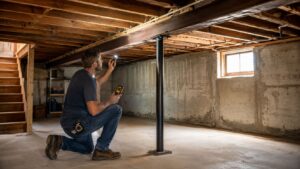
Structural engineering fees are a non-negotiable part of our process. We calculate exactly how much weight your current walls can handle before a single board is cut. For many 100-year-old MA homes, structural integrity means the capacity of the existing timber and stone to remain stable and plumb under the pressure of modern materials and additional stories. We often reinforce the first-floor framing or add steel columns to ensure your new space is as solid as the original house.
Permits and Local Regulations
Navigating the “red tape” is where our local expertise shines. If you live in a historic district like Newburyport or Concord, you face an extra layer of design review that dictates everything from window styles to siding materials. The Massachusetts State Building Code (780 CMR) also includes the Stretch Code, which mandates high energy efficiency standards for new construction. Aureli Construction handles the entire permitting process from start to finish. We manage the communication with town officials and inspectors, ensuring your cost of two story addition stays predictable while meeting every safety standard.
Design-Build vs. Traditional Bid: Controlling Your Budget
Choosing the right delivery method is the most effective way to manage the cost of two story addition projects. The traditional “Architect-First” model often creates a disconnect between creative vision and financial reality. Homeowners in Cambridge or Somerville might spend months designing a dream space, only to discover that the actual construction bids exceed their budget by 40 percent. This leads to “sticker shock” and forces expensive redesigns that waste both time and money. By contrast, design-build remodeling integrates the design and construction teams from the very first meeting. You get a single point of accountability, ensuring that every architectural choice aligns with your target investment.
We use value engineering to help you maintain a high-end aesthetic while controlling expenses. This isn’t about cutting corners; it’s about making strategic material swaps that don’t sacrifice quality. For instance, selecting a specific high-grade quartz might save $4,000 compared to rare marble without changing the room’s luxury feel. A fixed-price contract is vital for a project of this magnitude. It protects you from the common “cost-plus” trap where expenses spiral out of control. When you sign with us, you know the final number before the first shovel hits the ground in Arlington or Belmont.
The Planning Phase as a Cost-Saver
Precision in the early stages prevents expensive delays during the build. We utilize advanced 3D modeling to visualize the structure, allowing us to identify potential plumbing or HVAC conflicts before hammers swing. Early selection of materials, specifically kitchen cabinets and high-end fixtures, ensures that items are ordered and ready for installation. Our project managers keep builds in Wakefield and Melrose on schedule by coordinating these logistics months in advance, avoiding the 12 percent price hikes often seen with last-minute supply chain rushes.
Transparency in Estimates
A reliable quote should be “turnkey,” meaning it covers every phase of the project. We believe that honesty about the cost of two story addition work builds the trust necessary for a successful partnership. A comprehensive estimate from Aureli Construction includes:
- Detailed demolition and site preparation costs
- Structural engineering and local permit fees
- Specific allowances for flooring, lighting, and custom millwork
- Comprehensive HVAC, plumbing, and electrical upgrades
Our team prioritizes detailed on-site consultations in towns like Medford and Winchester to assess your home’s specific structural needs. This hands-on approach eliminates the guesswork that leads to unexpected change orders. We provide clear, itemized budgets so you can make informed decisions about where to invest and where to save.
Ready to see how a professional design-build team can maximize your home’s potential? Contact Aureli Construction today for a free on-site consultation and a detailed project estimate.
Maximizing Your Investment: Property Value and Next Steps
Investing in your property is a strategic move that pays dividends in both equity and quality of life. In towns like Medford and Reading, the cost of two story addition often correlates with a substantial increase in market value. While exact figures vary based on finishes, homeowners in the Greater Boston area typically see a return on investment between 60% and 70% according to regional real estate data. Beyond the numbers, there is the emotional ROI. You’re creating a forever home tailored to your lifestyle, avoiding the stress and high costs of moving in a competitive market.
Financing a project of this scale requires careful planning. Many Massachusetts homeowners utilize Home Equity Lines of Credit (HELOCs) to leverage their existing equity. Others opt for construction loans or cash-out refinancing to secure the necessary capital. We recommend speaking with a local lender early in the process to understand your borrowing power and lock in rates that fit your budget.
Increasing Long-Term Marketability
In Newton, the four-bedroom, three-bath configuration remains the gold standard for resale. Adding this specific layout ensures your home remains competitive for decades. You might also consider the value of adding accessory dwelling units or in-law suites. These spaces provide flexibility for multi-generational living or potential rental income. We always advise consulting with local real estate experts to ensure you aren’t over-improving for your specific street, keeping your investment aligned with neighborhood comps.
Your Path to a Seamless Addition
The Aureli Construction process takes you from your initial vision through the final walkthrough with total transparency. We handle the complexities of zoning and permits so you don’t have to. Our deep experience in Middlesex and Essex counties means we understand the specific soil conditions, historical requirements, and building codes of your community. We pride ourselves on being a single point of contact, managing every detail of the design and build phases.
To prepare for a successful on-site consultation, consider these steps:
- Gather any existing plot plans or blueprints of your current home.
- Create a list of “must-have” features versus “nice-to-have” amenities.
- Establish a preliminary budget range to help guide the design process.
- Research local architectural styles in your neighborhood to ensure a cohesive look.
This preparation helps us provide the most accurate assessment of the cost of two story addition for your specific property. Our goal is to ensure you feel both inspired and informed before the first hammer swings.
Schedule your free on-site consultation and detailed estimate with Aureli Construction today. Let’s start the conversation about transforming your home.
Transform Your Greater Boston Home Today
Expanding your living space with a vertical expansion is a sophisticated way to gain the room you need without leaving the neighborhood you love. You’ve seen how the cost of two story addition projects in 2026 is influenced by structural requirements, Massachusetts building codes, and the choice between a partial or full second-story build. By focusing on a design-build approach, you can maintain control over your budget while ensuring every detail aligns with the unique architectural character of towns like Winchester, Lexington, and Belmont. High-quality residential expansions require a steady hand and a deep understanding of local zoning laws to truly maximize your property’s long-term value.
Aureli Construction offers over 30 years of local Massachusetts construction experience, providing a seamless turnkey service that handles everything from initial permits to the final stroke of paint. Our team specializes in complex residential projects, ensuring your home remains a sanctuary throughout the construction process. We take pride in our role as a reliable partner for homeowners in Arlington, Medford, and across the Greater Boston area who demand excellence. Ready to expand? Contact Aureli Construction for a free on-site consultation and detailed estimate. We’re here to turn your vision into a structural reality that your family will enjoy for decades to come.
Frequently Asked Questions
Is it cheaper to add a second story or build out with a two-story addition?
Building up is generally more cost-effective because it utilizes your home’s existing footprint. A two-story addition requires new excavation and foundation work, which typically increases the structural budget by 15% to 20% compared to a vertical expansion. However, a two-story addition provides significantly more square footage across both levels. This makes it a popular choice for families in towns like Winchester or Belmont looking to maximize their property value.
How long does a typical two-story addition take to build in Massachusetts?
A standard two-story addition in the Greater Boston area typically takes between 6 and 9 months to complete from the start of demolition. This timeline includes an initial design and permitting phase of 8 to 12 weeks. Factors like winter weather in Medford or specific zoning board reviews in Cambridge can influence the final schedule. We manage every phase of the timeline to ensure your project stays on track and meets every deadline.
Do I have to move out of my house during a two-story addition project?
You aren’t always required to move out, but 85% of our clients find it more comfortable to relocate for 3 to 5 months during the most intensive construction phases. When we open up the roof or main walls, utility shut-offs and noise levels make daily life difficult. If we’re building a separate two-story addition attached to the side, you might stay in the main house; we’ll discuss safety and comfort during our initial planning.
Will my existing foundation support a second-floor addition?
Your existing foundation must be inspected by a structural engineer to confirm it can handle the increased load. In older homes in Arlington or Somerville, foundations often need structural reinforcement like underpinning or steel plates to meet the 2026 Massachusetts building codes. We handle these technical inspections as part of our full-service management to ensure the structural integrity of your home remains a top priority throughout the entire build.
What are the most expensive parts of a two-story home addition?
The foundation, framing, and mechanical systems represent the largest portion of the cost of two story addition. Excavation and concrete work for a new footprint are significant expenses, often followed by the complexity of tying in new HVAC, plumbing, and electrical lines to your existing systems. High-quality finishes and custom cabinetry in a new master suite or kitchen also contribute heavily to the final investment you’ll make in your home.
Can I add a second story to a house with a crawl space or slab foundation?
Yes, you can add a second story to a slab or crawl space, but it requires specific engineering solutions to distribute the weight. We often install new footings or structural columns to support the new level without compromising the existing base. This is a common challenge in certain neighborhoods in Reading and Wakefield. Our team implements specialized framing techniques to ensure a seamless and safe expansion that lasts for decades.
How do Massachusetts “Stretch Code” energy requirements affect addition costs?
The Massachusetts Stretch Code requires new additions to meet high energy-efficiency standards, which can increase initial material costs by 5% to 10%. These regulations mandate specific insulation R-values, high-performance windows, and airtight construction methods. While the upfront investment is higher, these requirements significantly reduce your monthly utility bills. They also improve the year-round comfort of your home in towns like Lexington and Wellesley, providing long-term financial benefits.
What is the first step in getting an accurate cost of two story addition?
The first step is scheduling a professional on-site consultation to evaluate your property’s unique constraints and your specific goals. An accurate cost of two story addition depends on your home’s current condition, local zoning laws in cities like Newton or Brookline, and your desired finish level. We provide a detailed estimate that covers everything from architectural drawings to final inspections. Contact Aureli Construction today for a free on-site consultation and a detailed estimate.