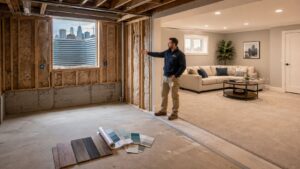
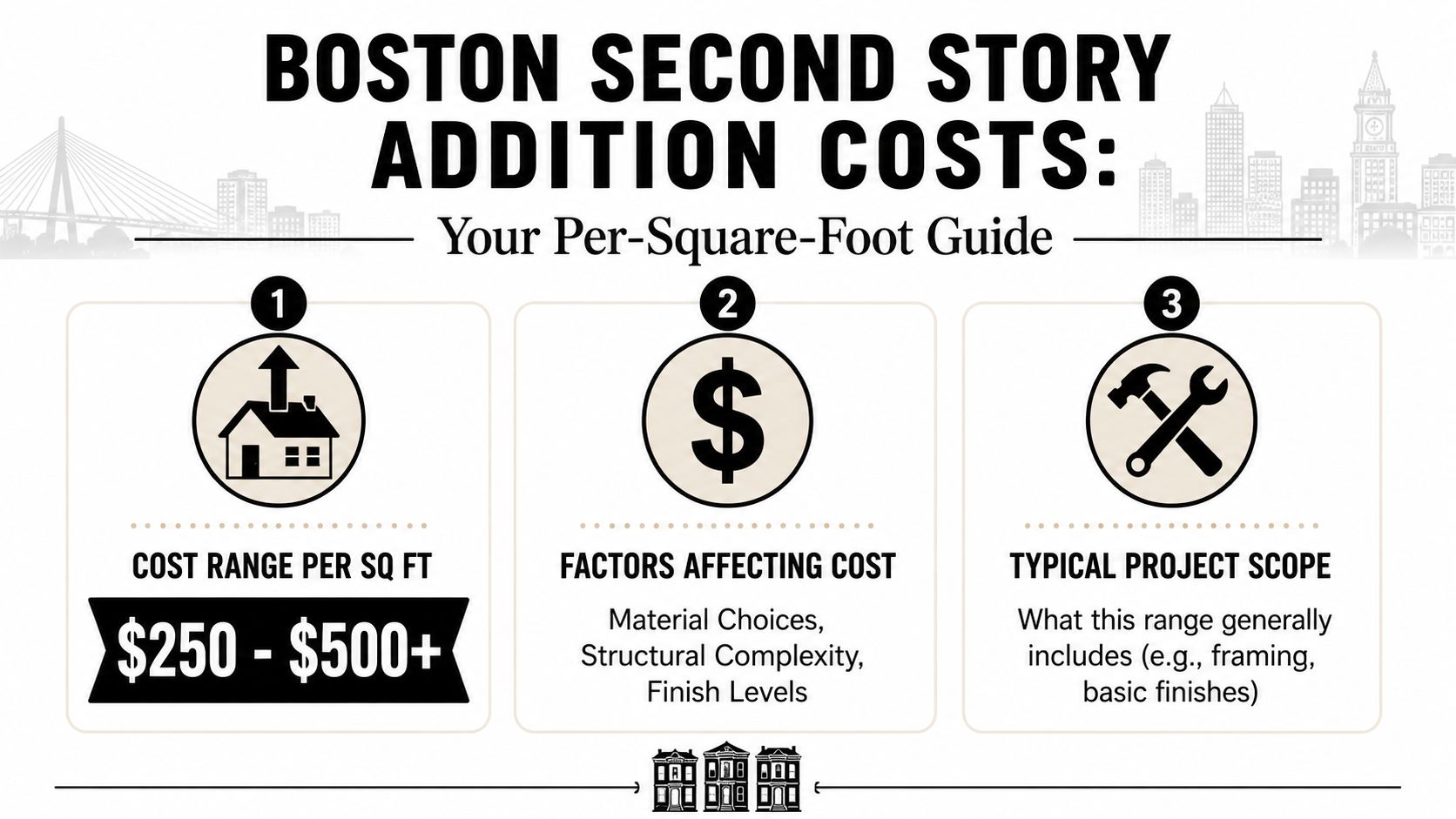
In Arlington, Cambridge, and the other older neighborhoods around Boston, a full second-story addition realistically costs $250 to $500+ per square foot, with many full projects landing between $200,000 and $500,000 because of older foundations, tighter sites, and stricter code review. If you're planning to stay in your home but need more space, that price is often the actual entry point for building up in Greater Boston.
A lot of homeowners who call us are in the same spot. They like the block, the schools, the commute, and the yard they already have, but the house no longer fits the family. In Greater Boston, moving isn't always the practical answer. Building up often makes more sense, especially in towns like Arlington, Belmont, Lexington, Medford, Newton, Somerville, and Wellesley where lot coverage, setbacks, and neighborhood context can make a rear addition harder than people expect.
The part national cost guides usually miss is the local structural reality. In this market, second story addition cost isn't driven only by finishes. The biggest swing is often whether the house is foundation-ready or foundation-reinforced. That one distinction can reshape the entire budget before framing starts.
Table of Contents
- Why Building Up Is the Smart Move in Greater Boston
- Cost Per Square Foot for a Boston Second Story Addition
- A Detailed Cost Breakdown for Your Second Story Addition
- How We Plan Your Addition The Aureli Design-Build Process
- Sample Second Story Addition Budgets in Massachusetts
- FAQ Your Second Story Addition Questions Answered
Why Building Up Is the Smart Move in Greater Boston
A common call starts the same way. The kids are sharing a room, one parent is working at the kitchen table, and the homeowners do not want to leave Newton, Arlington, or the school district they worked hard to get into.

In much of Greater Boston, building up is the move that keeps the lot usable. It preserves yard space, avoids pushing farther into setback lines, and often fits better on the narrow, older parcels common in Cambridge, Medford, Brookline, and Somerville. It can also improve the first floor because the new stair forces a smarter layout instead of just tacking square footage onto the back of the house.
That said, a second story is not automatically the better value.
It makes sense when the lot is constrained and the existing house gives you a workable starting point. In this region, that usually means two questions come before finishes or bedroom count. First, will zoning support the added height and massing? Second, and more important on older homes, is the house foundation-ready, or will it need reinforcement before it can safely carry a new level?
That foundation question changes everything. National cost guides usually treat a second-story addition like a simple square-foot calculation. Around Boston, many homes were built long before anyone expected a full extra floor, and that means field conditions matter more than online averages. A house with adequate footings, accessible framing, and a clean load path is a very different job from a house that needs new beams, posts, foundation work, and structural reconfiguration in the basement before framing can even start. Homeowners comparing early budgeting options can review this Greater Boston home addition price guide and then pressure-test those ranges against the actual condition of their house.
Why this option fits older Boston-area neighborhoods
Dense neighborhoods across Greater Boston limit what you can do at grade. Rear additions can trigger tighter zoning review, reduce outdoor space, and create awkward floor plans on houses that were never designed for a long footprint. Building upward often solves those problems more cleanly, especially on lots where every foot of side yard matters.
Massachusetts also puts more weight on structure than many homeowners expect. Under 780 CMR and local permit review, the project has to work as a system. The existing walls, beams, bearing points, roof removal plan, and new stair layout all have to make sense together. If you want a rough national benchmark before drilling into local conditions, this resource can help calculate addition costs, but Boston-area planning still comes back to the house you already own.
What works and what doesn't
The projects that go well start with structural investigation, zoning review, and honest stair planning. The projects that go sideways usually start with a finish wish list and a square-foot target.
If the shell can take the load, the foundation is ready, and the stair lands in a spot that does not ruin the first-floor flow, building up can be the cleanest way to stay in place and gain meaningful living space. If the house needs reinforcement, the project may still be worth doing, but the budget and schedule have to reflect that from the start.
Cost Per Square Foot for a Boston Second Story Addition
A Boston-area second-story addition can look straightforward on paper. Add 700 or 900 square feet above the existing first floor, build a new stair, extend the systems, finish the rooms. Then we open up the house and find the number that changes everything. Is the foundation ready for the added load, or does it need reinforcement?
That question is why broad national averages only get you so far. If you want a general tool to calculate addition costs, use one early for rough range planning. For a Greater Boston house, the existing structure usually decides the budget more than the square footage does.
In this market, second-story additions commonly price higher per square foot than ground-level additions because the project starts with structural verification, not just new space. On older homes in Arlington, Belmont, Cambridge, Newton, Medford, and nearby towns, I see the biggest spread come from one hidden variable: a house that is foundation-ready versus one that needs foundation reinforcement, bearing upgrades, or both.
Why Boston-area pricing climbs fast
The framing in many Greater Boston homes was never designed for a full new level. Add snow-load requirements, tight access, occupied-house sequencing, and local permit review under 780 CMR, and the cost picture changes quickly.
A one-story addition usually starts on a new foundation built for the new work. A second story asks the existing house to carry more weight through the roof framing, exterior walls, beams, posts, and foundation. If the load path is there, pricing stays more predictable. If it is not, the project can require excavation, new footings, foundation work, interior beam installation, or selective reframing before the addition itself really begins.
That is the local cost variable national guides usually miss.
The first cost drivers to pin down are:
- Foundation condition: Stone, brick, older block, or undersized concrete foundations often need more investigation before pricing means much.
- Load path and framing: New weight has to transfer cleanly from the new floor and walls down to bearing points below.
- Roof removal and rebuild: A full second story usually means tearing off the existing roof and weather-protecting the house while new framing goes up.
- Stair placement: A bad stair location can force a larger first-floor reconfiguration than homeowners expect.
- Mechanical extension: HVAC, plumbing, and electrical distribution get more expensive when routes are tight in an existing house.
- Municipal review: Height, setbacks, egress, structural drawings, and energy code coordination can all affect scope.
Foundation-ready versus foundation-reinforced
This is the split that matters most in older Boston-area housing stock.
A foundation-ready house already has the bearing capacity, framing logic, and basement or crawl conditions to support the addition with limited structural upgrades. Those projects are still complex, but they are easier to price and schedule.
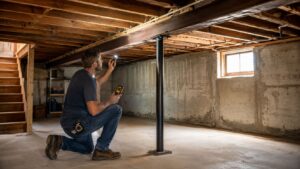
A foundation-reinforced house needs structural work below before you can safely build above. That can include new footings, underpinning in sections, added steel or LVLs, new posts, slab removals for bearing work, or rebuilding parts of the support system in the basement. Two houses with the same new square footage can end up far apart in cost because one is ready and the other needs major reinforcement first.
For broader local budgeting context, homeowners often compare this scope against other home addition price ranges in Greater Boston. The useful comparison is not just cost per square foot. It is structural condition plus floor plan impact.
Second story versus build-out
| Project type | Typical cost range |
|---|---|
| Ground-level addition | Lower structural risk, often more predictable if setbacks allow |
| Second-story addition | Higher structural complexity, with major variation based on foundation and framing |
You are paying for structure first, then space.
A short overview video helps homeowners understand why roof removal, engineering, and sequencing make these projects different from simpler additions.
The cheapest-looking estimate usually skips the hardest part of the project. The existing house has to carry the new one.
A Detailed Cost Breakdown for Your Second Story Addition
A second-story addition budget gets clearer once you separate the house into two parts. First, the existing structure has to carry a new floor. Then you price the rooms you want to live in.
That distinction matters in Greater Boston because older homes can look straightforward from the street and still need major work in the basement before any framing starts above.
Where the money usually goes
On most projects, the larger share of the budget is tied to structure and building systems, not finish materials. Homeowners naturally ask about tile, flooring, trim, and fixture allowances. Those choices matter, but they usually do not decide whether the project works financially. Foundation capacity, framing strategy, roof reconstruction, HVAC distribution, plumbing routing, and electrical upgrades usually have more impact on the final number.
A practical budget usually breaks into these categories:
- Design and engineering: Existing-condition drawings, architectural plans, structural calculations, and code coordination.
- Structural preparation: Foundation review, load-path corrections, beam and post work, and any required reinforcement.
- Framing and roof work: New floor system, exterior walls, roof reframing, sheathing, and temporary weather protection.
- Exterior shell: Windows, siding, flashing, insulation, roofing, and air-sealing details.
- Mechanical systems: HVAC extensions or new equipment, plumbing risers, waste and vent adjustments, electrical service and branch circuits.
- Interior finishes: Drywall, interior doors, trim, flooring, tile, paint, cabinets, and fixture installation.
Stair work often expands the scope. In many Boston-area homes, especially capes and colonials, the best stair location cuts into a bedroom, a hallway, or part of the first-floor kitchen. That change can trigger more framing, electrical, and finish work downstairs than homeowners expect.
Foundation-ready versus foundation-reinforced
This is the cost variable national articles usually miss.
In Cambridge, Belmont, Arlington, Newton, Medford, and similar towns, many houses were built long before anyone expected a full second story to be added later. Some homes are foundation-ready. The existing footing, foundation walls, beams, posts, and framing layout can support the added load with limited modification. Those projects are still complex, but the budget stays more predictable.
Others are foundation-reinforced projects. That means the engineer finds undersized footings, weak bearing points, inadequate beams, poor load transfer, or basement conditions that need corrective work before the addition can proceed. Once that happens, costs rise fast because the work is invasive and it has to happen first.
Typical reinforcement scope can include:
- New footings or enlarged bearing pads
- Underpinning in sections
- New steel or LVL beams
- Additional posts and point-load support
- Basement slab cutting and replacement
- Rebuilding portions of the load path down to proper bearing
That is why two homes with the same added square footage can land far apart in price.
In older Boston-area housing stock, the first budget question is not about finish level. It is whether the house is foundation-ready. Homeowners who want a closer look at that line item should review this breakdown of structural engineering costs for Massachusetts additions.
A good early planning comparison can also help owners understand how scope decisions affect pricing in other regions, even though Boston structural conditions are often tougher. One example is this guide to home addition planning for Seattle area.
Finish choices still affect the number
Once the structure is sorted out, finish decisions start to move the budget in a more familiar way. Standard window sizes, simpler rooflines, stacked plumbing, and straightforward bathroom layouts usually hold costs in line. Custom glass packages, complex dormers, high-end tile assemblies, and specialty millwork push the total higher.
The smartest finish decisions are usually the boring ones on paper and the best ones to live with later.
What tends to keep a second-story project on budget:
- Keep plumbing stacked: Baths above existing kitchen or bath areas are usually less expensive to pipe and vent.
- Use standard sizes: Stock or near-stock windows and doors reduce lead times and custom costs.
- Simplify roof geometry: Cleaner roof intersections are easier to frame, flash, and insulate correctly.
- Coordinate first-floor work carefully: If the stair and support changes already disrupt the main level, it can make sense to update selected areas at the same time.
What tends to increase cost quickly:
- Late structural discoveries: These create change orders and schedule delays.
- Complicated stair placement: A bad stair location can force expensive redesign of both floors.
- Heavy finish upgrades too early: Premium finishes do not fix a weak structural plan.
- Mechanical upgrades deferred until construction: Older electrical service, undersized HVAC, or poor duct paths often have to be addressed once walls are open.
The projects that perform best over time are the ones priced in the right order. Structure first. Systems second. Finishes third. That is how you avoid spending design money on a plan that the existing house cannot support economically.
How We Plan Your Addition The Aureli Design-Build Process
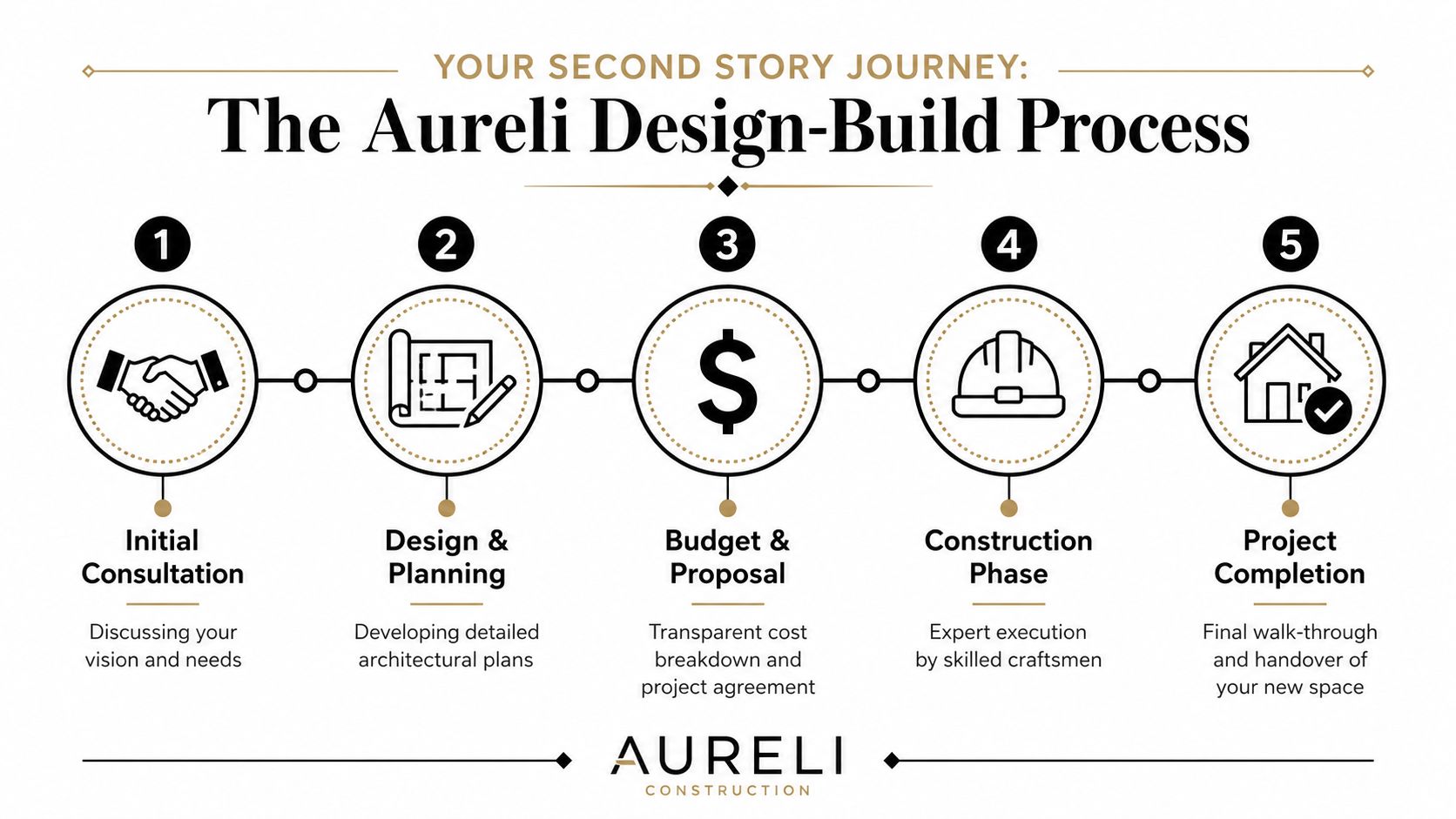
A second-story addition in Lexington, Belmont, or Newton doesn't move smoothly unless design, engineering, permitting, and construction stay coordinated from the beginning. In Massachusetts, that coordination matters because each town has its own review rhythm even when everyone is working under the same state code framework.
What happens before construction starts
The early phase is where good projects are won or lost. We start with the house as it exists, not the wish list. That means measuring the current structure, reviewing the likely stair location, checking zoning limits, and bringing engineering into the conversation early if the home is older.
Our planning sequence usually follows a practical order:
Feasibility first
We look at lot constraints, height issues, and the existing structure before anyone gets attached to a layout that may not work.Design tied to budget
Plans need to reflect real construction conditions. That avoids the common problem of designing a beautiful addition that blows up in pricing once the engineer weighs in.Scope locked before permit filing
Clean drawings and coordinated details make permit review easier and reduce construction-time confusion.
Homeowners who want a general outside perspective on early-stage planning can also review home addition planning for Seattle area. The local code environment is different, but the planning mindset is useful.
For Massachusetts-specific expectations, we also recommend reading about understanding the design-build process before choosing between contractors.
How permits and inspections work in Massachusetts
Under 780 CMR, a second-story addition usually requires building permits and multiple trade permits, with structural review at the center of the application. Depending on the town, zoning review may also be required for height, setbacks, lot coverage, or neighborhood context.
The inspection path usually includes these checkpoints:
- Framing inspection: The building department checks structural work before finishes cover it.
- Rough electrical and plumbing inspections: Trade work gets reviewed before walls close.
- Final inspection: The completed project must pass before closeout and occupancy.
A well-run project doesn't treat permits as paperwork. It treats them as part of the build strategy.
In places like Brookline, Cambridge, and Somerville, permit review can be detailed, especially when the house is older or the lot is tight. In suburban towns like Lexington and Wellesley, zoning and neighborhood context can shape massing decisions early. The smoother jobs are the ones where the drawings, engineering, and code path are coordinated before submission.
Sample Second Story Addition Budgets in Massachusetts
A homeowner in Greater Boston can get two prices for what looks like the same second-story addition and wonder why one is dramatically higher. In older housing stock, the difference is often below the first floor, not above it. If the existing foundation is ready for the added load, the budget stays in one range. If the foundation needs reinforcement, the project moves into a different category.
That is the cost variable national articles usually miss.
Medford partial addition
A partial second-story addition in Medford, such as a large rear dormer or a half-story expansion, often lands in the lower budget tier because the scope is smaller and the structural work can be more contained. These projects usually make sense for adding one bedroom, a small bath, or an office without rebuilding the entire upper level.
The main question is how much of the existing house has to be reworked to support the new space. On some older capes, a partial addition stays relatively efficient because we can keep more of the roof and wall structure. On others, once framing, stair layout, and load paths are examined, the "small" addition starts acting like a larger structural job.
Wellesley full second story
A full second-story addition in Wellesley often starts with a straightforward family goal. Keep the neighborhood, keep the lot, add real living space. On paper, an 800-square-foot addition can look predictable. In the field, the budget usually turns on whether the house is foundation-ready or foundation-reinforced.
If the existing foundation and first-floor structure can carry the load with limited upgrades, the job stays closer to the expected range for a standard full build. If we find undersized framing, old fieldstone conditions, or settlement concerns, the cost rises fast because the structural scope expands beyond the new second floor itself.
Wellesley also tends to reward careful design early. Height, massing, and roof form matter, and revisions made after structural engineering is underway are expensive.
Lexington higher-end full build
Lexington has plenty of homes where the addition itself is only part of the budget story. Larger footprints, custom exteriors, more involved rooflines, and higher finish expectations all push the number up. So does the level of disruption. On a high-end full build, homeowners should also account for temporary living costs, longer preconstruction coordination, and more detailed finish selections.
The hidden spread in pricing still comes back to structure. A house with a strong existing basement and clean load transfer can support a major second-story project far more efficiently than a similar-looking house that needs foundation reinforcement, beam work, and first-floor reframing.
That is why two neighbors with similar square footage can see very different proposals.
| Town and scope | Typical budget range | Main cost driver |
|---|---|---|
| Medford partial second story | Lower than a full-story build | How much existing roof and framing can stay |
| Wellesley 800 sq ft second story | Mid to upper range for a standard family addition | Foundation-ready vs. foundation-reinforced |
| Lexington higher-end full build | Upper-tier custom budget | Structural upgrades, custom exterior work, premium finishes |
The clearest lesson from these examples is simple. Square footage matters, but existing structure matters more. In Greater Boston, the biggest budget swing is often whether the house is already prepared to carry a second story or whether we have to strengthen it first.
FAQ Your Second Story Addition Questions Answered
Can we live in the house during construction
Sometimes, but not always. It depends on how the stair is being installed, how much of the roof is being removed, and whether utilities are being disrupted. Some homeowners stay through the early planning and selective demo phases, then relocate for the loudest and most invasive part of the work.
What doesn't work is assuming the house will function normally the entire time. Dust, noise, temporary weather protection, limited access to parts of the first floor, and trade traffic all affect day-to-day life.
If the job involves major roof removal and heavy structural work over occupied rooms, you should at least plan for the possibility of temporary housing.
How long does permitting really take
Homeowners should expect 3 to 6 months for planning and permitting, followed by another 3 to 6 months of active construction, for a total project timeline of 6 to 12 months according to Angi's second-story addition timeline guidance.
Cambridge, Brookline, and other busy building departments can feel slower because review is detailed. Zoning questions, structural revisions, and trade coordination can all stretch the pre-construction timeline.
How do you handle unexpected costs and change orders
The cleanest way is to identify structural risk early, then document any changes before the work proceeds. On second-story projects, the biggest surprise is usually hidden framing or foundation conditions once parts of the house are opened up.
A good process includes:
- Written scope clarification: Everyone should know what is included before construction begins.
- Documented pricing: Any added work should be priced and approved before it is performed.
- Clear reason for the change: Structural correction, owner upgrade, or code-required revision should be stated plainly.
What causes problems is informal decision-making on site. A quick verbal "go ahead" often turns into confusion later.
What financing options do homeowners usually consider
Most homeowners we talk to look at home equity financing first, then compare that with renovation or construction lending through their bank. The right choice depends on available equity, current loan terms, and how much of the project they want to finance.
The practical move is to settle your preliminary scope before you talk to lenders. A rough idea isn't enough for a serious financing conversation. A realistic budget tied to an actual design is much more useful.
Ready to get started? Contact Aureli Construction for a free estimate. As a Massachusetts licensed general contractor serving Arlington, Belmont, Brighton, Brookline, Burlington, Cambridge, Lexington, Medford, Melrose, Newburyport, Newton, Reading, Somerville, Stoneham, Wakefield, and Wellesley, we help homeowners plan second-story additions, home additions, kitchens, bathrooms, basements, and ADU projects with a clear process and realistic local pricing.