A homeowner in Somerville can find a prefab ADU advertised at $120,000 to $180,000 for a 600-square-foot unit, but once site work, foundation, utilities, permits, and installation are added, the actual total often lands at $200,000 to $300,000. In Massachusetts, that advertised unit price is often only part of the story, and in the Greater Boston market we tell clients to plan for a full project budget that is often much higher than the factory quote once local conditions and approvals are involved.
If you're early in the process, that's usually the moment the numbers stop making sense. You see a clean prefab model online, the base price looks manageable, and then you start hearing about utility trenching, foundation design, permit reviews, crane access, and inspections. In towns like Cambridge, Newton, Arlington, and Belmont, those aren't side notes. They drive the budget.
We build in Greater Boston, so we look at prefab ADU cost the way a contractor has to look at it. Not just the module price. The whole job. That means zoning, Massachusetts code compliance, delivery logistics, site access, drainage, foundation work, and the local permit path.
A prefab ADU can absolutely make sense. But the homeowners who budget accurately are the ones who treat it like a full construction project from day one, not a product purchase.
Table of Contents
- The True Cost of a Prefab ADU in Greater Boston
- A Detailed Prefab ADU Cost Breakdown for Newton MA
- Comparing Prefab vs Stick-Built ADU Costs in Arlington MA
- Site Prep and Permit Costs for ADUs in Cambridge MA
- What to Expect A Realistic Prefab ADU Timeline
- FAQs About Prefab ADU Costs in Massachusetts
- The First Step to an Accurate ADU Budget
The True Cost of a Prefab ADU in Greater Boston
A homeowner in Greater Boston gets a prefab quote that looks manageable, then the actual budget starts filling in. Foundation design. Utility trenching. Permit drawings. Delivery logistics. Crane access. By the time those numbers are on the table, the factory price is only one part of the job.
That is the main budgeting mistake with prefab ADUs here. Manufacturers sell a unit. Homeowners still have to build a legal, serviceable structure on a specific lot, under a specific local review process, with real site constraints that do not show up in an online price sheet.
One industry guide puts a 600 square foot prefab ADU at roughly $120,000 to $180,000 for the unit, while the all-in project cost often lands much higher once foundation, utilities, permits, site work, and installation are included. The same guide also notes that prefab savings can shrink fast on difficult sites, especially when access, grading, or local requirements add field work.
In Greater Boston, that happens all the time. Backyards are tight. Driveways are narrow. Existing sewer and water lines may be old or poorly documented. Trees, fences, retaining walls, and nearby homes can complicate delivery and installation before the unit even arrives. Local building departments also review the finished project, not the marketing promise.
Why online prefab pricing throws people off
A factory quote has value. It helps you decide whether a model is even in the right range.
What it does not do is answer the expensive questions. Can equipment reach the backyard without tearing up hardscape or neighboring property? Is the grade suitable for the foundation system the manufacturer assumes? How far do new utility runs need to travel? Will the town require plan revisions before permit approval?
Those are not minor add-ons. They are the costs that usually decide whether a prefab ADU stays close to the early quote or blows past it.
Practical rule: If a prefab quote does not include site verification, utility planning, permit review, delivery assumptions, and installation scope, it is not a usable construction budget.
What Greater Boston homeowners should expect
The realistic expectation in this market is a wide spread between the advertised unit cost and the true project cost. That spread gets larger in older neighborhoods and on lots with limited access, drainage issues, or more involved permitting. A flat, open lot with straightforward utility connections is one job. A tight Cambridge, Newton, Brookline, or Arlington backyard is another.
Homeowners looking for an ADU builder in Massachusetts or a home addition contractor in Boston should focus on one question early. Who is pricing the site work, permit path, and installation risk before money gets committed to a model? Prefab can reduce some on-site labor, but it does not remove the parts of the project that are most affected by local conditions.
That is why an accurate budget usually starts with a local GC, not a factory brochure.
A Detailed Prefab ADU Cost Breakdown for Newton MA
The cleanest way to understand prefab ADU cost is to split the budget into two buckets. First, the factory-built shell. Second, everything required to make that shell legal, serviceable, and livable on your property.
Why the factory quote is only one line item
Neutral market guidance shows the prefab unit itself commonly at about $150 to $300 per square foot in California, while foundation, site prep, utility hookups, permits, delivery, and crane access can add roughly $35,000 to $125,000 combined, pushing many projects into an all-in range of about $180,000 to $350,000, according to Nest ADU's prefab vs stick-built cost breakdown. The exact geography is different, but the budgeting logic applies directly here in Newton and across Greater Boston.
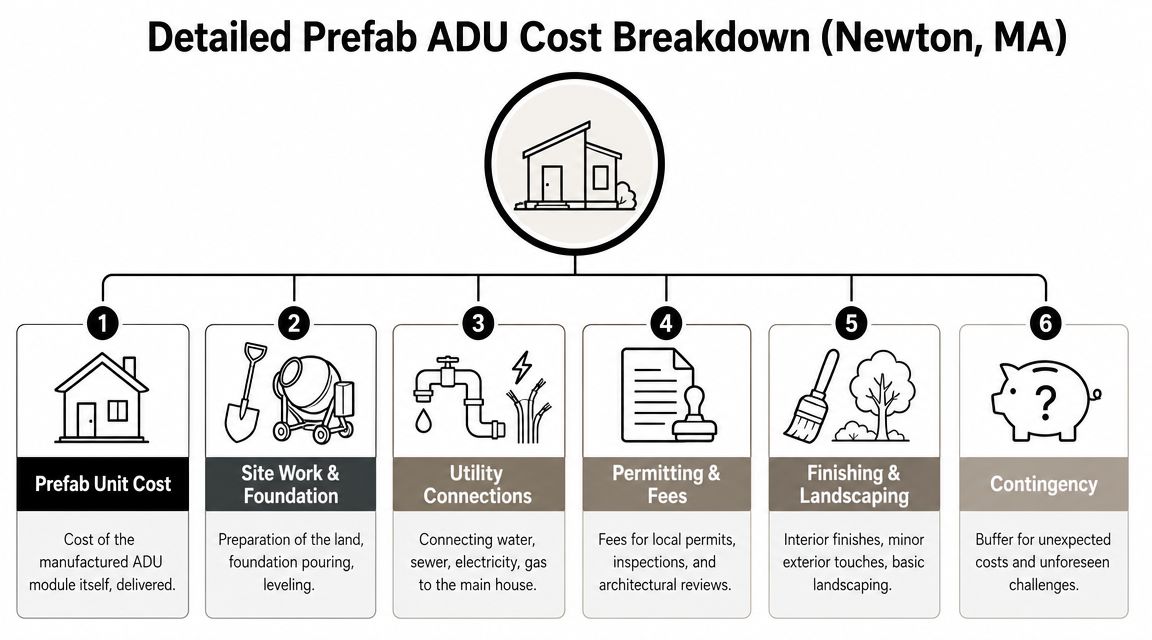
Here's how we break that down with homeowners.
| Cost component | What it covers | Why it moves |
|---|---|---|
| Prefab unit | Factory-built module or shell | Size, finish level, manufacturer scope |
| Site work and foundation | Excavation, grading, slab or other approved foundation work | Soil conditions, slope, drainage, access |
| Utility connections | Water, sewer, electrical, gas if applicable | Distance from house, trench route, service capacity |
| Permitting and fees | Local review, drawings, engineering, inspections | Town-specific requirements and revisions |
| Delivery and setting | Transport, staging, crane work, crew coordination | Street access, overhead wires, yard clearance |
| Finishing and exterior restoration | Button-up work, final tie-ins, patching, walkway or landscape repair | Scope left out of the prefab contract |
Where we see budgets change
The unit cost is the easiest number to get, and the easiest one to misunderstand. Many prefab companies price a standard model with standard assumptions. If your lot doesn't match those assumptions, the total shifts fast.
Site work and foundation is where Newton projects often become more property-specific. Existing retaining walls, tree protection, drainage control, and grade changes can all add coordination. Even on a flat lot, the foundation has to match engineering requirements and the manufacturer's setting plan.
Utility connections are rarely exciting, but they matter. A short, direct trench from the main house is one thing. A long route that has to avoid paving, landscaping, or other buried services is another.
The floor plan gets attention. The site conditions write the change orders.
Permitting and fees also deserve more respect than they usually get in online pricing calculators. In Massachusetts, ADUs still move through local zoning review, building permit review, and inspections under the applicable building code. If the property has historic constraints, tight setbacks, or review conditions from the municipality, that time and design effort becomes part of the budget.
Delivery and crane work can be straightforward on a wide lot. It gets harder in neighborhoods with overhead lines, narrow access, or limited staging space. We've seen homeowners focus on the unit dimensions while overlooking whether the module can physically reach the foundation area.
If you're comparing options in Newton, this local guide to ADU builders in Newton MA is a helpful next step because it puts zoning, permitting, and builder scope into the same conversation.
Comparing Prefab vs Stick-Built ADU Costs in Arlington MA
A lot of Arlington homeowners ask the same question. If prefab still needs a foundation, permits, utility work, and final inspections, when is it the better value?
The answer depends less on ideology and more on the lot. Prefab is a method. Stick-built is a method. The right one depends on access, customization needs, and how much of the project cost sits outside the structure itself.
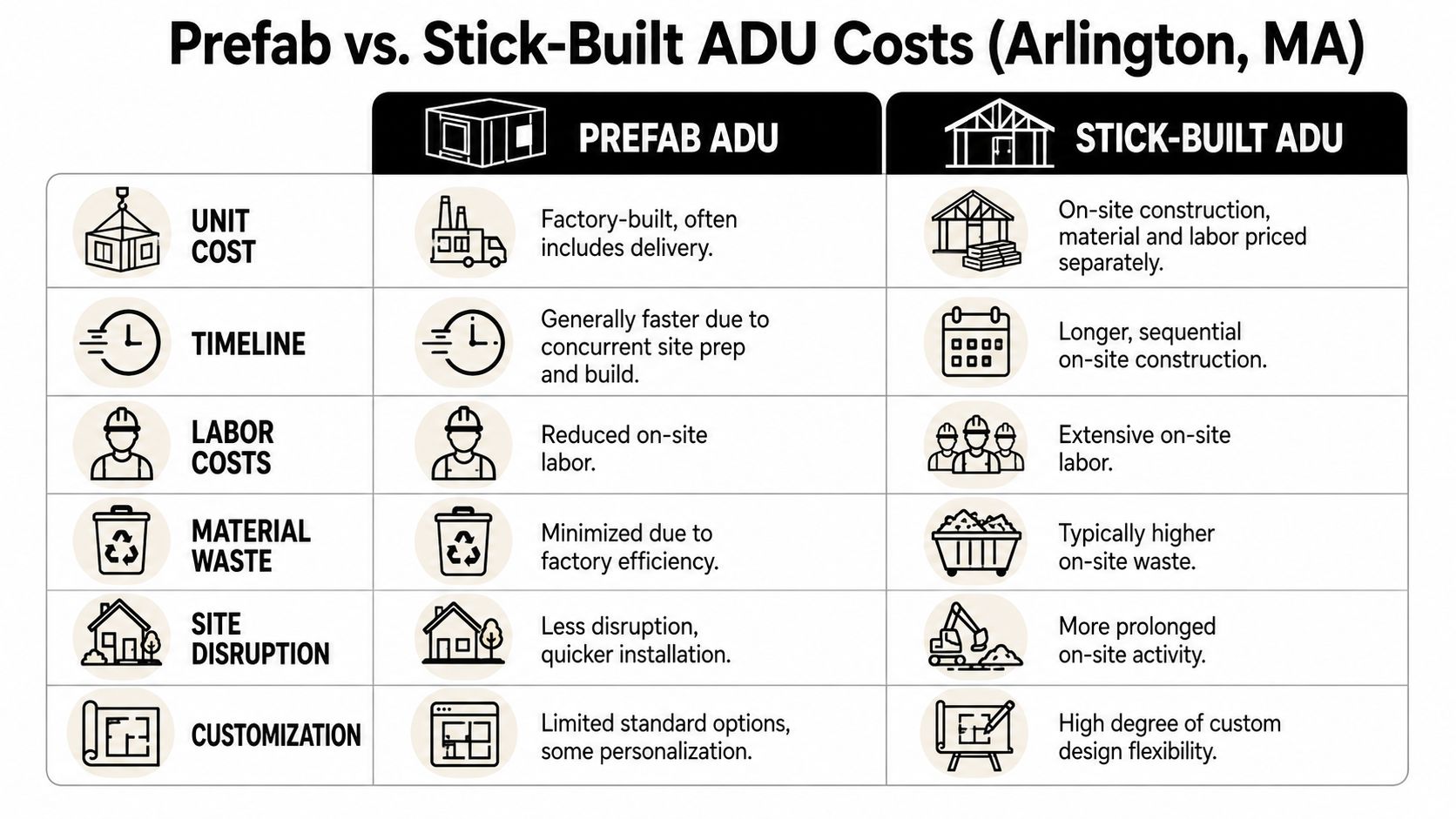
Prefab works best on the right lot
Prefab has real advantages when the site cooperates.
- Faster overlap of work: Factory fabrication can happen while site prep and permitting move forward.
- Less on-site labor: A shorter field installation window can reduce neighborhood disruption.
- More predictable model pricing: Standard layouts can make early budgeting easier.
- Cleaner factory production: Controlled indoor fabrication can reduce weather exposure during construction.
That said, none of those advantages erase local conditions. If access is poor or utility runs are difficult, the project starts behaving like a complex site-built job anyway.
A useful point from industry data is that economies of scale matter. Small ADUs can be less efficient on a per-square-foot basis, while larger 800 to 1,200 square foot layouts can land in similar or only modestly higher total-cost bands because shell, transport, and permitting overhead don't rise proportionally, according to Ladu's analysis of whether prefab ADUs are cheaper.
Stick-built wins when the site is awkward
Stick-built ADUs often make more sense when the lot is constrained or the homeowner wants the new structure to look like it has always belonged on the property.
In Arlington, that's common. Older homes, established neighborhoods, and tighter side-yard conditions can make a modular delivery plan harder than homeowners expect. A stick-built approach also gives more flexibility if setbacks, roof shape, massing, or exterior detailing need to respond closely to local zoning or neighborhood context.
Here's a quick comparison we use in planning conversations:
| Factor | Prefab ADU | Stick-Built ADU |
|---|---|---|
| Unit cost | Factory-built, often includes delivery assumptions | On-site construction, labor and materials priced through the build scope |
| Timeline | Faster when site prep and fabrication run together | Longer because most work happens sequentially on site |
| Labor profile | Reduced field labor | More on-site trade coordination |
| Material waste | Usually lower in a factory setting | Typically more site waste |
| Site disruption | Shorter heavy-construction window | Longer construction presence at the property |
| Customization | Limited to manufacturer options and modifications | Higher design flexibility |
This video gives homeowners a visual way to think through those differences before they commit to one path.
Prefab vs Stick-Built ADU At a Glance
Choose prefab when the lot is accessible and the standard model fits your goals. Choose stick-built when the site or the design needs flexibility.
For homeowners also comparing larger additions, kitchens, or a future kitchen remodel Greater Boston project, the decision is similar. The right method is the one that fits the property, not the one with the cleanest ad copy.
Site Prep and Permit Costs for ADUs in Cambridge MA
A Cambridge homeowner can price a prefab unit online in an afternoon and still miss the part that changes the budget most. The factory price is only one line item. The lot, the permit path, and the utility work decide what the project really costs.
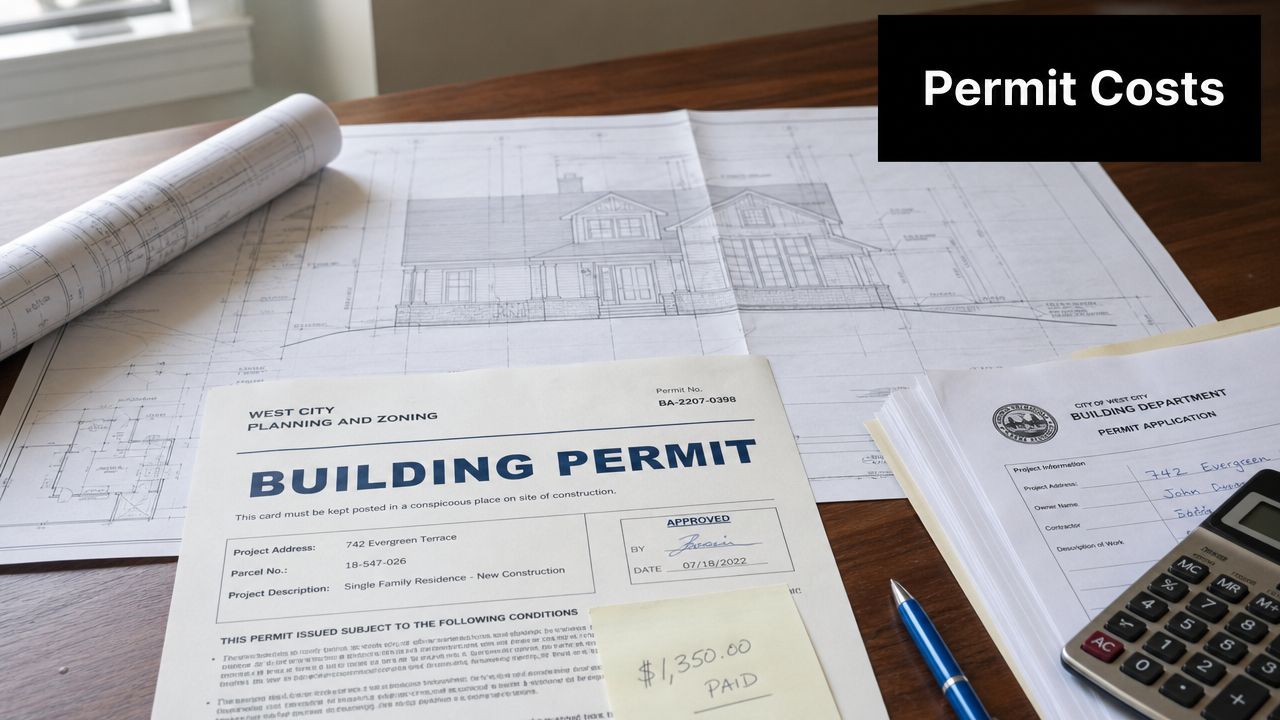
In Cambridge, generic prefab pricing breaks down fast because the module may be standardized, but the property never is. A tight driveway, a narrow side yard, an old sewer line, or a foundation design change can add real money before the unit is ever delivered. That is the gap many prefab manufacturers leave out. They sell the box. Someone local still has to make that box work on your parcel.
Where Cambridge site costs usually increase
Access is often the first problem. Many Cambridge lots have limited staging space, fences close to lot lines, overhead wires, mature trees, and neighboring structures that leave very little room for delivery and crane work. If the set crew cannot reach the backyard cleanly, the installation plan gets more expensive and sometimes forces design changes.
Utility connections are the next place budgets shift. The ADU still needs water, sewer, electrical service, and often gas or HVAC coordination, depending on the design. On older properties, those connections are not always simple tie-ins. We regularly find aging service lines, unexpected depth changes, or drainage issues that require additional excavation and inspections.
Then there is the ground itself. Parts of Cambridge and nearby towns can bring poor access for equipment, tight excavation conditions, or foundation coordination issues that do not show up in a prefab brochure. If grading, tree protection, or stormwater handling enters the picture, the site budget climbs for a reason. The work protects the structure and keeps the project approvable.
What the permit process actually covers
A prefab ADU does not arrive pre-approved for your lot. The manufacturer may provide drawings for the unit, but the city reviews the full project as it will sit on your property, with local zoning, foundation details, utility plans, and code requirements all accounted for.
That review can involve more than one department. Zoning, building, utilities, engineering, and in some cases historic or neighborhood review can all affect the approval path. In Cambridge, that local coordination matters as much as the unit itself because one revision in setbacks, lot coverage, or placement can affect the foundation layout, utility routing, and delivery plan.
For Cambridge homeowners planning an ADU, this local Cambridge ADU planning and construction guide is a practical reference because it focuses on permit and construction conditions specific to the area.
Costs homeowners tend to miss
These are the items that get left out of early prefab pricing conversations:
- Survey and plot verification: Needed to confirm setbacks, placement, and existing site conditions.
- Foundation and excavation work: Includes digging, forming, concrete, and any soil or access complications.
- Utility trenching and tie-ins: Water, sewer, electrical, and service upgrades can add up quickly.
- Drainage and site restoration: Regrading, walkways, fencing, and repairing disturbed areas are part of the finished job.
- Permit revisions and coordination time: Changes during review can trigger updated drawings or added professional fees.
- Delivery logistics: Street access, crane setup, traffic control, and staging restrictions can affect installation cost.
Those are not surprise charges in the bad sense. They are normal project costs that need to be priced accurately from the start.
Homeowners should also check how a contractor manages liability during excavation, crane work, and subcontractor coordination. This overview of commercial insurance for contractors is useful if you want to know what coverage to ask about before work begins.
What to Expect A Realistic Prefab ADU Timeline
The timeline people hear in prefab marketing is usually the factory timeline. The project timeline is longer because the lot, permits, and final inspections still happen on site.
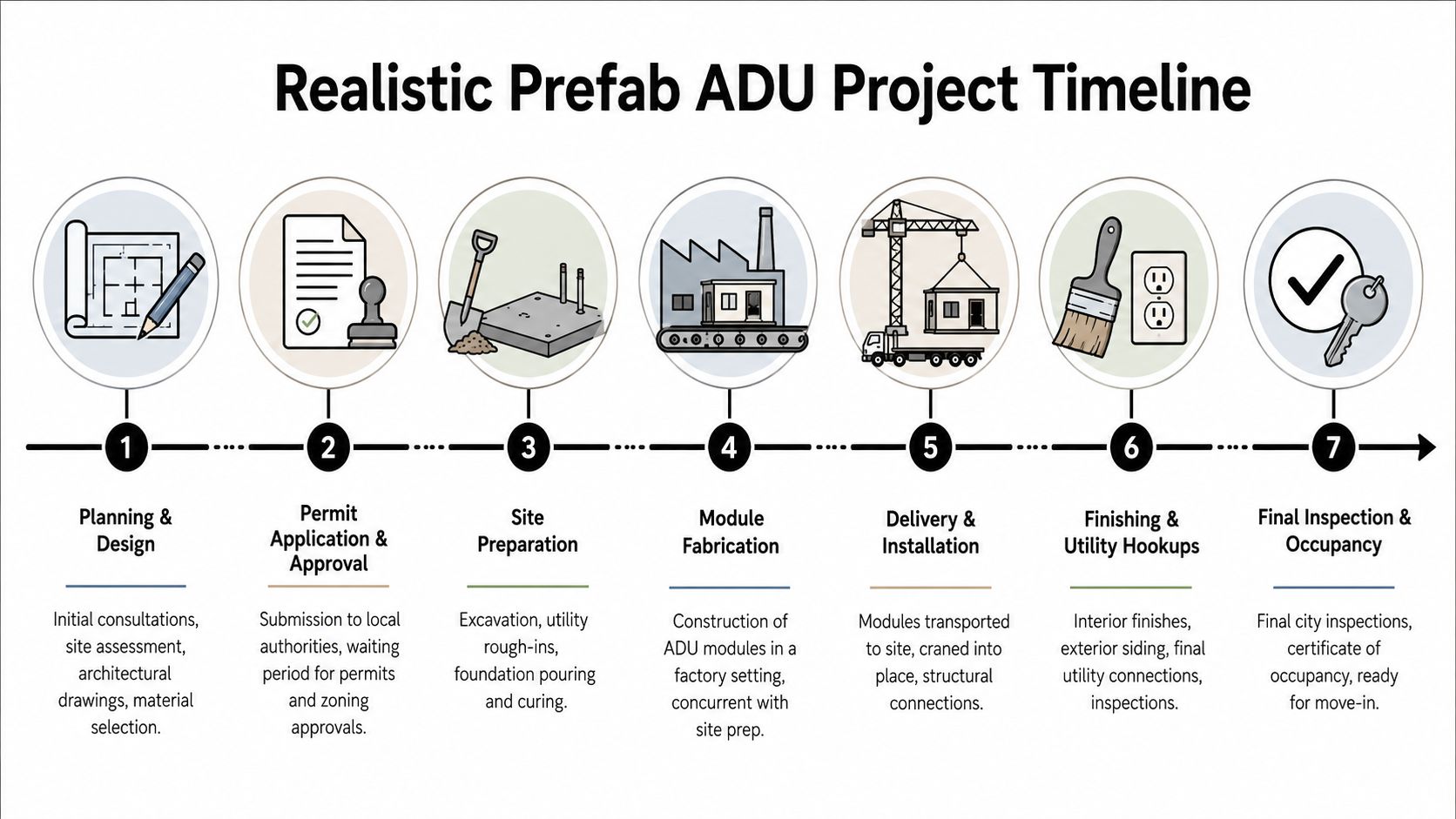
The factory build is only one phase
A realistic prefab ADU schedule in Massachusetts usually moves through these stages:
Planning and design
Site review, model selection, code review, and engineering coordination happen first.Permit application and approval
Local review can take time, especially if revisions are required.Site preparation
Excavation, layout, utility rough-ins, and foundation work need to be completed correctly before delivery.Module fabrication
This can happen while site work is moving, which is one of prefab's real advantages.Delivery and installation
The set day is dramatic, but it's just one part of the job.Utility hookups and finish work
Button-up work, inspections, and final corrections still need trade coordination.Final inspection and occupancy
The project isn't done until local approvals are complete.
What slows projects down
The biggest schedule issue isn't usually the module production itself. It's coordination. If survey information comes in late, utility routing changes, or a permit reviewer asks for revised plans, the project shifts.
Weather also affects site work even if the unit is built indoors. Foundation work, trenching, drainage corrections, and final exterior restoration still depend on field conditions.
Homeowners should plan around the full sequence, not the crane day.
For a broader look at how remodeling schedules really unfold across additions and major renovations, this home remodel timelines guide helps set expectations for permitting, inspections, and trade sequencing in Massachusetts.
FAQs About Prefab ADU Costs in Massachusetts
Is a prefab ADU cheaper in Massachusetts
A homeowner in Newton might see a prefab unit online and assume the budget is mostly settled. Then the actual work begins. Survey work, foundation design, utility routing, crane access, and town review all sit outside the glossy base price.
Prefab can cost less than stick-built construction on the right property. The savings are usually modest, and they depend on a simple site, clean access, short utility runs, and a permit path that does not force redesign. In Greater Boston, those conditions are not guaranteed.
That is why I tell homeowners to judge prefab by the installed cost, not the factory quote. On a flat lot with good backyard access, prefab can be a smart way to control schedule and labor. On a tight Cambridge or Somerville lot, the field work can eat up the expected savings fast.
What are the most common hidden costs
The biggest surprise is how much of the project happens before and after the unit arrives.
A manufacturer may price the structure itself. The homeowner still has to pay for the work that makes that structure legal, serviceable, and buildable on a Massachusetts property. For many projects, that is where the budget gets out of line.
The costs that catch people off guard most often are:
- Foundation and engineering: The unit still needs a code-compliant foundation designed for the soil conditions and the module load.
- Utility work: Water, sewer, electric, and sometimes gas need real field pricing. Older neighborhoods around Boston often mean congested utility paths and dated existing services.
- Permit and design revisions: Town comments can trigger updated drawings, added engineering, or coordination with local boards.
- Delivery and crane logistics: Street occupancy permits, police details, staging space, and access protection are not usually part of the advertised prefab number.
- Site restoration: Fences come down, lawns get torn up, walks crack, and drainage sometimes needs correction after trenching and installation.
Those are not fringe items. They are standard project costs.
Can I act as my own general contractor
You can, but it is harder than it looks on paper.
A prefab ADU still needs someone to line up surveyors, excavators, concrete crews, electricians, plumbers, inspectors, delivery timing, and manufacturer coordination. In Greater Boston, one missed step can delay several trades because access is tight, permit windows are narrow, and older houses rarely match the original record drawings.
Some homeowners are comfortable managing pieces of that work. The problem is not effort alone. It is pricing accuracy and sequencing. If the foundation is poured before utility elevations are confirmed, or the crane plan changes after permit review, the savings from self-managing disappear quickly.
Will a prefab ADU affect property taxes
Usually, yes.
If you add legal habitable space with permanent utilities and a foundation, the town may reassess the property after completion. How much that changes the tax bill depends on the local assessor and the final scope of work.
Builders can explain what is being added to the property. The assessor or a tax professional should answer the tax question itself. That conversation is worth having early, especially in towns like Brookline, Newton, and Wellesley where assessed values are already high.
How do I get a realistic budget before choosing a model
Start with the lot.
The right order is simple:
- Confirm zoning and use rules for the property.
- Check site access for excavation, delivery, and crane setup.
- Trace the utility runs from the existing services to the ADU location.
- Match the module to a real foundation plan instead of a generic allowance.
- Price the full installed job with permits, site work, and restoration included.
That is how homeowners get a number they can trust. A catalog price is only a starting point. A site-based budget is what tells you whether prefab makes sense for your property in Massachusetts.
The First Step to an Accurate ADU Budget
The first useful step isn't choosing a floor plan. It's getting the property evaluated by someone who understands how prefab and local construction meet on site.
A prefab ADU can be a smart solution in Belmont, Medford, Cambridge, or Newton. But accurate budgeting depends on three things. Whether the lot can support the install efficiently. Whether the town will approve the project as planned. Whether the utility and foundation scope fits the assumptions built into the manufacturer's quote.
What a useful first meeting should cover
A serious planning conversation should answer these questions:
- Can the unit reach the backyard? Delivery access and crane setup need to be realistic.
- What does the town require? Zoning review and permit path should be discussed early.
- Where do utilities connect? The shortest route isn't always the buildable route.
- What scope is excluded from the prefab quote? Homeowners need to see the whole budget, not just the shell.
- How will the addition be treated financially later? For owners considering rental use, this breakdown of VerticalRent's tax deduction advice is a useful resource for understanding how improvements are generally categorized.
We handle this kind of planning work regularly as part of ADU and remodeling projects across Greater Boston, alongside related work like basement finishing Cambridge MA and bathroom renovation Arlington MA, because the same rule applies across all of them. The hidden cost is usually in the conditions you don't see until someone walks the site carefully.
A budget gets more accurate when the assumptions get more local.
If you're planning an ADU in Cambridge, Arlington, Newton, Belmont, Medford, or nearby Greater Boston towns, contact Aureli Construction for a free estimate. We'll review your site, talk through permits and construction constraints, and help you price the full project instead of just the prefab unit.