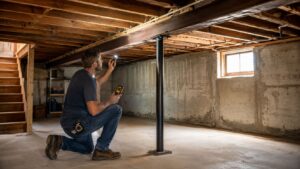
In Arlington, MA, this comes up all the time. A homeowner is ready to build an addition, convert space for family, or start an ADU plan, and then someone says they need a soil report before the permit set can move forward.
That catches people off guard because they assume actual costs start with framing, concrete, or finish selections. In practice, soil testing cost is often one of the first pre-construction expenses that affects foundation design, permit approval, and the overall project budget.
For major structural work in Greater Boston, what's under the house matters as much as what we build above it. If the ground conditions are uncertain, the right test up front saves redesigns, delays, and avoidable foundation problems later. Homeowners don't need to become geotechnical experts, but they do need to understand why this step shows up so early in the process, especially under Massachusetts code and local permit review. If you're trying to make sense of that sequence, this overview of the permitting process in Massachusetts helps put the soil work in context.
Table of Contents
- Understanding Soil Testing for Your Greater Boston Project
- Why Soil Testing Is Often Required for MA Home Additions and ADUs
- Decoding Soil Test Types Geotechnical vs Fertility Tests
- The Real Soil Testing Cost in Greater Boston
- How We Streamline the Soil Testing Process
- Frequently Asked Questions About Massachusetts Soil Testing
Understanding Soil Testing for Your Greater Boston Project
In Belmont, Cambridge, and Somerville, we see the same pattern. A homeowner starts with a straightforward goal, maybe a rear addition, a new foundation for an ADU, or a basement project that needs structural work. Then the engineer asks for soil information because no one wants to guess at bearing conditions, drainage behavior, or groundwater issues.
That's normal. It's also necessary.
A construction soil investigation isn't a landscaping extra. It's part of responsible pre-construction planning when the project depends on new footings, foundation walls, slabs, or excavation. Older Greater Boston lots can have fill, inconsistent soils, tight access, and site conditions that vary even from one side of a yard to the other.
Practical rule: If your project changes the structure below grade or adds a new load to the ground, assume soil review may be part of the path to permit and engineering sign-off.
The main reason homeowners get confused is that “soil testing” covers very different services. One version is inexpensive and garden-oriented. The other is tied directly to structural design and permit review. That difference is where budget questions start.
Why Soil Testing Is Often Required for MA Home Additions and ADUs
In Newton, Cambridge, and other Greater Boston communities, soil testing often isn't optional once a project involves a new foundation. Under the Massachusetts State Building Code, 780 CMR, foundation design has to match actual site conditions. Building departments, structural engineers, and plan reviewers don't want assumptions when a home addition, detached structure, or major excavation is involved.
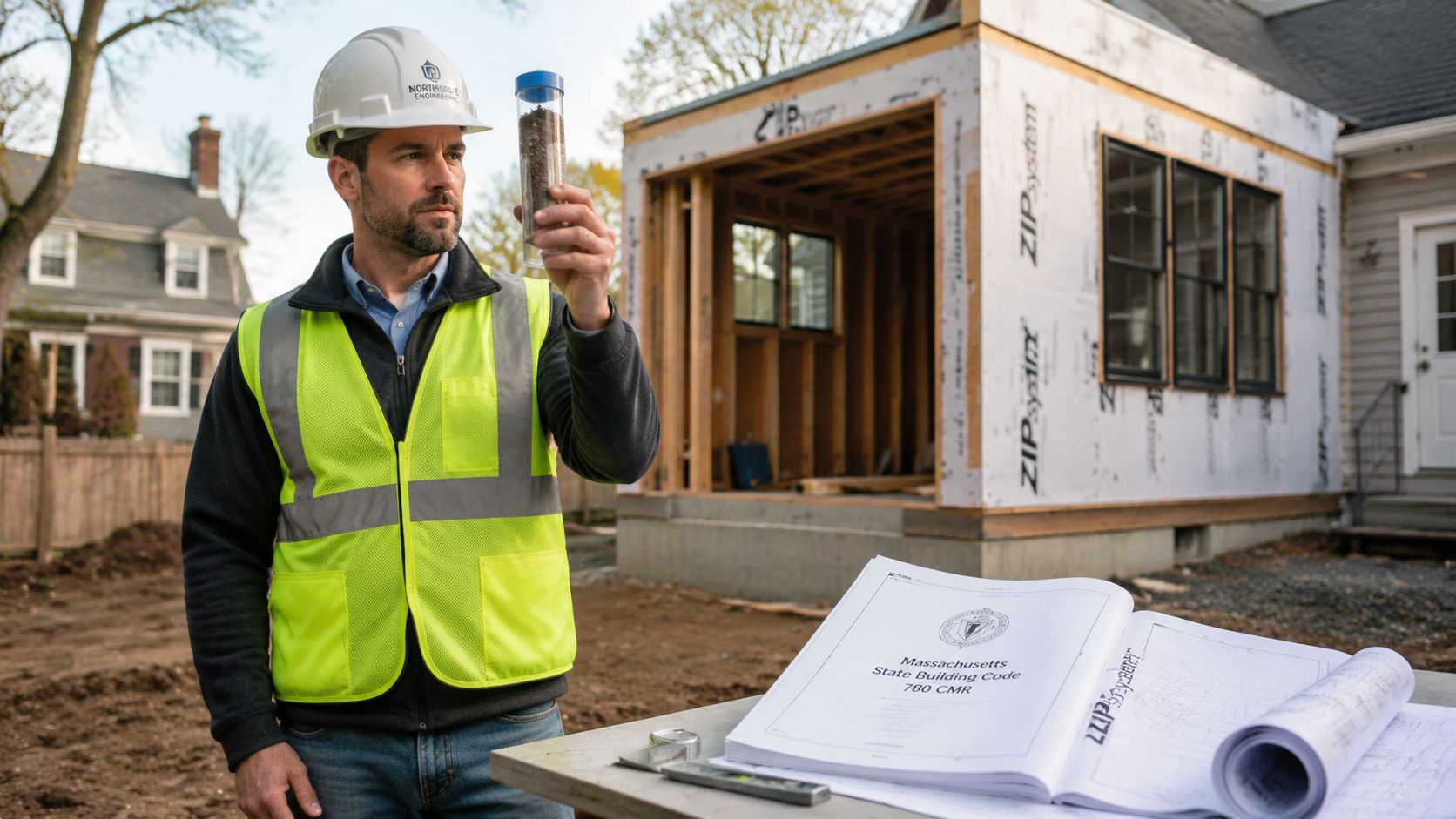
When the permit trigger usually happens
For a kitchen remodel in Arlington or bathroom renovation in Medford, you usually won't need a geotechnical report unless the job includes substantial structural changes, new foundation work, or significant excavation. For a home addition, basement underpinning, detached garage conversion, or an ADU in Massachusetts, the chance of needing soil information goes up quickly.
Local zoning and planning rules decide where and what you can build. The building permit process decides whether the structure is adequately designed for that site. Those are two different filters, and homeowners often run into both.
Why costs rise when the code questions get more technical
Once the project team needs more than basic soil classification, the price can jump because the tests themselves are more specialized. Some university labs charge $95 for CEC/exchangeable cations, $115 for permeability-class testing, and $200 per hour for special reporting requirements, according to Missouri Extension's soil testing fee schedule. That's not a Massachusetts permit fee schedule, but it clearly shows how method complexity, not just sample count, affects testing cost.
If the report has to answer a code or engineering question, the fee usually reflects the time needed to produce a defensible answer, not just the act of collecting dirt.
A related issue in some suburban settings is septic design. There, a perc test can become part of the approval path because drainage and absorption matter for system design. Different project, same principle. The town wants proof that the site can support the proposed work.
Decoding Soil Test Types Geotechnical vs Fertility Tests
Homeowners often compare the wrong things. They'll see a garden soil test online and wonder why a builder or engineer is talking about a much larger pre-construction number. These are not the same service.
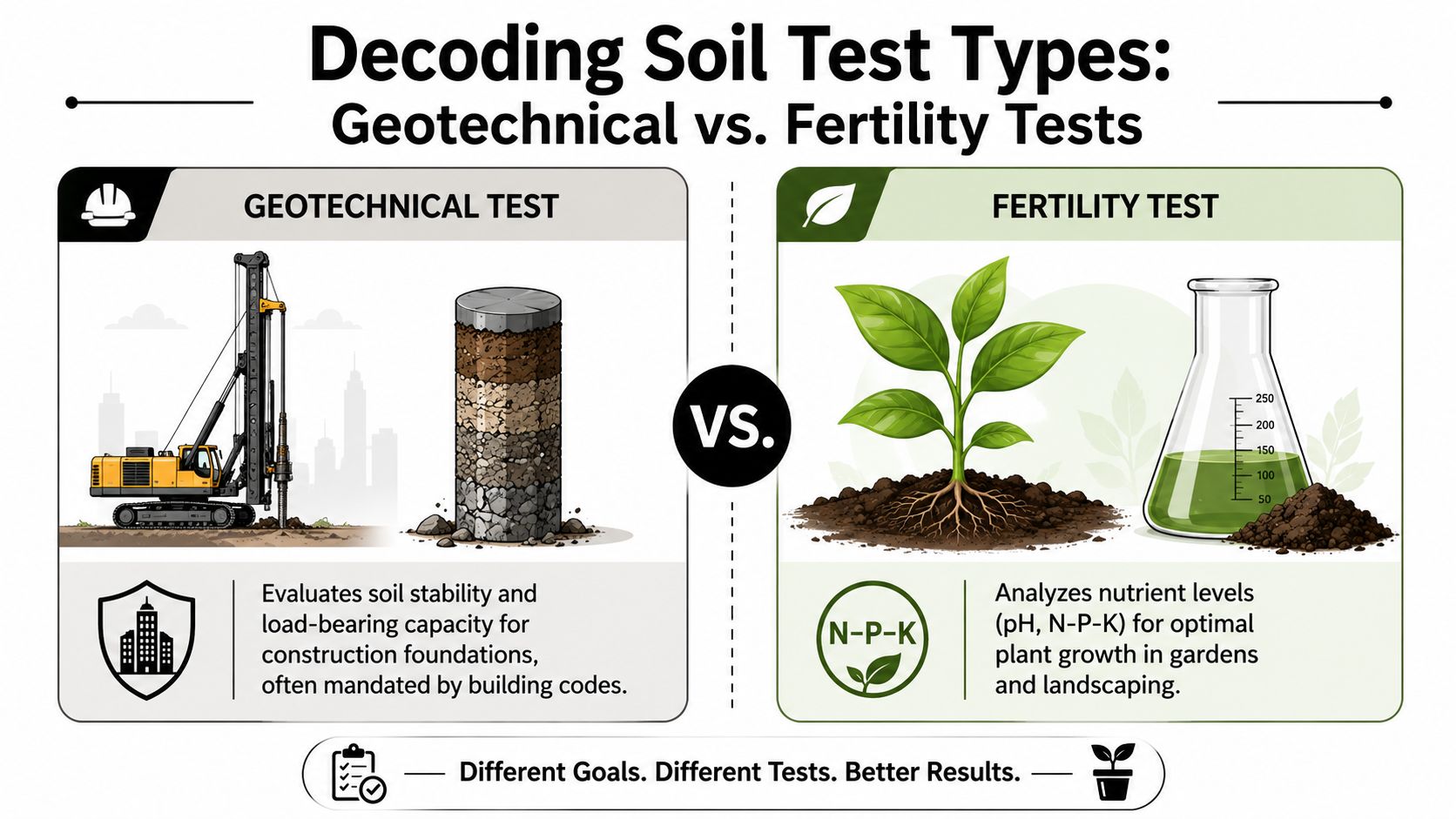
A fertility test is for growing things. A geotechnical test is for supporting a structure. One tells you what the soil needs. The other tells the engineer what the foundation needs.
What a basic fertility test does
The USDA NRCS has long described routine soil tests as costing $7 to $10 per sample for basic nutrient analysis, while noting that some public programs offer the test free and private labs often charge in that same range for standard packages, as outlined in this USDA NRCS soil testing guide. That baseline usually covers common fertility indicators such as pH and core nutrient values.
That's useful for lawns, gardens, and planting plans. It's not what a structural engineer needs to size footings for an addition in Lexington or an ADU slab in Brookline.
What a geotechnical investigation does
A geotechnical investigation is closer to a medical workup than a garden checkup. The team may perform borings, log soil layers, collect samples at depth, review groundwater conditions, and issue a report that the design team uses for foundation recommendations.
That report can affect:
- Footing design for additions and new structures
- Excavation planning where access is tight or neighboring structures are close
- Drainage and waterproofing decisions for below-grade work
- Structural review during permit submission under 780 CMR
Later site work also depends on understanding how the ground behaves under load. If you want a practical field explanation of compaction and why subgrade prep matters, this article on compacting soil for driveways is a useful reference.
For projects that change the footprint of the house, this is one reason planning has to start before excavation. It's the same logic behind a well-run home addition project in Greater Boston. The structure is only as reliable as the assumptions under it.
A quick visual helps make that distinction clearer:
The Real Soil Testing Cost in Greater Boston
Here's the part homeowners want. What does soil testing cost when you're building in Cambridge, Belmont, Newton, or elsewhere around Boston?
The honest answer is that the price range is wide because the word “soil test” covers everything from a simple composition check to a full geotechnical investigation tied to foundation design. HomeAdvisor reports that a simple soil composition test may run $600 to $675, the national average for more detailed soil testing is $1,382, and most homeowners pay between $652 and $2,112. It also notes that more extensive geotechnical testing can reach $1,000 to $5,000 depending on scope and depth, as summarized in this HomeAdvisor soil testing cost guide.
Typical cost table for Greater Boston planning
Those national figures are a useful frame, but Boston-area planning still depends on site conditions, access, and engineering scope. In practice, homeowners should read proposals by scope, not just by headline number.
| Test Type | Typical Project | Greater Boston Cost Range | What It Determines |
|---|---|---|---|
| Basic fertility lab test | Garden, lawn, planting plan | At the low end of the market, often similar to routine public or university lab pricing | Nutrient levels, pH, baseline soil chemistry |
| Simple composition test | Early planning for limited site questions | Often aligns with the lower end of professional consumer pricing | Basic soil makeup and surface-level composition |
| Geotechnical investigation | Addition, ADU, new foundation, major excavation | Commonly falls into the higher professional testing tier for structural work | Bearing conditions, subsurface layers, groundwater-related concerns, foundation recommendations |
| Expanded site investigation | Larger lots, difficult access, uncertain subsurface conditions, environmental concerns | Can rise well beyond standard residential testing scope | Broader geotechnical and site-risk analysis |
What changes the number
Three things usually move the quote.
First, how many borings and how deep they need to go. A compact site with a straightforward addition is different from a project with deeper foundation questions.
Second, site access. A tight urban lot in Somerville or Cambridge can make equipment access harder than an open yard in Burlington or Wellesley.
Third, reporting requirements. If the engineer has to coordinate more closely with the structural design, answer additional permit comments, or respond to unusual findings, the fee follows the workload. That's why smart planning matters. Good estimating starts with scoping the work correctly, not chasing the cheapest line item. For a broader perspective on pre-construction planning, these BIM Heroes construction cost strategies are worth a read.
If you're budgeting a larger project, it also helps to compare the soil investigation against the full job cost, not in isolation. This Greater Boston home addition price guide gives useful context for where pre-construction expenses sit inside an overall addition budget.
How We Streamline the Soil Testing Process
Most homeowners don't want to chase engineers, labs, borings, and permit comments. They want one coordinated process. That's the right approach.
For projects in Arlington, Lexington, Medford, and surrounding towns, we typically coordinate the soil testing step alongside the design and permitting workflow. The geotechnical engineer needs the proposed footprint, likely load locations, and access plan so the borings happen in the right places. If that coordination is sloppy, the report may be less useful and the design team can end up revisiting work.
What good coordination looks like
We treat soil investigation as part of pre-construction management, not as a disconnected vendor task.
- Site review first so the engineer understands the actual constraints
- Plan sharing early so boring locations match the proposed structure
- Report translation so the homeowner gets clear implications, not just technical language
- Permit coordination because building departments may want the findings reflected in the structural set
A good soil report doesn't just sit in a file. The design team uses it to make better foundation decisions before concrete is ordered.
Even estimating tools have improved how contractors organize these early-stage decisions. If you're curious how firms structure pricing and scope during pre-construction, this guide to contractor estimating software gives a good behind-the-scenes look at the process mindset.
Frequently Asked Questions About Massachusetts Soil Testing
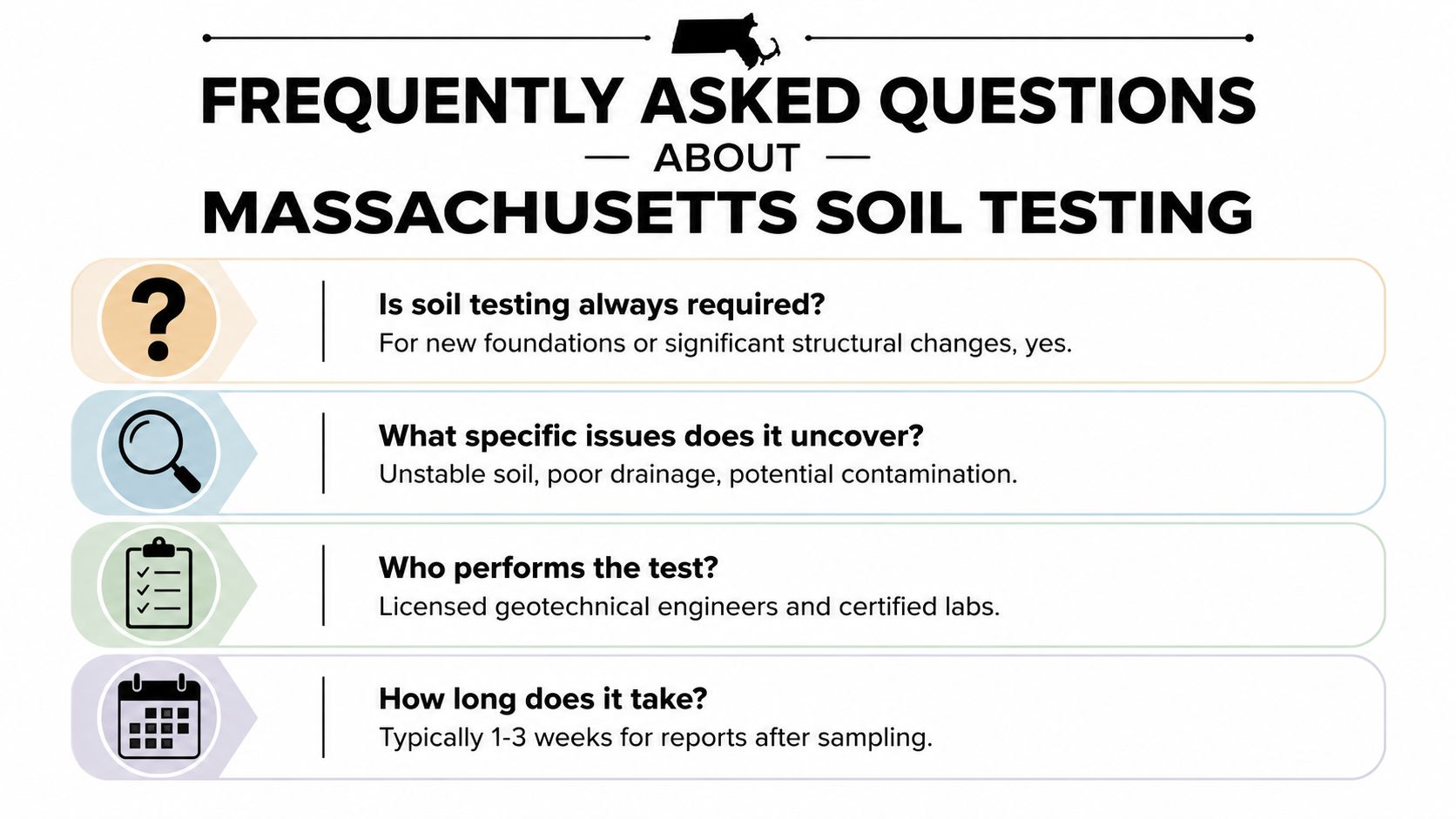
Is soil testing always required for a remodel?
No. For many interior projects, like a kitchen remodel Greater Boston homeowners are doing inside the existing footprint, soil testing usually doesn't enter the picture. It becomes much more relevant when the project includes a new foundation, excavation, underpinning, or another structural change that transfers load to the ground.
What if the report shows poor soil or water issues?
That doesn't always stop the project. It usually means the structural and foundation design needs to respond to actual site conditions. The point of the report is to catch that before construction starts, when changes are still manageable on paper.
Are there hidden costs beyond the testing fee?
Yes. University and extension labs often price basic tests at $11 to $30 plus mailing, but that excludes sample collection, rush processing, and professional interpretation, according to the University of Maryland Extension overview of soil testing labs. For a construction project, the all-in number matters more than the base lab fee because the engineer's time and report are what drive decisions.
Does soil testing slow the project down?
It adds a step, but it usually prevents larger delays later. If a permit reviewer or structural engineer asks for soil information after plans are already moving, that late request is more disruptive than handling it early.
Do small projects like bathroom renovation Arlington MA or basement finishing Cambridge MA need this?
Sometimes, but not by default. If the work stays within the existing structure, the answer is often no. If the basement project involves new underpinning, slab work, or significant below-grade structural changes, then soil and groundwater conditions can become important fast.
Ready to get started? Contact Aureli Construction for a free estimate and clear guidance on additions, ADUs, basements, kitchens, and bathroom projects across Greater Boston.