
In Cambridge, we see a lot of homeowners doing the same thing before a kitchen remodel. They save screenshots, search kitchen backsplash ideas images late at night, and end up with a folder full of beautiful photos that don't answer the practical questions. Will this material hold up behind the range, will it work with our cabinets, and will the town inspector have an issue once walls get opened up?
That gap matters in Greater Boston. A backsplash isn't just decoration in an older Arlington triple-decker, a Belmont colonial, or a Somerville condo kitchen with limited wall space. It has to handle steam, grease, cleaning, and sometimes permit review if the remodel includes electrical work, wall repair, or triggers parts of the MA State Building Code and 780 CMR. In many local remodels, especially around outlets, cooktops, and patched plaster walls, the right finish depends just as much on substrate prep and code-smart installation as the tile itself.
Images are still useful. They help narrow down style fast, especially if you're using design visualizer tools to compare cabinet colors, counters, and tile layouts before buying materials. But the best backsplash choices are the ones that look good in photos and still make sense in a real Massachusetts kitchen.
Below are the backsplash styles we recommend most often, along with where they work, where they don't, what they cost in the Boston area, and the practical trade-offs homeowners should know before they commit.
Table of Contents
- 1. Classic Subway Tile Backsplash
- 2. Marble or Natural Stone Backsplash
- 3. Glass Tile Backsplash
- 4. Mosaic and Mixed-Material Backsplash
- 5. Shaker or Beadboard Backsplash
- 6. Hexagon and Geometric Tile Backsplash
- 7. Stainless Steel and Metal Backsplash
- 8. Hand-Painted or Mural Backsplash
- 10. Zellige or Handmade Cement Tile Backsplash
- 10. Zellige or Handmade Cement Tile Backsplash
- Top 10 Kitchen Backsplash Ideas Image Comparison
- Final Thoughts
1. Classic Subway Tile Backsplash
Subway tile is still one of the safest choices if you want a kitchen that won't feel dated in a few years. In our kitchen remodel Greater Boston projects, it works in older homes and newer additions because it's simple, easy to clean, and flexible with almost any cabinet style.
For local homeowners comparing kitchen backsplash ideas images, this is usually the reference point. White, cream, and soft gray subway tile can support a quiet kitchen or act as a backdrop for stronger countertops, painted islands, and warmer wood tones.
Why it still works in Arlington MA and Medford kitchens
In Arlington, Belmont, and Medford, a lot of kitchens have mixed conditions. Some walls are old plaster, some are recently patched drywall, and some have uneven corners that show every mistake. Subway tile is forgiving. It also lines up well with outlets and under-cabinet lighting, which helps keep labor straightforward.
We usually recommend ceramic or porcelain here because they're among the most code-compliant and durable backsplash materials for Greater Boston kitchens, especially in brick, square, octagon, and other geometric forms under 780 CMR Chapter 12 considerations for fire resistance and moisture control in high-use areas, as discussed in this overview of recommended backsplash materials.
Practical rule: If you want a backsplash that looks clean for years, spend as much attention on grout and layout as you do on tile color.
Installed pricing in the Boston area typically lands around $15 to $25 per square foot for straightforward subway tile work. If you move to epoxy grout, expect an added premium, but we still like it for busy family kitchens because it resists staining better than standard cement grout.
A few combinations that consistently work:
- Bright white field tile: Good for a contemporary Somerville kitchen with white cabinetry and light quartz.
- Cream tile with charcoal grout: Strong fit for a classic Newton kitchen with warmer finishes.
- Soft gray offset tile: Works well in a Lexington kitchen with stainless appliances and neutral stone counters.
For grout decisions, we tell clients to look at how to pick grout color before they lock anything in. White-on-white feels crisp but shows neglect faster. A soft gray grout line usually ages better.
2. Marble or Natural Stone Backsplash
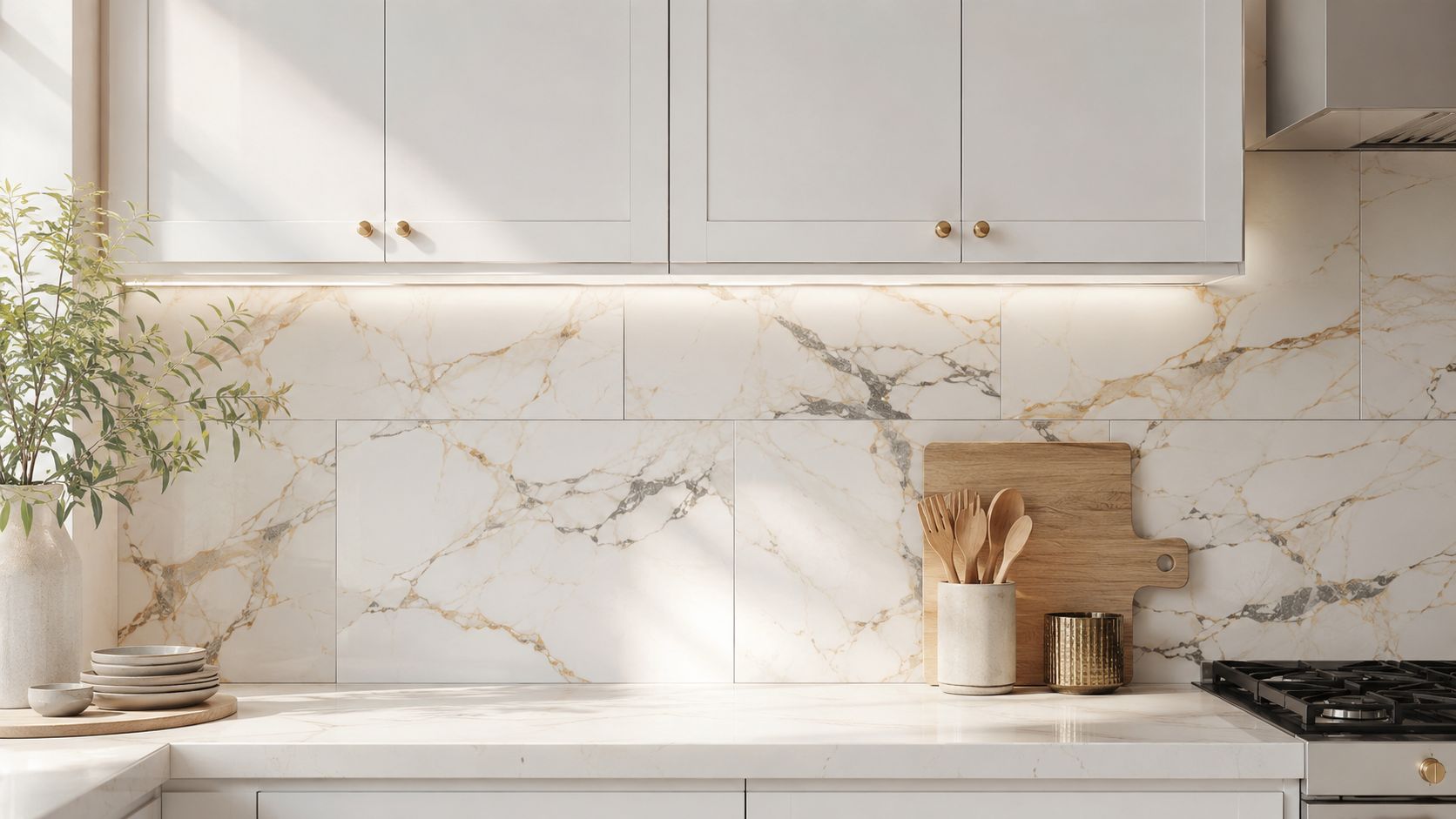
Stone gives a kitchen immediate weight. When a homeowner in Brookline, Newton, or Wellesley wants a backsplash to feel custom instead of standard, marble, travertine, limestone, slate, and granite usually come up first.
The upside is obvious. You get natural veining, movement, and variation that factory tile can't fake. The downside is also obvious once the kitchen is in use. Stone needs maintenance, and some homeowners like the lived-in character more than others.
Where we use stone in Brookline MA and Wellesley kitchens
We typically use stone backsplashes when the rest of the kitchen is restrained. Flat-panel cabinetry, simple hardware, and quieter wall colors help the material do the work. A honed finish is usually the smarter choice than polished because it hides fingerprints and water marks better.
Installed cost in Greater Boston is commonly around $30 to $60 or more per square foot, depending on the stone and the layout. Sealing matters. Natural stone should be professionally sealed before use and maintained on an ongoing basis, especially where cooking oils, tomato sauce, lemon, vinegar, and wine are part of everyday life.
For design direction, the strongest pairings we see are:
- Honed Calacatta marble: Best when the wall itself is supposed to read as the feature.
- Slate in mixed grays and blacks: Strong with walnut cabinets and darker floors.
- Travertine with subtle veining: Good in transitional or Mediterranean-leaning kitchens.
In kitchens with darker cabinetry, stone can either sharpen the contrast or soften it depending on the slab and finish. We often walk clients through examples like the ones shown in kitchen backsplash ideas with dark cabinets because cabinet color changes how the veining reads.
3. Glass Tile Backsplash
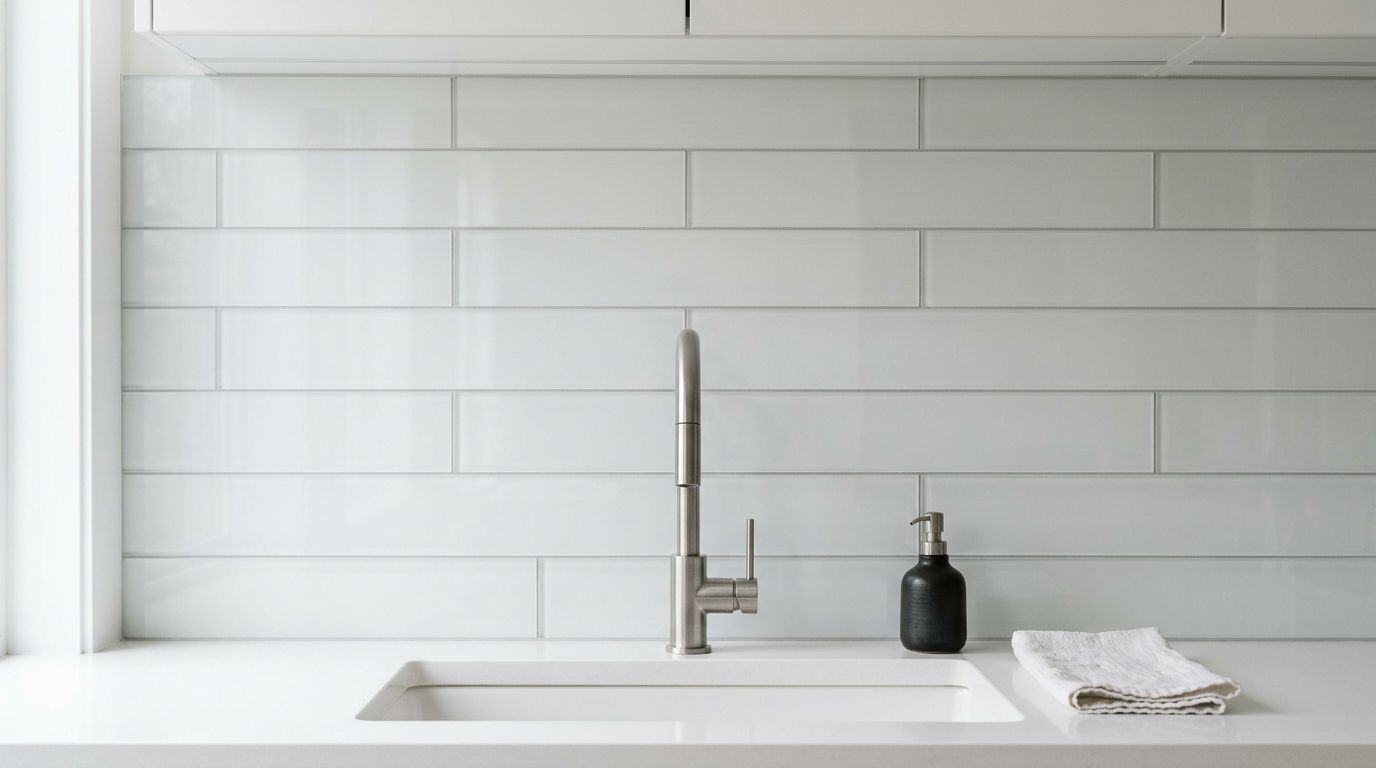
Glass tile is one of the easiest ways to brighten a compact kitchen. In Cambridge condos, Arlington capes, and Medford remodels where natural light is limited, it reflects more light than ceramic and can make the room feel more open.
It also cleans easily because the surface is non-porous. That's the main practical advantage. The trade-off is that installation has to be cleaner and more precise. Glass shows thinset inconsistencies, chipped cuts, and sloppy grout work fast.
Best use cases in Cambridge MA remodels
We recommend frosted or lightly textured glass more often than clear glass. It hides fingerprints, dust, and haze better, and it feels less fussy once the kitchen is lived in. Larger formats also help because they reduce grout lines.
Installed cost commonly runs about $20 to $35 per square foot. We also like a waterproofing membrane behind the assembly in splash-heavy zones, especially around sinks and in older homes where wall conditions aren't ideal after demolition.
Glass looks best when the wall behind it is prepped right. Any hump, dip, or rough patch telegraphs through the finish.
Good applications include:
- Frosted white glass with light gray grout: Clean fit for a bright Cambridge kitchen renovation.
- Blue-green iridescent mosaic: Better as a focal area than an entire wall.
- Large-format clear or frosted glass: Strong in minimalist kitchens with flat-front cabinets.
For homeowners looking at sheet glass or fixed splash protection instead of tile modules, there are some useful examples of expert fixed glass installations that show how clean the look can be when details are handled properly.
4. Mosaic and Mixed-Material Backsplash
Kitchen backsplash ideas images can get people into trouble. Mosaic and mixed-material backsplashes photograph beautifully, but they're hard to execute well. The difference between custom and cluttered usually comes down to restraint, material thickness, and whether the installer has real tile experience.
In Newton, Somerville, and Belmont, we use mosaic most often as a feature rather than a full-room finish. That keeps it from taking over the kitchen and keeps cleaning manageable.
How we keep custom patterns from looking chaotic
The material mix matters. Glass, stone, brass, ceramic, and mirror can work together, but only if the scale and sheen are controlled. When every tile tries to be the star, the whole wall gets noisy.
Installed pricing is usually around $25 to $50 or more per square foot depending on material mix and pattern complexity. Labor can be the biggest driver because hand-set layouts and irregular pieces take time.
The combinations that usually land best are:
- Sea glass, stone, and subtle mirror accents: Better in a contained backsplash zone than a whole perimeter wall.
- Small geometric tile in blue, white, and gray: Works when cabinets are simple and counters are quiet.
- Terracotta with brass and glass accents: Good for a traditional home that needs warmth.
Before installation starts, we want a drawing, board, or full mockup. Mid-project design changes are expensive and frustrating for everyone.
A quick visual reference helps show how layout complexity affects the final look:
5. Shaker or Beadboard Backsplash
Wood backsplash can look great in the right place. It adds warmth fast, especially in Reading, Wakefield, and Arlington kitchens where homeowners want a farmhouse or cottage feel without turning the room into a theme.
What it doesn't do well is handle direct heat and heavy cooking splash behind a range. That's where people often choose it from photos, then regret it once the kitchen starts working hard.
Where wood backsplash works and where it should stop
We like beadboard or shaker-style paneling in lower-risk areas. Behind open shelves, along a coffee station, or on a short wall away from the cooktop, it can be a good fit. Directly behind a range, we usually switch to tile, metal, or another more resilient finish.
Local installation cost often falls around $15 to $35 per square foot depending on the panel product and finish work. The protection system matters as much as the panel itself. We want proper substrate prep, a sealed surface, and trim details that don't leave raw edges exposed to moisture.
A few approaches that work:
- Painted white beadboard: Strong in a Wakefield farmhouse kitchen with open shelving.
- Soft sage shaker-style paneling: Good in a Reading kitchen with bronze or antique brass hardware.
- Natural wood beadboard: Works when the rest of the kitchen is simple and balanced.
Don't let a pretty image talk you into wood directly behind a high-output range. It's the wrong place for that material in most working kitchens.
If the project includes outlet relocation, wall repair, or broader remodeling work, backsplash installation can also trigger permit and code review in Massachusetts, especially under the MA State Building Code and local enforcement practices in towns like Cambridge and Arlington, as covered in this Massachusetts backsplash and code discussion.
6. Hexagon and Geometric Tile Backsplash
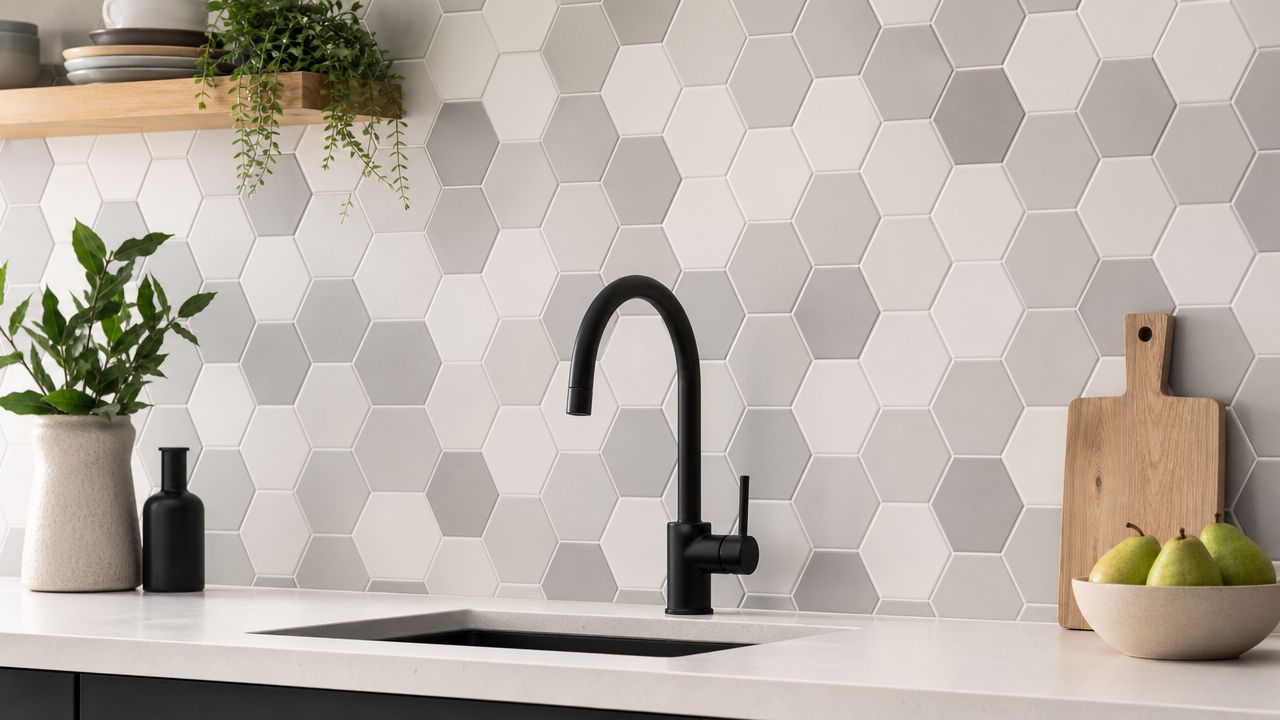
Geometric tile is popular for a reason. It adds motion without needing strong color, and it can make a simple kitchen feel more finished. In Lexington, Brookline, and Cambridge, we use hexagons, chevrons, and other patterned tile when the homeowner wants more energy than subway tile but doesn't want a mural or a bold material mix.
The catch is alignment. If the layout starts drifting, the whole wall looks off. This is not the place to cut corners on installation.
Geometric tile in Lexington MA and Cambridge kitchens
Installed cost usually lands around $20 to $40 per square foot depending on material and pattern complexity. We often advise limiting the pattern to the main focal area and keeping the rest of the kitchen quieter.
That approach works especially well in:
- White hex tile with light gray grout: Clean option for a modern Cambridge kitchen.
- Chevron in mixed grays: Strong fit in a contemporary Lexington remodel.
- Honeycomb mosaic in soft blue and white: Useful when a Brookline kitchen needs color without too much visual weight.
In design trend terms, this fits the broader move toward statement kitchen tiles, fluted ceramics, geometric relief patterns, and dimensional surfaces that add movement and depth, while matte finishes remain at the front of 2025 tile direction and high-gloss finishes and overly busy patterns are falling out of favor, as outlined in this roundup of current backsplash trends.
If you're comparing kitchen remodeling Lexington or kitchen renovation Somerville ideas with more classic kitchens, this is usually the midpoint between timeless and trend-driven.
7. Stainless Steel and Metal Backsplash
Metal backsplashes are practical first and stylish second. That's why they work so well for serious cooks. In Medford, Somerville, and Newton, we install stainless panels when homeowners want a cleaner, more professional cooking wall that can handle heavy use.
Solid metal behind the range is one of the easiest surfaces to wipe down. It doesn't ask much from the homeowner except a tolerance for fingerprints and water spots.
What to expect from a professional-style backsplash in Greater Boston
Custom stainless or other metal backsplash installations often run around $30 to $50 or more per square foot. The appeal is durability, sanitation, and the fact that the finish doesn't depend on grout lines.
We generally recommend:
- Brushed finishes: Better than polished for hiding fingerprints.
- Larger custom panels: Cleaner look than small metal tiles.
- Warm balancing materials: Wood shelves, warmer paint, or stone counters keep the kitchen from feeling cold.
There's also a strong design reason this style keeps showing up. The broader market has shifted away from all-white kitchens and toward wood tones, stone elements, earthy hues, and mixing materials like glass, stone, metal, and wood to create one-of-a-kind kitchens, according to this 2025 backsplash trends summary.
For homeowners searching kitchen remodeling Medford, kitchen remodeling contractor Somerville, or custom kitchen Newton inspiration, metal is worth considering if the kitchen is used hard and cleaned often.
8. Hand-Painted or Mural Backsplash
A mural backsplash isn't a standard remodel choice, but in the right kitchen it can be the best part of the room. We see this most often in custom work in Arlington, Belmont, and Cambridge where the homeowner wants something personal instead of a catalog finish.
The challenge is durability. Art in a kitchen has to live with moisture, grease, heat, and cleaning products. If that part gets ignored, the finish won't last.
Planning a custom backsplash with artists and trades
This kind of work needs coordination early. The artist, cabinet layout, outlet placement, lighting, and protective finish all need to be figured out before the wall is final. If we're changing wall surfaces, relocating electrical, or opening up plaster, permitting and inspection can also become part of the process.
Costs vary widely here and are usually quoted by the artist and installer based on scale and complexity. We've seen the best results when the mural is either in a lower-splash zone or protected near the cooktop with a glass panel or another more durable surface.
Good directions include:
- Botanical themes: Great in farmhouse or garden-facing kitchens.
- Geometric painted patterns: Best in modern kitchens with simple cabinets.
- Family or place-based imagery: Strong in custom homes where the kitchen is meant to tell a story.
Most kitchen inspiration galleries skip the local code and installation reality. That's a problem, especially in Greater Boston homes. Many image-heavy idea collections don't explain whether a trendy material is appropriate in heat and moisture zones, and non-compliant backsplash retrofits can add $2,000 to $5,000 after installation in high-cost markets like Lexington or Winchester, as noted in this discussion of the gap between inspiration images and code realities.
10. Zellige or Handmade Cement Tile Backsplash
A lot of Boston-area kitchens look a little too crisp after a full remodel. New shaker cabinets, clean quartz, sharp paint lines. Then the backsplash goes in, and the room still feels flat. Zellige and handmade cement tile solve that problem because the surface has movement, edge variation, and color shift that factory-made tile usually does not.
These materials work especially well in older homes in Cambridge, Somerville, Jamaica Plain, and Arlington, where a perfectly uniform backsplash can look out of place against plaster walls, varied natural light, and original trim details. The trade-off is straightforward. You have to like variation. No installer can make handmade tile look machine-perfect, and trying usually makes the finished wall worse.
Where zellige works best, and where cement tile needs more caution
Zellige is usually the easier fit for a kitchen backsplash. The glazed surface handles splash zones better, and the irregular face gives the wall depth without adding a lot of pattern. We often use it in galley kitchens or smaller Boston kitchens where the backsplash needs character but cannot overpower the room.
Handmade cement tile is different. It is porous, heavier-looking, and better when the kitchen design can support more pattern and maintenance. Behind a prep area or a light-use coffee station, it can be a strong choice. Directly behind a range, it needs careful sealing and realistic expectations about staining, especially in homes that cook often.
In Massachusetts kitchens, substrate prep matters as much as the tile itself. On older exterior walls, we check for uneven plaster, past moisture damage, and spots that need flattening before any tile goes up. Around sinks and heavy splash areas, proper wall protection behind the finish is part of a durable install, not an upgrade. Homeowners looking at encaustic tile applications and maintenance considerations should pay close attention to sealing and long-term cleanup, because that is where many handmade products either hold up well or become high-maintenance.
Installed costs usually land on the higher side because layout takes longer, sorting takes longer, and waste can be higher than expected. In Greater Boston, we usually tell clients to budget more labor for zellige than standard ceramic, and even more for patterned cement tile if the layout has outlets, tight end cuts, or a framed focal area.
A few pairings tend to work well:
- Off-white or sand zellige with soapstone or honed quartz: Good in older New England homes that need texture without more visual noise.
- Green or blue handmade tile with light oak cabinets: Useful when the kitchen needs warmth and color at the same time.
- Patterned cement tile with simple painted cabinetry: Best when the backsplash is meant to be a focal point, not background.
This is one of those backsplash choices that looks great in photos and still needs a practical filter. We recommend it often, but only for homeowners who want character more than uniformity and are comfortable with the cleaning, sealing, and install cost that come with handmade material.
10. Zellige or Handmade Cement Tile Backsplash
If you've been saving kitchen backsplash ideas images lately, you've probably noticed how many of them use handmade-looking tile. That isn't random. In 2025, ceramic tile remained the top choice for kitchen backsplashes, but the look shifted toward handmade finishes, irregular edges, soft matte glazes, and more artisanal texture, which lines up with the continued popularity of statement tile and dimensional surfaces in newer kitchens, according to this market and design overview.
Zellige and handmade cement tile fit that direction perfectly. They have variation, movement, and a less manufactured look that works especially well in Somerville, Cambridge, and Reading kitchens.
Why handmade finishes fit 2025 and 2026 kitchens
These materials are not for homeowners who want every tile to match. Shade variation is the point. Surface waviness is the point. If you want a clean grid with no visual variation, choose porcelain instead.
Installed cost often falls around $30 to $60 or more per square foot, depending on the tile and layout. Labor also matters because every box has variation, and the installer has to work with the material instead of forcing uniformity.
We see the strongest results when handmade tile is paired with:
- Warm wood cabinets: Good contrast with the variation in the glaze.
- Simple stone counters: Lets the wall carry the texture.
- Open shelving or quieter uppers: Keeps the wall visible.
Handmade tile should look intentionally irregular, not accidentally sloppy. There's a difference, and good installation is what makes it clear.
For homeowners drawn to richer cement-based patterns as well, encaustic tiles are worth reviewing before you commit.
Top 10 Kitchen Backsplash Ideas Image Comparison
| Backsplash Style | Implementation Complexity 🔄 | Resource & Cost Requirements ⚡ | Expected Outcomes ⭐📊 | Ideal Use Cases | Key Advantages 💡 |
|---|---|---|---|---|---|
| Classic Subway Tile, Timeless and Budget-Friendly | Low, simple staggered install; most contractors can do it | $15–$25 / sq ft; common ceramic/porcelain; quick install | ⭐⭐⭐, Clean, neutral backdrop; moderate visual impact | First-time remodels; modern or traditional kitchens | Affordable, easy to maintain; use epoxy grout to resist stains |
| Marble / Natural Stone, Elegant and High-Impact | High, skilled stone specialists required; careful handling | $30–$60+ / sq ft; premium materials; requires sealing and skilled install | ⭐⭐⭐⭐, Luxury, unique veining; high perceived value | High-end remodels in Brookline/Newton/Wellesley | Timeless luxury and uniqueness; seal every 12–18 months |
| Glass Tile, Modern, Reflective, Light-Boosting | Medium, fragile, needs careful cutting and setting | $20–$35 / sq ft; non-porous; moderate install time | ⭐⭐⭐, Brightens space; contemporary feel | Small or darker kitchens that need light amplification | Reflective and easy to clean; choose frosted/textured to hide fingerprints |
| Mosaic & Mixed-Material, Artistic and Custom | High, artisan-level precision; complex grouting | $25–$50+ / sq ft; varied materials; time-intensive labor | ⭐⭐⭐⭐, Strong focal point; highly customized impact | Feature walls, eclectic or designer-led kitchens | Highly personalized statement; work with experienced designer/installer |
| Shaker / Beadboard, Rustic Charm and Cozy Feel | Low–Medium, carpentry skills; simpler install away from heat | $15–$35 / sq ft; wood panels; requires sealing/paint | ⭐⭐, Warm, textured look; moderate durability in low-splash areas | Farmhouse, cottage, transitional kitchens; secondary zones | Paintable and changeable; use kitchen-grade sealant and avoid cooktop areas |
| Hexagon & Geometric Tile, Trendy and Pattern-Driven | Medium–High, pattern alignment critical; pro recommended | $20–$40 / sq ft; moderate material costs; careful layout | ⭐⭐⭐, Eye-catching, pattern-driven focal point | Modern, mid-century or eclectic kitchens as a focal zone | Strong visual interest; limit area to prevent visual overwhelm |
| Stainless Steel & Metal, Industrial and Professional | High, custom panels or precise metal tile work | $30–$50+ / sq ft; custom fabrication; durable but specialized install | ⭐⭐⭐⭐, Professional, sanitary, long-lasting | Cook's kitchens, industrial/minimalist designs | Non-porous and easy to sanitize; choose brushed finish to hide prints |
| Hand-Painted / Mural, Artistic and Completely Custom | Very High, artist collaboration, waterproofing and sealing | $40–$100+ per linear foot; artist fees; careful protection required | ⭐⭐⭐⭐, Unique, emotional focal art; high subjective value | Bespoke homes, art-focused remodels; feature areas only | One-of-a-kind artwork; seal properly and document artist for touch-ups |
| Penny Round / Pebble Tile, Texture-Rich and Organic | Medium, mesh-backed sheets but precise grouting needed | $20–$40 / sq ft; requires epoxy grout and careful sealing | ⭐⭐⭐, Textural, organic aesthetic; tactile interest | Coastal, spa-like, transitional kitchens; secondary areas | Adds artisanal texture; use epoxy grout and regular sealing |
| Zellige / Handmade Cement, Bohemian and Artisanal | High, hand-variation demands patient, skilled installation | $30–$60+ / sq ft; artisanal tiles; longer install and grout care | ⭐⭐⭐⭐, Distinctive handcrafted character; strong visual warmth | Bohemian, eclectic or globally inspired kitchens | Unique handcrafted look; expect irregularities and hire experienced setters |
Final Thoughts
You save a few backsplash photos on Sunday night, then Monday morning practical questions arise. Will this material hold up behind a busy range? Will the wall need repair before tile goes up? Will your town inspector want more protection around the sink or cooktop than the drawings show?
That is the part homeowners across Greater Boston run into all the time. A backsplash choice has to work with old plaster, uneven framing, tight outlet layouts, and the moisture swings that come with New England houses. Massachusetts does not have one statewide residential rule that says every kitchen needs a full backsplash, but local inspectors often expect a protected, cleanable surface in splash-prone areas. Homeowners should confirm that with their own building department or inspector, as discussed in this code conversation about backsplash requirements.
From our side as a Massachusetts contractor, the right backsplash usually comes down to use, maintenance, and installation conditions before style. Subway tile stays popular because it is cost-effective, easy to service, and forgiving on older walls. Marble and other natural stone look excellent, but they ask for sealing and more careful cleaning. Glass can help in darker kitchens common in older Boston-area homes, though it shows installation flaws fast. Handmade tile brings warmth and variation, but it also takes a setter who knows how to manage irregular edges, grout joints, and layout.
Most backsplash selections also happen during a broader remodel, not as a stand-alone upgrade. That matches what we see in Arlington, Belmont, Medford, and Wellesley. Once walls are opened, details like backer choice, surface flatness, outlet extension rings, and waterproofing behind the tile matter more than the photo that inspired the project.
For homeowners planning kitchen remodeling in Arlington, kitchen remodeling in Belmont, kitchen renovation in Medford, or kitchen remodeling in Wellesley, we give the same advice. Start with how the kitchen is used, how much upkeep you are willing to take on, and whether the backsplash area sits in a high-heat or heavy-moisture zone. Then choose the look that fits those limits.
Keep collecting images if they help. Just filter them through practical questions about substrate prep, grout type, cleanability, outlet placement, and what happens if opening the wall triggers permit or repair work. After installation, regular upkeep matters too, especially on lighter grout lines. Homeowners can review how to effectively clean your tile grout to keep the finish looking sharp.
Aureli Construction handles kitchen remodeling, permitting coordination, and code-smart finish planning across Cambridge, Arlington, Belmont, Brighton, Brookline, Burlington, Lexington, Medford, Melrose, Newburyport, Newton, Reading, Somerville, Stoneham, Wakefield, and Wellesley. Local process experience matters. In older Greater Boston homes, it often saves time, change orders, and avoidable inspection problems.
Ready to sort through kitchen backsplash ideas images and turn them into a real plan for your home? Contact Aureli Construction for a free estimate.