In Arlington, MA, a lot of homeowners hit the same wall before demo even starts. They know they want more space, a better kitchen, or a serious remodel, but they're stuck on the first real decision: do we hire an architect and then a general contractor, or do we hire one team to handle both?
That choice changes almost everything. It affects how many moving parts you have to manage, how often budget surprises show up, how long permit revisions drag on, and how much of your own time gets pulled into the job. Around Greater Boston, where projects often run through zoning review, historic concerns, energy code requirements, and multiple inspections under the Massachusetts State Building Code and 780 CMR, the homeowner's role isn't a side issue. It's often the biggest unpriced variable in the whole job.
For many families in Cambridge, Belmont, Lexington, Newton, and Somerville, the main difference in design build vs general contractor comes down to one question. Do you want to make design decisions, or do you also want to act as the project manager between separate professionals?
A lot of people don't realize they're signing up for that second job until the project is underway.
Table of Contents
- The Fork in the Road for Every Greater Boston Homeowner
- The Traditional Path The General Contractor Model
- The Integrated Approach The Design-Build Model
- Design Build vs GC A Head-to-Head Comparison
- Navigating Permits and Code in Massachusetts
- Which Model Is Right for Your Boston-Area Remodel
- Frequently Asked Questions About Choosing a Contractor
The Fork in the Road for Every Greater Boston Homeowner
In Arlington, MA, this usually starts with a kitchen that no longer works, a growing family, or a second-floor idea that seems simple until someone mentions engineering, permits, and setbacks. One person says, “call an architect first.” Another says, “get pricing from builders before you go too far.” That's where the fork in the road shows up.
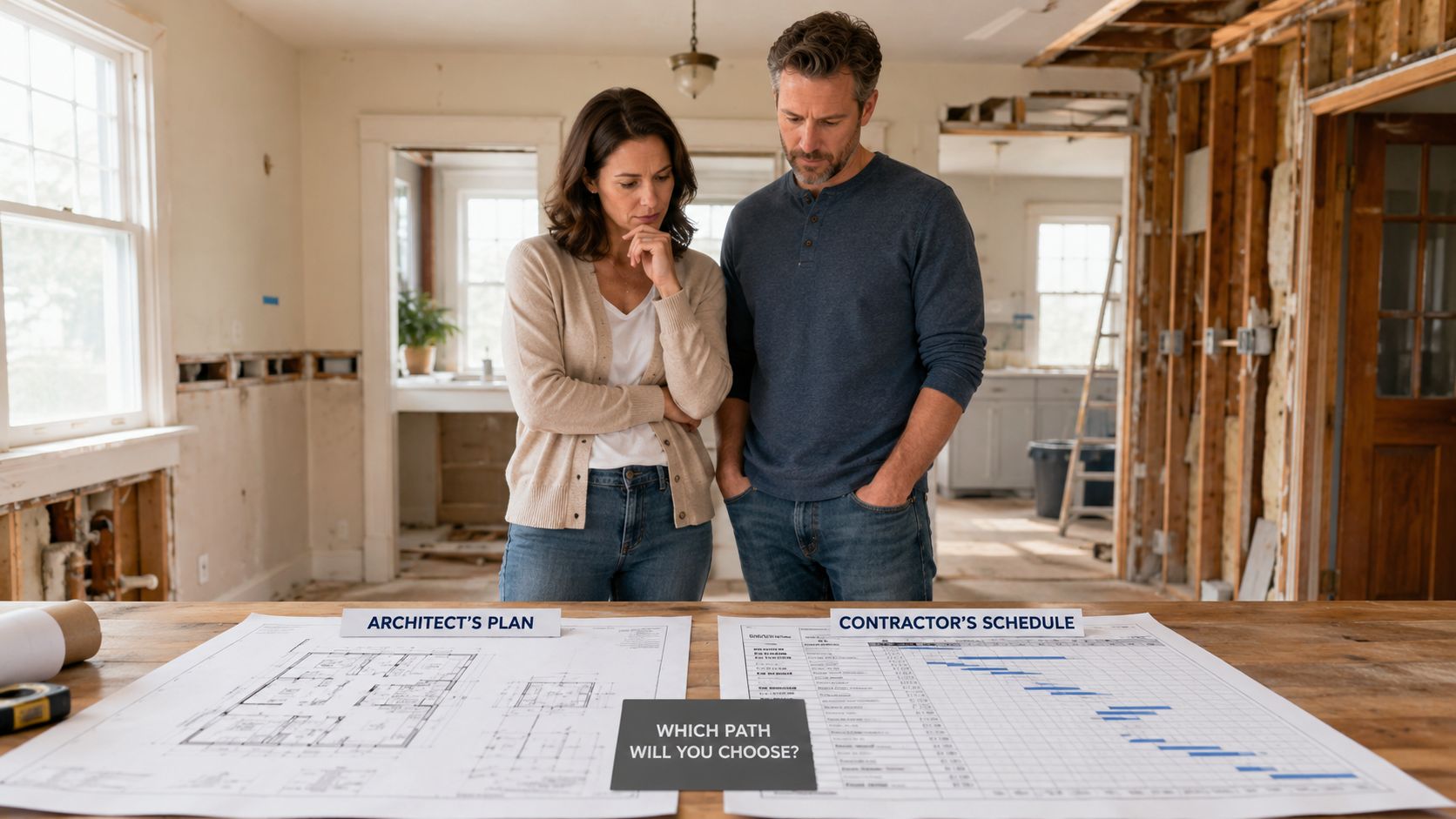
The traditional route is usually called design-bid-build. You hire a designer or architect, complete the plans, send them out for bids, then hire a general contractor to build from those documents. That process is familiar, and for some projects it can work well.
The other route is design-build. One firm handles planning, design coordination, pricing, permitting, and construction under one contract. For homeowners, the biggest practical difference is simple. Instead of managing a handoff between separate businesses, you work through one team from concept to completion.
Practical rule: The more your project involves structure, layout changes, zoning questions, or permit complexity, the more expensive homeowner coordination becomes.
That's the part many articles skip. Homeowners often compare line-item prices but don't account for the project manager tax they pay with their own time. In Greater Boston, that tax shows up in meetings, email chains, permit corrections, material decisions, and the stress of trying to settle disputes between what was drawn and what can be built.
If you're searching for a home addition contractor Boston MA, planning a kitchen remodel Greater Boston, or weighing an ADU builder Massachusetts option, this decision comes first. It usually matters more than the paint color, fixture package, or cabinet line you choose later.
The Traditional Path The General Contractor Model
The general contractor model is still the default path many homeowners know. It follows a straight line. First comes design. Then bidding. Then construction.
How the sequence usually works
A homeowner hires an architect or designer to produce drawings. Once those plans feel complete, they're priced by one or more contractors. After that, the homeowner picks a builder and signs a construction contract.
That sounds clean on paper. In practice, the homeowner becomes the point of connection between the design side and the construction side.
Here's what that often means on a real project:
- You carry questions between teams. If the builder spots a framing conflict, unclear detail, or missing note, that question usually goes back through you to the designer.
- You help resolve budget gaps. If the plans price higher than expected, you're the one deciding what gets redesigned, delayed, or removed.
- You absorb handoff risk. The contractor didn't shape the design while it was being developed, so constructability issues often surface later.
The hidden cost isn't just financial. It's managerial.
According to recent design-bid-build analysis, the traditional model adds 12 to 18 weeks to a project timeline because the phases happen sequentially. The same source states that 40% of GC projects experience change orders due to design-construct misalignment, costing an average of $8,500 per project.
Where homeowners feel the strain
If you already have complete, highly detailed plans and you're comfortable managing a construction process, a GC can be a reasonable fit. Some homeowners prefer that level of separation because they want independent design before choosing a builder.
But this model works best when the documents are build-ready and the homeowner has time to stay involved. Homeowners often underestimate what “involved” means.
You're not just choosing finishes. You're often coordinating scope, schedule, clarification, and revision across separate contracts.
In Massachusetts, that can get messy fast. One code-driven plan revision can affect engineering, permit documents, pricing, and schedule. If your architect and contractor aren't under one roof, each step takes another round of communication.
This is especially noticeable on additions, structural kitchen work, and layouts that move plumbing or load-bearing walls. It can also affect smaller spaces. A homeowner shopping for bathroom renovation Arlington MA services or basement finishing Cambridge MA might assume a GC model is simpler, then find themselves sorting out venting, fixture changes, or inspection corrections between trades and designer.
The GC route isn't wrong. It just shifts more responsibility to the homeowner than is commonly anticipated.
The Integrated Approach The Design-Build Model
The design-build model changes the structure of the job from day one. Instead of hiring a designer first and a builder later, the homeowner hires one company that coordinates both.
That single contract matters. It means the people developing the plan are already thinking about budget, scheduling, permit strategy, site conditions, and how the work will be built.
What changes under one roof
In a design-build setup, designers, estimators, project managers, engineers, and field staff work as one team. The practical advantage isn't just convenience. It's earlier alignment.
When layout ideas are being developed, construction input is already in the room. If a beam affects a ceiling line, if a dormer changes structural scope, or if a kitchen concept pushes the budget too far, those issues are addressed while the plan is still flexible.
That creates a different project rhythm:
- Concept and budget move together
- Design decisions are priced in real time
- Permit planning starts with construction reality in mind
- Responsibility stays with one team
For homeowners, the biggest benefit is fewer gray areas. There's one point of contact, one chain of accountability, and less finger-pointing when questions come up.
A good overview of that structure is this guide to understanding the design-build process.
Why this matters on real remodels
On paper, design-build sounds like an organizational choice. On an actual project in Cambridge, Brookline, or Wellesley, it becomes a decision about control.
A kitchen remodel with wall removal, a bathroom relocation, an ADU, or a second-story addition involves design, engineering, pricing, permits, and sequencing. Those pieces affect each other constantly. If one team handles the full chain, changes happen faster and with less rework.
The best design-build projects don't eliminate decisions. They eliminate the handoff errors between decisions.
That's why the integrated model tends to work especially well for projects where homeowners want a better process, not just a builder. If the goal is to reduce confusion, keep design tied to budget, and avoid becoming the middleman, design-build gives you a much cleaner path.
Design Build vs GC A Head-to-Head Comparison
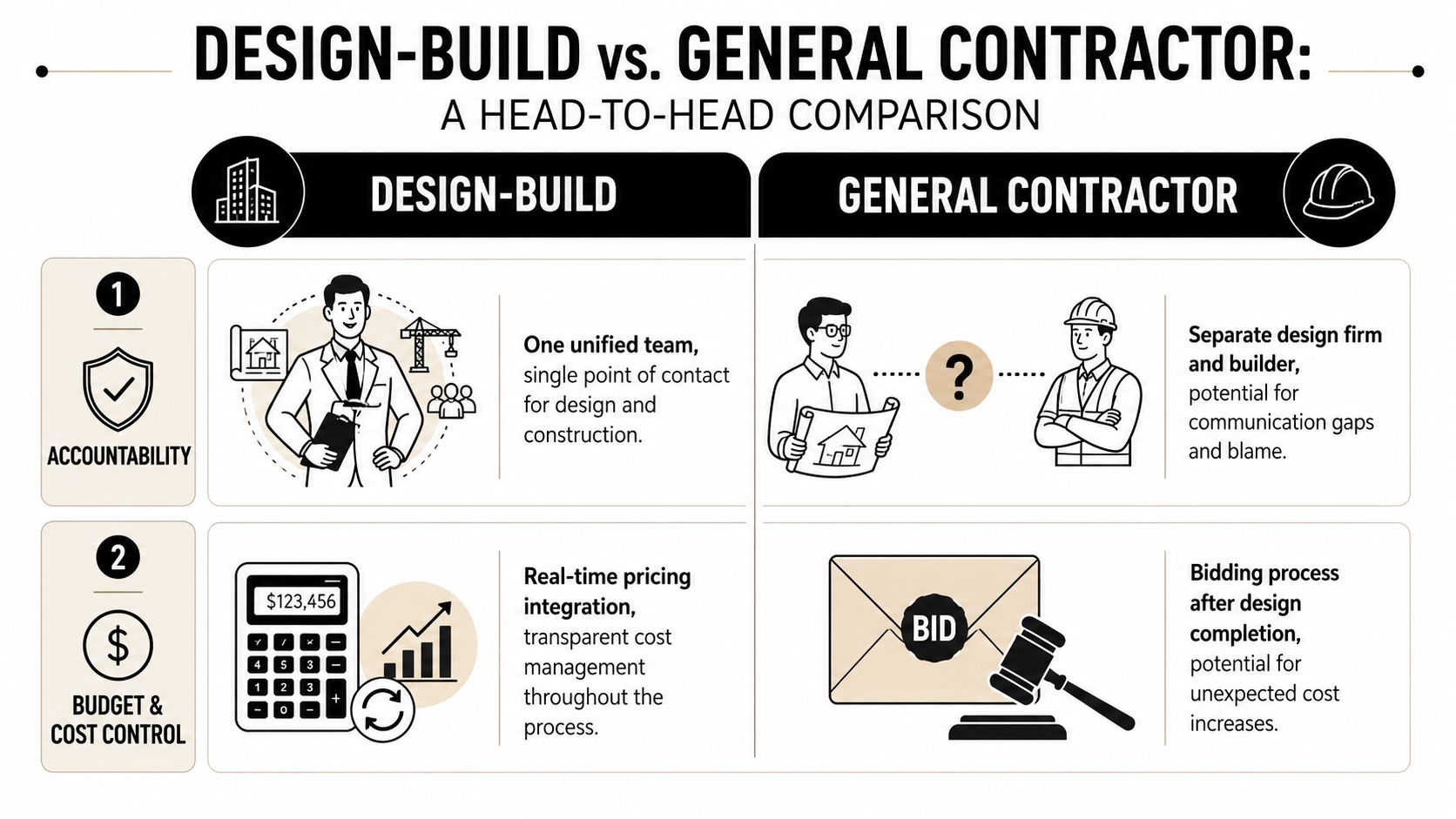
The easiest way to compare design build vs general contractor is to look at who owns the moving parts. Homeowners usually feel the difference in four places: accountability, budget control, schedule, and communication.
Quick comparison table
| Factor | Design-Build | General Contractor |
|---|---|---|
| Contracts | One contract for design and construction | Separate design and construction contracts |
| Accountability | One team owns the result | Responsibility is split |
| Budget process | Pricing develops with design | Pricing often happens after design is complete |
| Timeline structure | Overlapping phases | Sequential phases |
| Homeowner role | Decision-maker | Decision-maker plus coordinator |
| Communication | One main channel | Back-and-forth between separate parties |
Accountability
With design-build, one team is responsible for both what was drawn and what gets built. If there's a conflict between design intent and field conditions, the same company has to solve it.
With a traditional GC model, accountability is divided. The architect may say the contractor should have known. The contractor may say the plans were incomplete. The homeowner often ends up in the middle trying to push the issue forward.
That distinction becomes very real when a project hits structural, mechanical, or permit-driven revisions.
Budget and Cost Control
Budgeting works differently in each model. In design-build, pricing is part of design development, so scope decisions happen with cost feedback in real time. In a GC model, the homeowner may spend months developing plans before seeing where the construction market prices them.
That's one reason integrated delivery often performs better. According to Penn State and Construction Industry Institute findings summarized here, design-build projects are delivered approximately 33.5% faster and 6.1% cheaper than traditional design-bid-build projects.
Those numbers don't mean every design-build project is cheaper on day one. They mean the process tends to control waste better.
Project Timeline
Timeline is where homeowners feel the difference fastest. In design-build, parts of planning, pricing, selections, and construction preparation can overlap. In design-bid-build, each phase waits for the one before it to finish.
The result is usually a longer runway before work starts. It also creates more chances for rebidding or redesign if project cost comes in above target.
For a homeowner in Newton or Wellesley, that can translate into a longer period living in limbo. You may not be paying extra line items yet, but you're still paying in delay, carrying costs, and postponed use of the space.
Communication
Communication sounds soft until it fails. Then it becomes the whole project.
In design-build, there's one organized conversation. In the GC route, the homeowner often becomes the translator between architecture, estimating, permit comments, and field questions.
A remodel gets easier when the people solving problems are talking to each other directly instead of through the owner.
For homeowners comparing builders, this is the section to pay attention to. Competitive bidding can feel like strong cost discipline. Sometimes it is. But if the plans aren't fully coordinated, the lower initial number can be the start of a longer and more expensive chain of revisions.
Navigating Permits and Code in Massachusetts
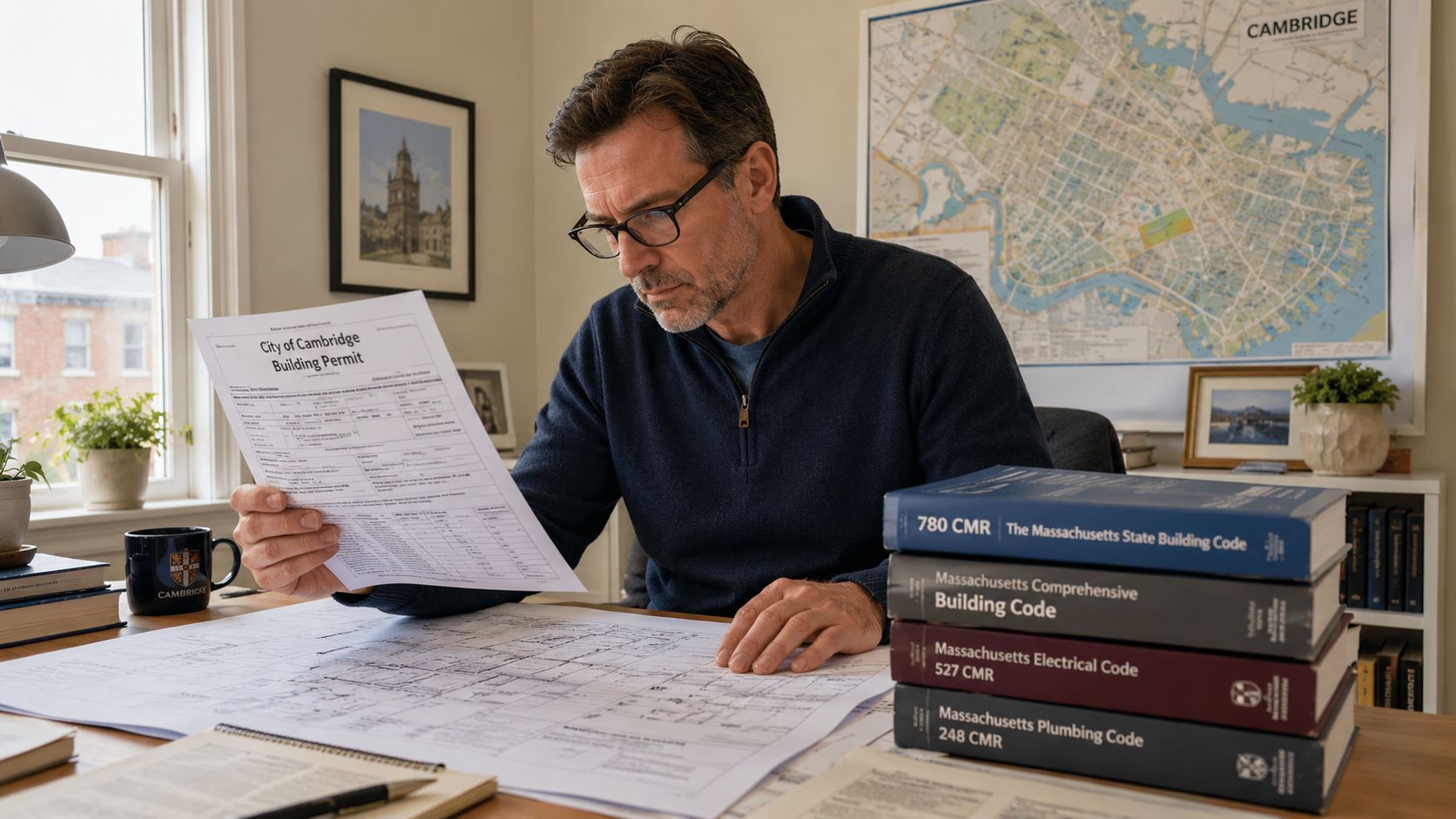
Permits and code aren't side paperwork in Massachusetts. They shape the project from the beginning, especially for additions, structural remodels, ADUs, and any work that changes egress, energy compliance, or major systems under 780 CMR and local bylaws.
Why Massachusetts projects get complicated fast
A second-story addition in Greater Boston is a good example. It typically requires full architectural drawings, stamped engineering calculations, energy compliance forms, site plans with setbacks, and often historical commission review. Massachusetts renovation guidance summarized here notes that basic permitting often takes 4 to 8 weeks, and 1 to 3 more months may be added if a variance is needed.
That's before construction inspections start. On major projects, homeowners should expect rough inspections for framing, electrical, and plumbing, followed by final inspections before closeout and occupancy.
There are also direct permit costs. For residential work in Greater Boston, local permit fee guidance puts building permit costs at $100 to $500 for small additions, $500 to $1,500 for medium renovations, and $1,500 to $5,000+ for major or new construction, with separate electrical, plumbing, and mechanical permit fees often required.
Where the homeowner pays for disconnects
Under a GC model, permits are often based on plans developed before the builder has fully pressure-tested the details. If field reality forces a revision, the homeowner can get pulled into a loop of updated drawings, revised pricing, and permit resubmission.
That's one reason integrated planning matters so much in this market. A design-build team can catch permit and code issues earlier, coordinate engineering with actual construction scope, and reduce the number of late-stage surprises.
This matters even more in towns with stricter review or energy requirements. In Arlington, for example, an addition exceeding 1,000 square feet or more than 100% of the existing conditioned floor area triggers whole-home compliance under the 2023 MA Stretch Code, including a HERS rating compliance audit for the entire dwelling before permit approval, as noted in this summary of Arlington MA Stretch Code impacts.
A practical primer on that process is this article on understanding building codes and permits for home additions.
If you're planning work in Cambridge, Brookline, Lexington, Medford, or Newton, permit strategy isn't something to sort out after design. It needs to be part of design.
Which Model Is Right for Your Boston-Area Remodel
Most homeowners don't need an abstract theory. They need to know which model fits the job they're planning.
Design-build is usually the better fit when
If your project involves overlapping decisions, design-build is usually the stronger option.
That includes:
- Home additions and second stories. In Massachusetts, the average cost of a home addition runs $150 to $400 per square foot, and total project timelines often span 9 to 12 months from initial design through final construction, according to this Massachusetts home addition cost guide. At that scale, design, engineering, permit strategy, and construction planning need to stay tightly connected.
- ADUs and in-law suites. If you're looking for an ADU builder Massachusetts homeowners can rely on, an integrated process helps keep zoning, layout, and buildability aligned from the start.
- Major kitchen remodels. For structural or layout-heavy work, a design-build approach usually prevents avoidable confusion. Homeowners researching kitchen remodeling newton, kitchen remodeling arlington, or kitchen remodeling medford are often dealing with walls, plumbing moves, and finish selections that all affect each other.
- Complex bath work. If a project includes layout changes, waterproofing coordination, venting corrections, or fixture relocation, integrated planning tends to reduce friction. The same applies when comparing local options for bathroom remodeling medford or bathroom renovation somerville.
Local rule of thumb: The more your remodel touches structure, permitting, or systems, the less sense it makes to separate design from construction.
A traditional GC can still make sense when
A GC model can still work for a simpler job. If you already have complete construction documents, minimal unknowns, and you want to stay highly involved, hiring a general contractor may be reasonable.
This is more realistic when:
- The scope is narrow.
- The plans are complete and coordinated.
- You're ready to manage communication between professionals.
- You're comfortable making decisions quickly when conflicts appear.
A lot of homeowners think they want “more control” through separation. Sometimes what they really want is better visibility, clearer pricing, and fewer surprises. Those are different things.
If you're evaluating builders for a large renovation, this checklist for how to vet home addition companies in Greater Boston is a good place to start.
Frequently Asked Questions About Choosing a Contractor
How are design changes and change orders handled in each model
In a traditional GC setup, design changes often move through at least two separate parties. The designer updates the intent, the contractor prices the impact, and the homeowner approves the revision. That process can be slow.
In design-build, changes are usually more coordinated because the design and construction teams are already working together. That doesn't mean changes are free. It means the path from idea to cost to execution is shorter and clearer.
What happens if the project goes over budget
With separate contracts, budget overruns can trigger arguments about whether the problem came from design assumptions, site conditions, or construction pricing. Homeowners can get stuck sorting that out.
With design-build, there's one accountable team. That usually makes problem-solving more direct because the same company has to reconcile design decisions with actual construction cost.
Can I live in my house during the renovation
Sometimes yes, sometimes no. It depends on which rooms are affected, whether utilities stay active, how much dust containment is realistic, and whether there are children or pets in the house.
For kitchen remodels, major additions, and projects that involve structural work, many families choose at least a temporary partial move-out. If you're trying to compare layout ideas before making that decision, these kitchen remodel concepts can help you think through workflow, storage, and what level of disruption a redesign may create.
How much time will I need to commit as the homeowner
This is where design build vs general contractor becomes personal. In a GC model, your time commitment is much higher because you're often helping connect design clarifications, approvals, pricing decisions, and communication between separate teams.
In a design-build model, you still make important decisions. But you're not usually serving as the traffic controller.
Do kitchen and bathroom remodels in Greater Boston need permits
Often, yes. If the work includes structural changes, electrical, plumbing, mechanical updates, or significant layout modifications, permits are typically required. Local departments may also require rough and final inspections before sign-off.
That applies whether you're planning kitchen remodeling Burlington, kitchen remodeling Wellesley, bathroom remodel cost Newton, or how much does a bathroom remodel cost Somerville research. In this area, the permitting path is part of the job, not an optional extra.
Ready to get started? Contact Aureli Construction for a free estimate at homeadditionma.com.