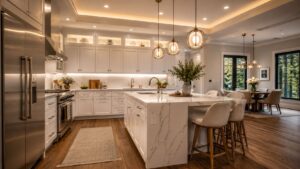
In Lexington, we often meet homeowners who love their house and dislike their kitchen. The trim is original, the floors have character, the windows are worth keeping, but the room itself feels cramped, dark, and stuck between decades. One wall jogs out for no obvious reason. The ceiling height changes. The radiator is in the worst possible spot. That's normal in Greater Boston.
A modern transitional kitchen is usually the right answer for that kind of house. It blends classic warmth with contemporary simplicity, so the kitchen feels updated without looking out of place next to older millwork, plaster walls, or period details. It also gives you more room to make smart compromises when the house won't accept a perfect showroom layout.
When beginning the planning stage, dedicate time to exploring concepts for transforming your kitchen space, subsequently bringing those inspirations into alignment with your home's environment. The transition from inspiration to construction is where most remodels either succeed or falter.
Table of Contents
- Your Guide to Modern Transitional Kitchens in Greater Boston
- What Defines Modern Transitional Kitchens
- Material and Finish Selections for a Timeless Look
- Layout Planning for a Kitchen Remodel in Newton MA
- Kitchen Remodel Costs in Cambridge and Greater Boston
- Project Examples and Common Design Mistakes to Avoid
- FAQ for Hiring a Kitchen Remodel Contractor in Massachusetts
- How long does a full kitchen remodel usually take in the Boston area
- Do I need a permit for a kitchen remodel in Massachusetts
- What's the difference between a general contractor and a design-build firm for a kitchen project
- What should I ask before hiring a kitchen remodel contractor Boston MA homeowners can trust
Your Guide to Modern Transitional Kitchens in Greater Boston
A good transitional kitchen in Belmont, Newton, or Cambridge doesn't start with cabinet color. It starts with restraint. Older New England homes already have a lot going on. Window casings, uneven walls, framed openings, narrow footprints, and existing hardwood all compete for attention. If the kitchen adds too much style noise, the room feels busy instead of finished.
That's why modern transitional kitchens work so well in Greater Boston. They let the house keep its identity while giving the kitchen better function, cleaner lines, and more dependable storage. The result isn't cold and it isn't fussy. It feels settled.
Why this style works in Massachusetts homes
Many local homes sit in the middle ground. They aren't pure historic restorations, and they aren't new construction either. A stark ultra-modern kitchen can feel disconnected from a colonial in Wellesley or a two-family in Somerville. A heavily ornate kitchen can make a smaller Arlington house feel crowded.
Practical rule: In older homes, the best kitchen usually looks a little quieter than the inspiration photo you started with.
We've found that homeowners planning a kitchen remodel Greater Boston project are usually trying to solve three things at once:
- Better flow: The cooktop, sink, and refrigerator need to stop fighting each other.
- Better storage: Older homes often waste vertical space or trap it behind bad cabinet sizing.
- Better fit with the house: New work should look intentional next to old trim, plaster, and flooring.
The visual balance that makes it feel right
Transitional design does that by mixing simple cabinet profiles, neutral finishes, practical lighting, and classic material cues. Think painted Shaker doors, slab-front accents where needed, quartz or natural stone counters, understated pulls, and lighting that adds detail without dominating the room.
If you want a broader design perspective before narrowing down your material palette, the discussion on the evolution of styles in the kitchen remodel world is a useful reference point.
What Defines Modern Transitional Kitchens
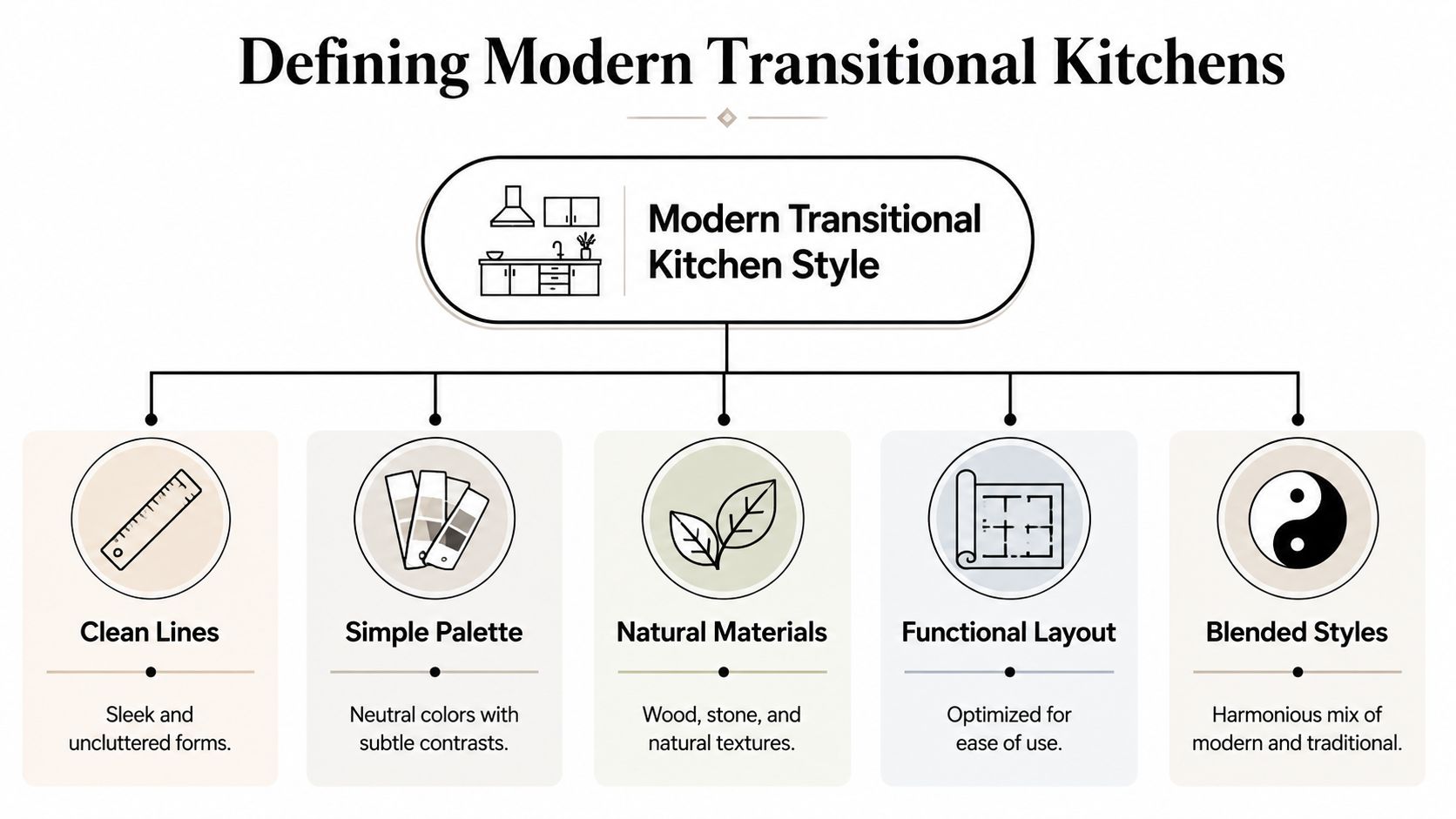
A transitional kitchen isn't a 50-50 split between traditional and modern. It's a controlled mix. One side usually leads, and the other side supports it. In Greater Boston homes, the most successful version usually leans classic in proportion and modern in cleanup. That means the room keeps warmth and depth, but drops the extra ornament.
A 2025 U.S. survey reported that about 25% of respondents had changed or were planning to change to a transitional-style kitchen after renovation. The same reference notes that industry commentary from the National Association of Realtors describes transitional style as the most popular kitchen design category in renovation surveys. That tracks with what we see locally. Homeowners want something current, but they don't want a kitchen that feels overcommitted to one design era.
Why this style works in Massachusetts homes
The style has staying power because it solves a real design problem. A period home in Brookline may need to respect original character. A renovated home in Burlington may need cleaner lines. A transitional approach can handle both without forcing the same formula onto every house.
Here's what usually defines it in practice:
- Cabinet fronts with discipline: Shaker is common because it has detail without excess.
- A calm color palette: Whites, off-whites, warm grays, taupes, wood tones, and muted greens work well.
- Less decorative clutter: You don't need ornate corbels, busy moldings, and multiple backsplash patterns in the same room.
- Modern function hidden inside a classic shell: Deep drawers, appliance garages, pull-outs, integrated trash, and better task lighting.
The visual balance that makes it feel right
The room should feel layered, not split. If you pair classic cabinet doors with ultra-industrial fixtures, glossy slab counters, and aggressive contrast everywhere, the result feels confused. If every choice leans traditional, the kitchen stops being transitional and starts reading formal.
A strong transitional kitchen looks coherent from across the room before you notice any individual finish.
That's the main distinction homeowners miss when comparing inspiration photos. The best modern transitional kitchens aren't built from trendy moments. They're built from proportion, repetition, and restraint.
Material and Finish Selections for a Timeless Look
Material selection is where a lot of homeowners accidentally push a transitional kitchen too far in one direction. In Arlington and Belmont, we usually advise clients to choose the permanent surfaces first. Cabinet profile, countertop, flooring, and backsplash matter more than whether the pendant is brass or black. Get the bones right, and the accessories become much easier.
Cabinet doors and paint choices
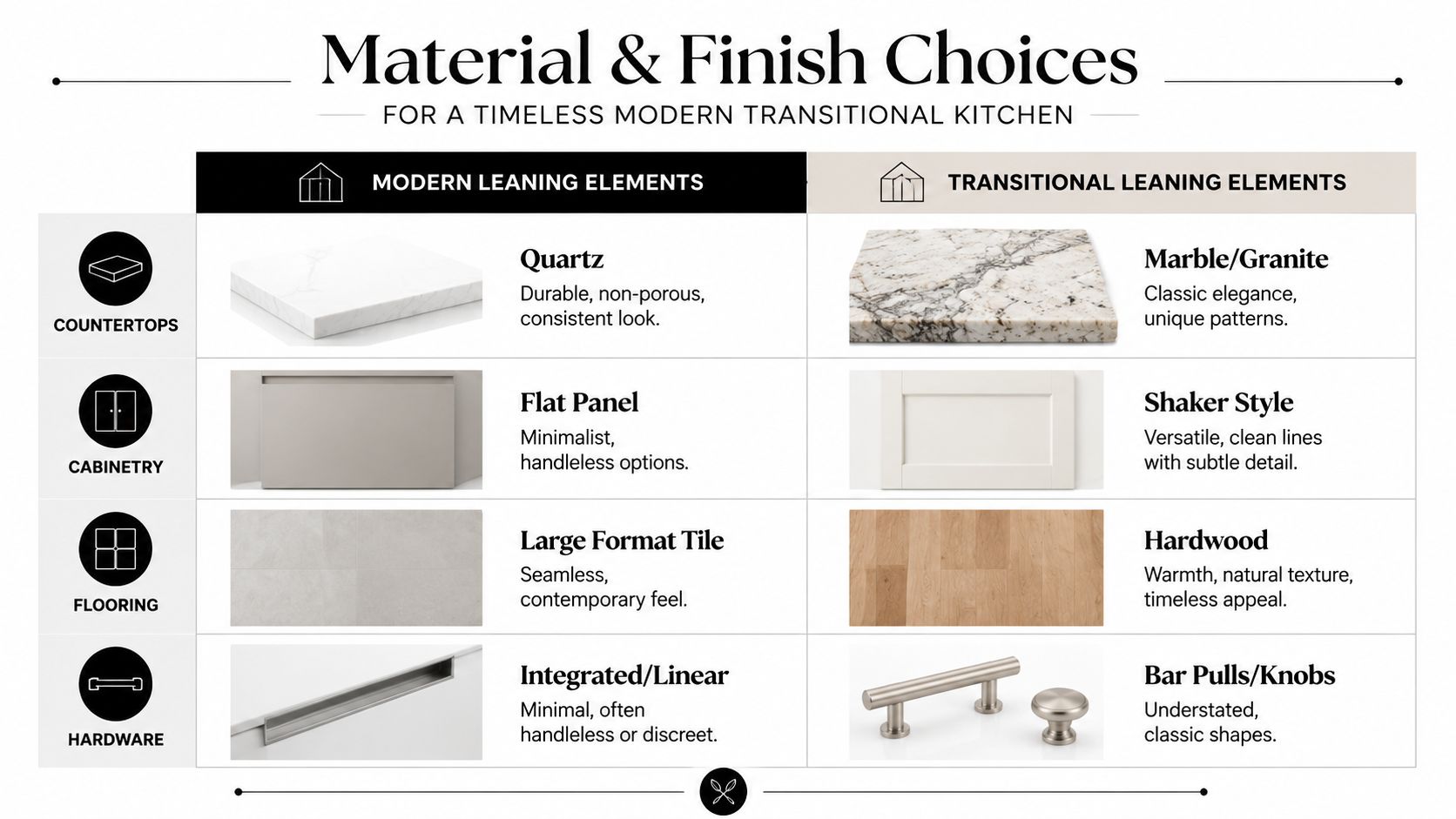
Cabinet geometry does a lot of heavy lifting in this style. According to industry guidance on transitional kitchens, cabinet geometry and visual load management are core technical levers in modern transitional kitchens, and examples consistently pair Shaker or flat-panel doors with light-to-medium neutral finishes because the recessed-panel profile preserves some traditional depth while simplified faces and limited ornament reduce visual clutter.
That's exactly right in older Boston-area homes. When walls are slightly off, ceilings vary, and natural light changes from front to back, the cabinet face needs to calm the room down.
Practical choices that usually work:
- Shaker doors: Best for colonials, Victorians, and houses with existing trim detail.
- Flat-panel perimeter or island cabinets: Useful when you want a more modern read without making the whole room stark.
- Painted finishes in off-white, mushroom, greige, or muted green: Easier to live with than hard bright white in older homes.
- Wood accents used selectively: White oak islands or shelving can warm up painted cabinetry without turning rustic.
If you're refinishing rather than replacing cabinets, the finish quality matters. Homeowners comparing paint systems can review guidance on choosing professional cabinet paint to understand why prep, primer, and topcoat matter as much as color.
Countertops and backsplash decisions
For countertops, quartz is often the most practical fit for a kitchen remodel Greater Boston project. It handles daily use well, keeps the look consistent, and pairs easily with both painted and wood cabinetry. Natural stone can also work, especially when the house already has a more classic feel, but the pattern needs to stay controlled.
Backsplashes should support the room, not become the main event.
A simple breakdown helps:
| Element | Usually works well | Usually causes problems |
|---|---|---|
| Countertops | Soft-vein quartz, quiet natural stone | Heavy movement that fights the cabinetry |
| Backsplash | Simple subway, stacked tile, restrained zellige | Strong pattern plus bold counter plus busy floor |
| Grout | Tone-on-tone or low contrast | High-contrast grout in a small room |
Field note: If the countertop has movement, simplify the backsplash. If the backsplash has texture, keep the countertop quieter.
Subway tile still works. So do handmade-look ceramics in a calm tone. What doesn't work is stacking too many “statement” materials in one compact Boston kitchen.
Hardware lighting and flooring
Hardware should be understated. Bar pulls, simple tab pulls, and small round knobs all fit, depending on the cabinet style. Mixed metals can work, but they need a reason. We prefer one dominant finish and one supporting finish at most.
Lighting needs layers, especially in homes with limited overhead lighting locations.
Use a combination of:
- Recessed task lighting: For even coverage across work zones.
- Pendant lighting: Best over an island or peninsula, but scaled to the room.
- Under-cabinet lighting: Essential in older homes where natural light can be uneven.
- Decorative fixture at the dining edge: Helpful in open kitchen layouts.
Flooring usually looks best when it connects to the rest of the house. In many Newton, Reading, and Winchester-area homes, hardwood is the right call if conditions allow. In some kitchens, tile is the better practical choice, especially near exterior entries or where leveling issues make a full flooring transition more complex.
For more detailed cabinetry direction, the ideas in current kitchen cabinet trends can help you compare profile and finish options without chasing short-lived styles.
Layout Planning for a Kitchen Remodel in Newton MA
Most online photos of modern transitional kitchens assume you're working with a simple rectangle and no structural surprises. That's not how most Newton kitchens look when demolition starts. You may find a chase where you wanted a pantry, an uneven floor under old layers, a chimney mass taking up corner space, or ceiling framing that limits the hood layout.
Older homes need layout first finishes second
Independent design guidance on awkward kitchens notes that designers should "honor" the space rather than fight it, and that awkward angles can limit storage if cabinet height and ceiling volume aren't addressed in the plan for non-ideal layouts. That's especially relevant in older Boston-area homes.
That principle matters more than style. A beautiful finish package won't rescue a kitchen with bad circulation, weak landing space, or no practical pantry storage.
We usually push homeowners to answer these questions early:
- Where does prep happen now, and why is it awkward?
- Which wall should carry the tall storage?
- Can the ceiling height support stacked cabinetry, or will that crowd the room?
- Does opening a wall improve flow, or just move the congestion somewhere else?
A few common layout realities in local homes:
- Galley kitchens in Somerville two-families: These often need smarter tall storage and better appliance placement more than they need full removal of walls.
- Center-hall colonials in Newton: The challenge is often widening openings without overexposing the kitchen to the whole first floor.
- Brookline apartments and condos: Existing plumbing stacks and association limits can narrow what's possible quickly.
Later in planning, it helps to watch a real-world walkthrough of how remodel sequencing typically unfolds.
Massachusetts code permit and inspection realities
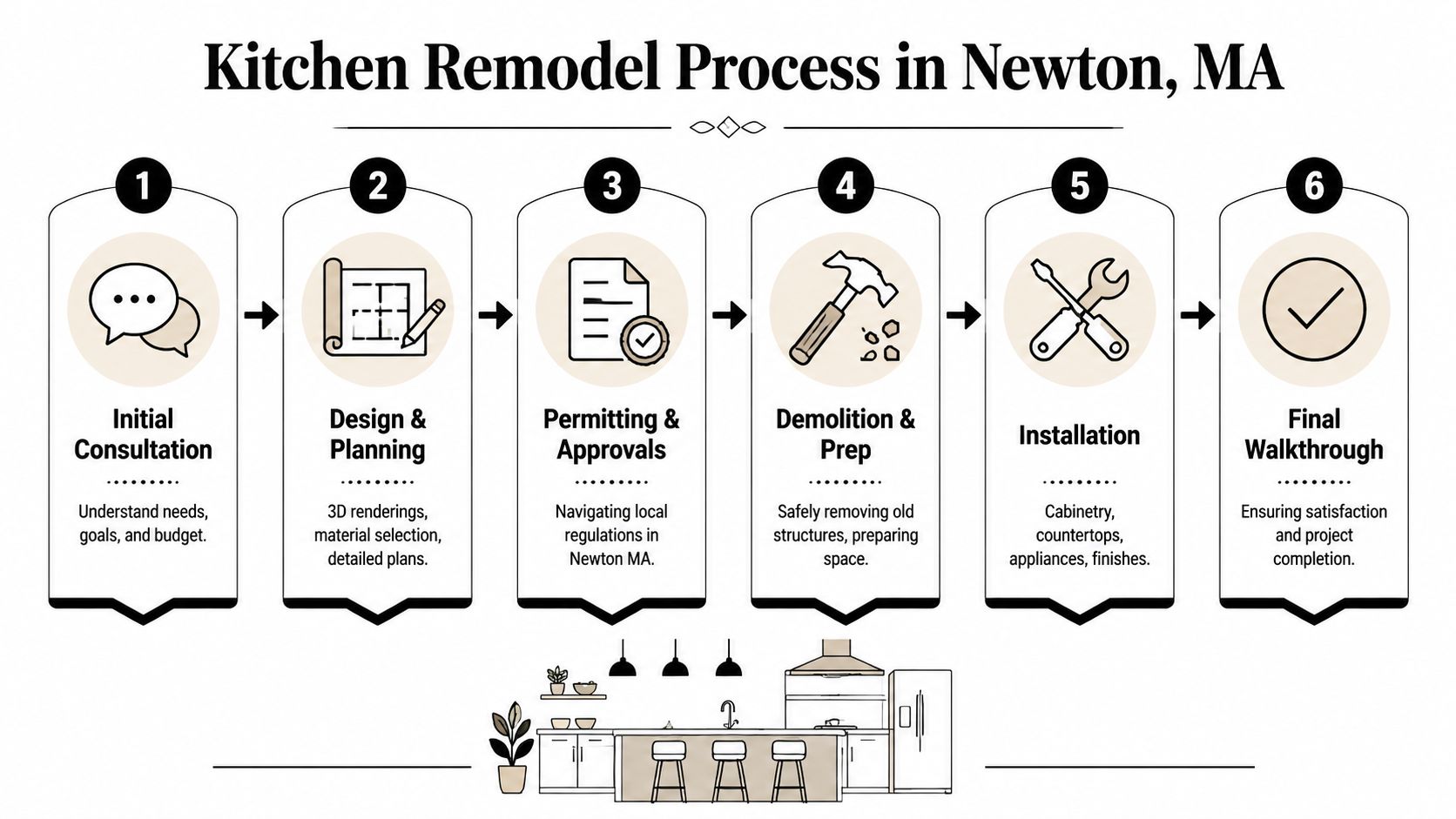
A kitchen remodel in Massachusetts often triggers more than finish work. Once you move plumbing, alter electrical, change structural framing, or modify ventilation, permits and inspections usually come into play. Exact requirements vary by town, but homeowners in Cambridge, Newton, and Brookline should expect permit review to be part of the process.
Code issues that commonly affect kitchen projects include:
- Mechanical ventilation: Range hood routing has to work with the house structure, not just the appliance spec sheet.
- Electrical upgrades: Older kitchens may need circuit changes to support modern appliance loads and current code expectations.
- Plumbing relocation: Moving a sink or adding a pot filler can affect the full scope faster than homeowners expect.
- Structural changes: Removing or widening walls often requires engineering and inspection.
In older homes, the cleanest-looking kitchen is usually the one designed around the structure instead of pretending the structure isn't there.
Kitchen Remodel Costs in Cambridge and Greater Boston
Kitchen pricing in this market is not national-average pricing. Labor, permitting, trade coordination, delivery conditions, and the age of the housing stock all push Greater Boston projects into a different range. A third-floor condo in Cambridge with tight access costs differently than a straightforward first-floor remodel in Burlington.
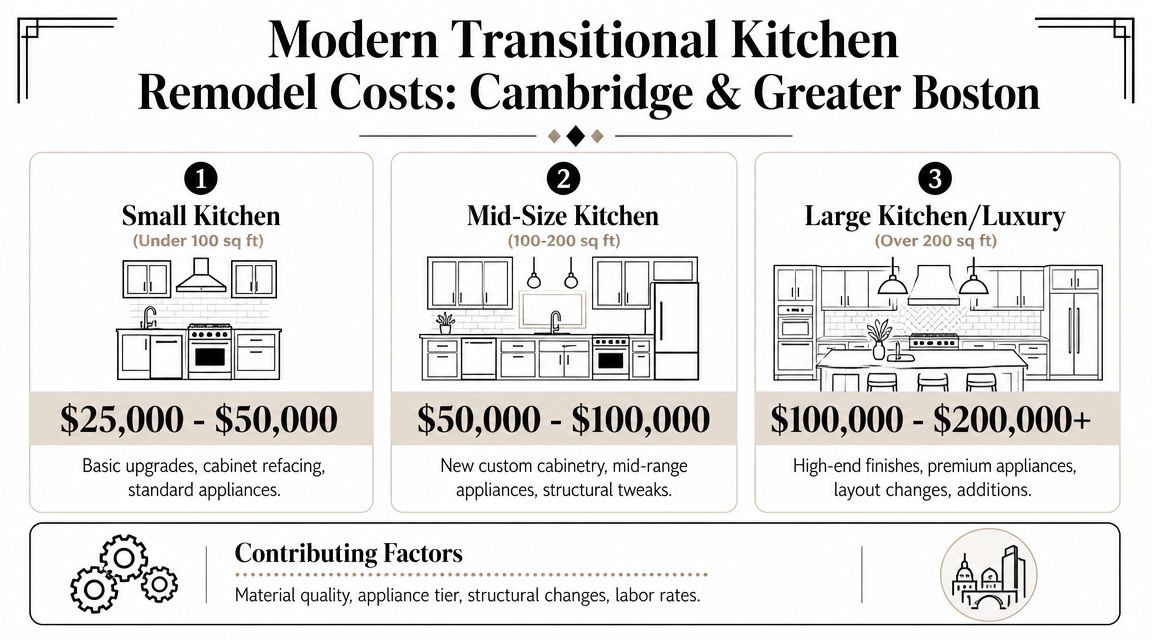
What budget ranges look like locally
For a modern transitional kitchen in this region, realistic planning ranges often look like this:
| Project level | Typical local range | What that usually includes |
|---|---|---|
| Small kitchen | $25,000 to $50,000 | Cosmetic upgrades, selective cabinet work, standard appliance integration, limited layout changes |
| Mid-size kitchen | $50,000 to $100,000 | New cabinetry, updated electrical and plumbing, better storage, upgraded finishes, moderate layout adjustments |
| Large or luxury kitchen | $100,000 to $200,000+ | Custom cabinetry, premium appliances, major layout rework, structural changes, higher-end finish package |
Those numbers are market ranges for Massachusetts planning purposes, not a promise of exact pricing. Actual cost depends on scope.
A kitchen remodel also tends to hold value well. A 2022 NAR/NARI report summary found that 86% of homeowners said they had an increased sense of enjoyment after a complete kitchen renovation, and that homeowners can recover about 75% of a kitchen overhaul's cost at resale.
What pushes a project up or down
The biggest budget drivers are usually not the things homeowners guess first.
The items that move cost most:
- Cabinet construction: Stock, semi-custom, and custom are very different conversations.
- Layout changes: Moving plumbing, gas, or walls adds complexity fast.
- Appliance tier: A standard appliance package and a premium integrated package are different budgets.
- Access conditions: Tight city lots, narrow stairs, condo rules, and parking limits all affect labor.
- Age of the house: Hidden conditions are common in older Cambridge and Somerville homes.
Budget advice: Spend on layout, cabinetry, and lighting first. Those choices shape daily use more than decorative upgrades do.
If you're comparing scope and design-build process expectations, this Greater Boston kitchen remodeling guide is a helpful planning resource.
Project Examples and Common Design Mistakes to Avoid
The most useful examples aren't polished showroom stories. They're the common project types we see across Greater Boston, where a modern transitional kitchen has to solve actual problems.
Common project types we see around Greater Boston
A tight galley kitchen in a Somerville two-family often needs visual relief more than dramatic expansion. Lighter cabinet finishes, a simpler backsplash, better under-cabinet lighting, and taller pantry storage can make the room feel larger without forcing an unrealistic open plan.
A colonial kitchen in Wakefield or Wellesley often has the opposite issue. The room may have enough square footage, but the circulation is clumsy because everything is pushed to the perimeter and the island is oversized. In that case, the best transitional solution is usually cleaner geometry, fewer decorative interruptions, and a better-defined prep zone.
A Brookline or Cambridge older home may also have details worth keeping, such as original casings, archways, or floor transitions. The right move isn't always to erase those. It's often to simplify the new kitchen so the old details still belong.
Keep the parts of the house that give it identity. Modernize the kitchen where function demands it.
Mistakes that date a kitchen fast
We help homeowners avoid the same mistakes over and over:
- Choosing too many focal points: If the hood, island, backsplash, counter, lighting, and floor all demand attention, none of them look better.
- Ignoring storage geometry: Pretty cabinets don't help if the drawer stack is in the wrong place or upper cabinets stop short for no reason.
- Forcing symmetry where the room won't support it: Older homes rarely reward rigid planning.
- Using bright cool whites everywhere: In many Massachusetts homes, that finish reads harsh against older wood floors and natural light.
- Undersizing lighting: A kitchen can have expensive finishes and still feel unfinished if task lighting is weak.
- Copying a new-build aesthetic into a period home: The mismatch is obvious as soon as you walk in.
The kitchens that last are usually the ones that make fewer louder moves.
FAQ for Hiring a Kitchen Remodel Contractor in Massachusetts
How long does a full kitchen remodel usually take in the Boston area
The construction phase for a full kitchen remodel often runs several weeks, but the actual timeline includes design, selections, permitting, ordering, and inspections. In Massachusetts, older homes and town-specific permit review can add time before demolition even starts. Custom cabinets and structural work also extend schedules.
Do I need a permit for a kitchen remodel in Massachusetts
If the work is limited to basic finish replacement, permit needs may be minimal. Once you move plumbing, change electrical, alter framing, update ventilation, or make structural changes, permits are commonly required. Local building departments and inspections matter, and requirements can vary by municipality.
What's the difference between a general contractor and a design-build firm for a kitchen project
A general contractor builds the project. A design-build firm handles planning, design coordination, and construction under one roof. For older Greater Boston homes, that can make a big difference because layout, permitting, engineering, and finish choices affect each other early.
What should I ask before hiring a kitchen remodel contractor Boston MA homeowners can trust
Ask who handles permits, who supervises the job daily, how change orders are managed, how allowances are set, and whether the contractor has experience with older Massachusetts housing stock. Also ask how they coordinate electrical, plumbing, and cabinet lead times.
Ready to build a kitchen that fits your home instead of fighting it? Contact Aureli Construction for a free estimate on your modern transitional kitchen remodel in Greater Boston.