
In Arlington and Belmont, we meet a lot of homeowners in the same spot. They love the old staircase, the original trim, the tall windows, and the street presence of the house, but the kitchen is cramped, the bathrooms are dated, and the mechanical systems belong to another era.
That tension is central to historic home renovation in Greater Boston. You're not just picking finishes. You're deciding what must stay, what can change, and how to bring an older house up to modern living standards without stripping out the parts that made you buy it in the first place.
This also isn't a small category of spending. The broader renovation market keeps growing, with U.S. home improvement spending rising from USD 328 billion in 2019 to an estimated USD 485 billion in 2024, and 51% of renovating homeowners spending USD 25,000 or more in 2023, according to Fortune Business Insights. Historic homes often land above that threshold because they rarely need cosmetic work alone.
Table of Contents
- The Dream and Dilemma of Owning a Historic Massachusetts Home
- What Defines a Historic Renovation
- Our Step-by-Step Historic Renovation Process in Greater Boston
- Historic Home Renovation Costs in the Boston Area
- Navigating MA Building Codes and Historic Commissions
- Smart Energy Efficiency Upgrades for Your Older Home
- FAQ for Your Massachusetts Historic Renovation
- Can we live in the house during construction
- What happens if you find rot, old wiring, or other hidden problems
- How long does a major historic renovation take in Greater Boston
- How do change orders work if we want to adjust the plan
- Is it worth renovating the basement or adding an ADU in an older home
The Dream and Dilemma of Owning a Historic Massachusetts Home
In Lexington, Brookline, and Cambridge, the pattern is usually the same. A homeowner buys a house for its character, then spends the first winter realizing the layout doesn't fit the way they live and the systems behind the walls need attention before any design upgrade will matter.
A historic home renovation starts with competing priorities. You want a bigger kitchen, better insulation, cleaner electrical work, and bathrooms that function for a family. At the same time, you don't want to lose the plaster details, original flooring, old-growth trim, or proportions that give the house its identity.
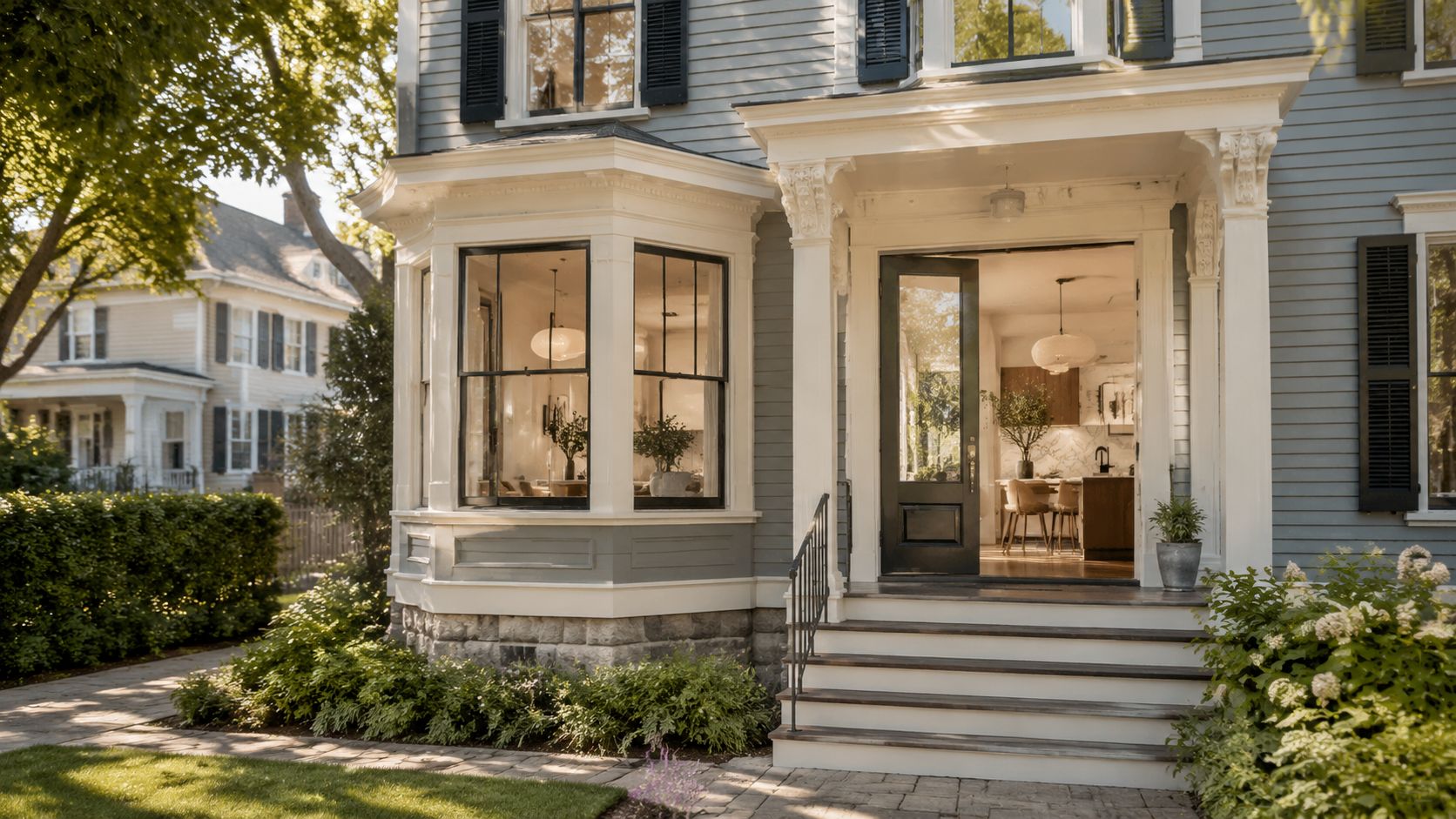
That's where a lot of projects go wrong. Homeowners get pushed toward a standard remodel approach, and a standard remodel approach often treats the house like a blank shell. Older homes in Massachusetts are not blank shells. They have original material, layered repairs, structural quirks, and, in many towns, public review on exterior changes.
Practical rule: If you start by asking, “How do we modernize everything?” you usually overspend and remove too much. If you start by asking, “What gives this house its character, and what must perform better?” you make better decisions.
We see this across Greater Boston, from Belmont Colonials to Somerville two-families to Newton Victorians. The houses are different, but the job is the same. Protect the visible historic fabric. Upgrade the hidden systems. Make changes that feel natural to the house rather than imposed on it.
What Defines a Historic Renovation
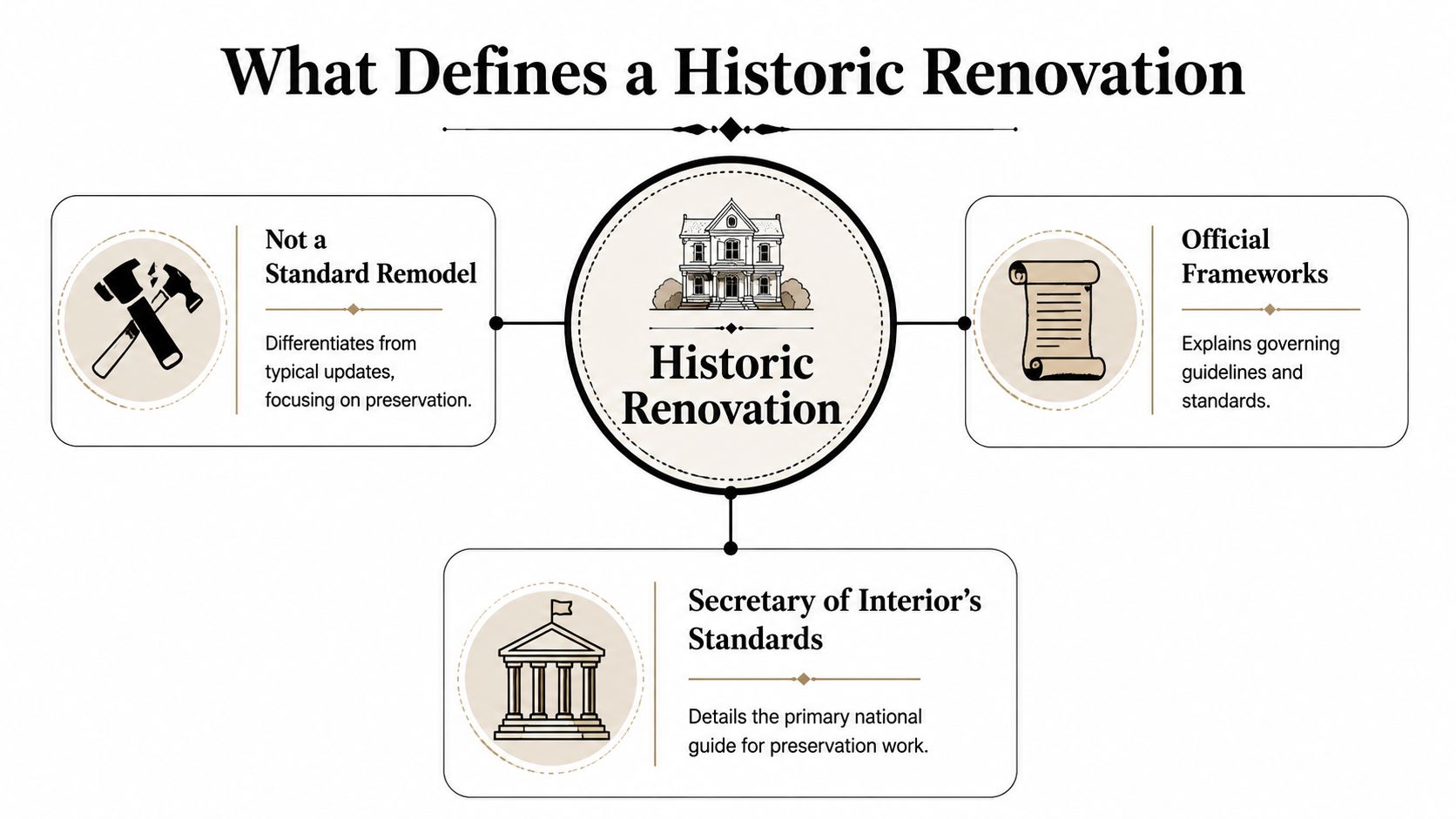
A historic renovation isn't just an old-house remodel. It follows a preservation framework that asks a different question from the start. Instead of “what do we want to replace,” the better question is “what should be retained, repaired, or carefully adapted.”
Why a historic project follows a different rulebook
The core framework comes from the Secretary of the Interior's Standards for the Treatment of Historic Properties, which define four treatment types: preservation, rehabilitation, restoration, and reconstruction, as outlined by the National Park Service standards for treatment of historic properties.
For a homeowner, those categories matter because they shape what's acceptable:
- Preservation means maintaining existing historic material as much as possible.
- Rehabilitation allows updates for modern use while retaining historic character.
- Restoration focuses on depicting the property at a particular period in time.
- Reconstruction recreates missing elements when needed.
Most residential projects in Greater Boston land closest to rehabilitation. That's the practical middle ground. You can improve daily function, add modern systems, and rework some spaces, but the house should still read like the house.
A key principle is Standard 9. New additions or alterations shouldn't destroy historic materials, and they should remain compatible with the original building while still being distinguishable from it. That's the line between a thoughtful renovation and one that blurs or erases the building's history.
How those standards affect real decisions
This shows up in very ordinary choices. Original wood windows are a good example. A homeowner may want full replacement for efficiency or convenience. A commission, architect, or preservation consultant may push to repair the sash, improve weatherstripping, and use storms instead. That can feel frustrating until you understand the logic. The existing window is part of the home's character, profile, and craftsmanship.
The same applies to trim, doors, wood flooring, masonry, stair parts, and porch elements. Repair is usually preferred before replacement. Replacement, when it's necessary, needs to respect profile, size, material, and detailing.
The best historic renovations don't freeze a house in time. They let the house keep its identity while making it usable now.
We also tell homeowners to look beyond local examples for craft thinking. A good outside reference is Newline Painting heritage expertise, which speaks to the restoration mindset that period homes require. The location is different, but the principle is the same. Heritage work is about material judgment, not just product selection.
Our Step-by-Step Historic Renovation Process in Greater Boston
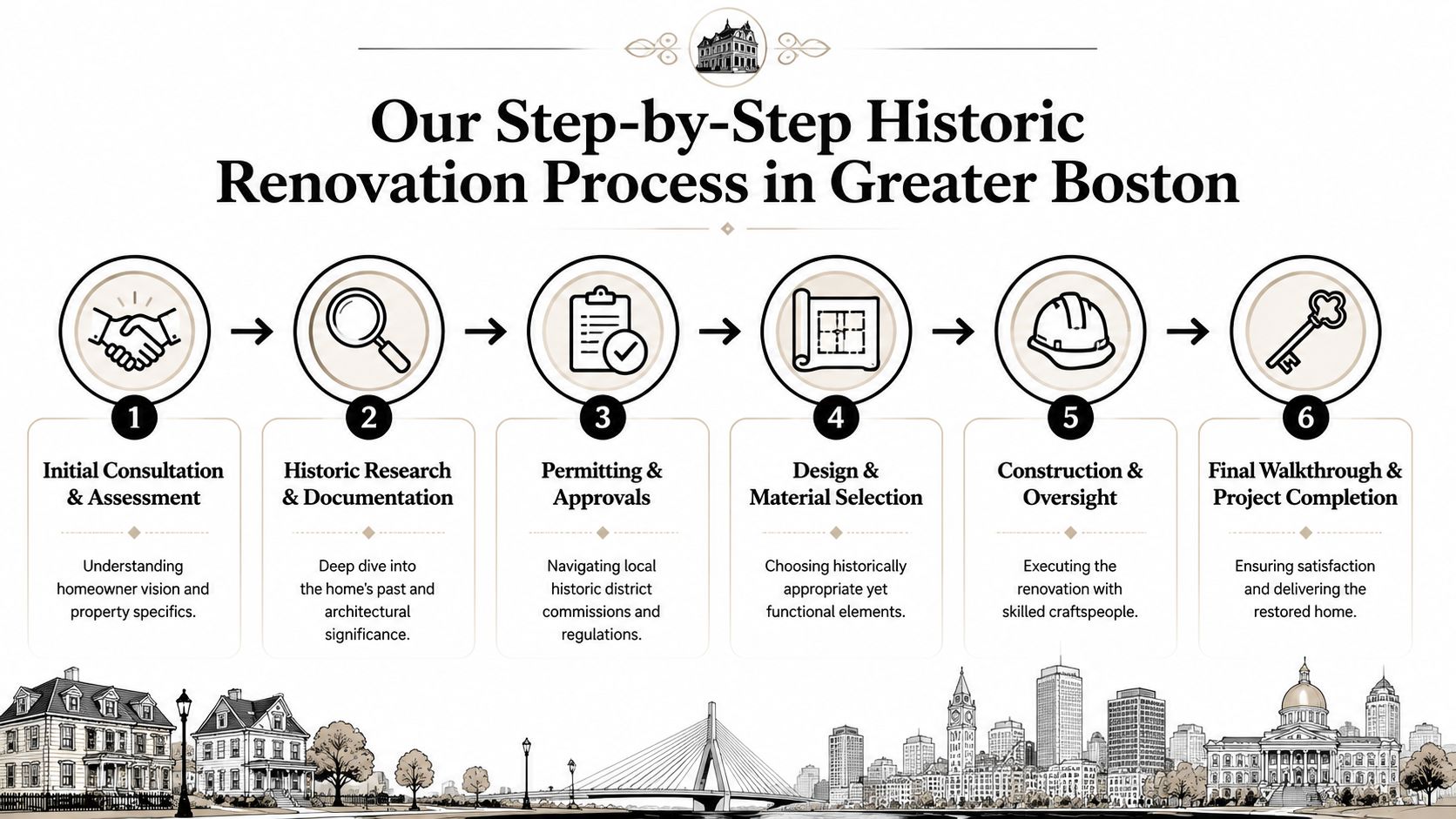
Historic work goes better when the sequence is disciplined. Problems multiply when homeowners jump into demolition before the house, the permit path, and the preservation constraints are fully understood.
Early in the process, we use a clear roadmap so the structural, design, and approval pieces move together instead of colliding in the field.
1. Initial assessment and historic review
We start by walking the property with a practical eye. We're looking at structure, water entry, settlement, roof lines, wall conditions, basement moisture, access for new mechanicals, and what original features still remain in good enough condition to save.
At the same time, we identify the home's character-defining elements. That may be front elevation details, stair geometry, casing profiles, plaster medallions, old flooring, or original window assemblies. If we don't know what matters on day one, someone will remove it by accident on day twenty.
This stage also tells you whether the project should be phased. Some homes need envelope and system work first, then kitchen and bath upgrades later. Others can support a larger whole-home renovation from the start.
2. Design coordination and scope control
Once we understand the house, we develop a design that respects it. The strongest plans usually improve circulation, storage, and daily use without flattening the interior into a generic open box.
That may mean:
- Opening selected areas, not every wall so the house still keeps room definition.
- Reworking kitchens carefully around original windows, ceiling heights, and floor transitions.
- Adding bathrooms where plumbing runs make sense instead of forcing expensive routes through finished historic spaces.
- Planning additions with restraint so old and new read clearly as related but not fake-matched.
For homeowners considering related work, this is often where projects overlap with a home addition contractor Boston MA, a kitchen upgrade, or a basement reconfiguration. In older houses, those scopes affect each other, so we plan them together.
A useful side topic for homeowners doing wood restoration is paint removal. If you're trying to understand why stripping old coatings can turn into painstaking handwork, Neasden Hardware's paint removal guide gives a good overview of the basic challenges involved.
Here's the project video many homeowners find helpful when they're trying to picture how a complex renovation comes together in practice.
3. Permitting, approvals, and construction execution
After design, we move into engineering, documentation, and permit preparation. Historic homes often need more complete drawing sets because so many downstream decisions depend on existing conditions, structural assumptions, and review comments from local boards.
In Greater Boston, that can involve local building departments, preservation staff, zoning review, and specialty permits depending on the scope. We coordinate the sequence so framing, electrical, plumbing, insulation, and finish work don't get approved on paper but blocked in reality.
During construction, old houses reward patience and punish rushing. A framing crew opens a wall and finds altered joists. A flooring contractor lifts a threshold and discovers patchwork repairs from decades ago. A masonry area that looked stable from outside may need more careful intervention once exposed.
Field advice: On a historic renovation, the cleanest-looking plan is not always the smartest one. The smartest one leaves room for what the house will reveal once work starts.
Historic Home Renovation Costs in the Boston Area
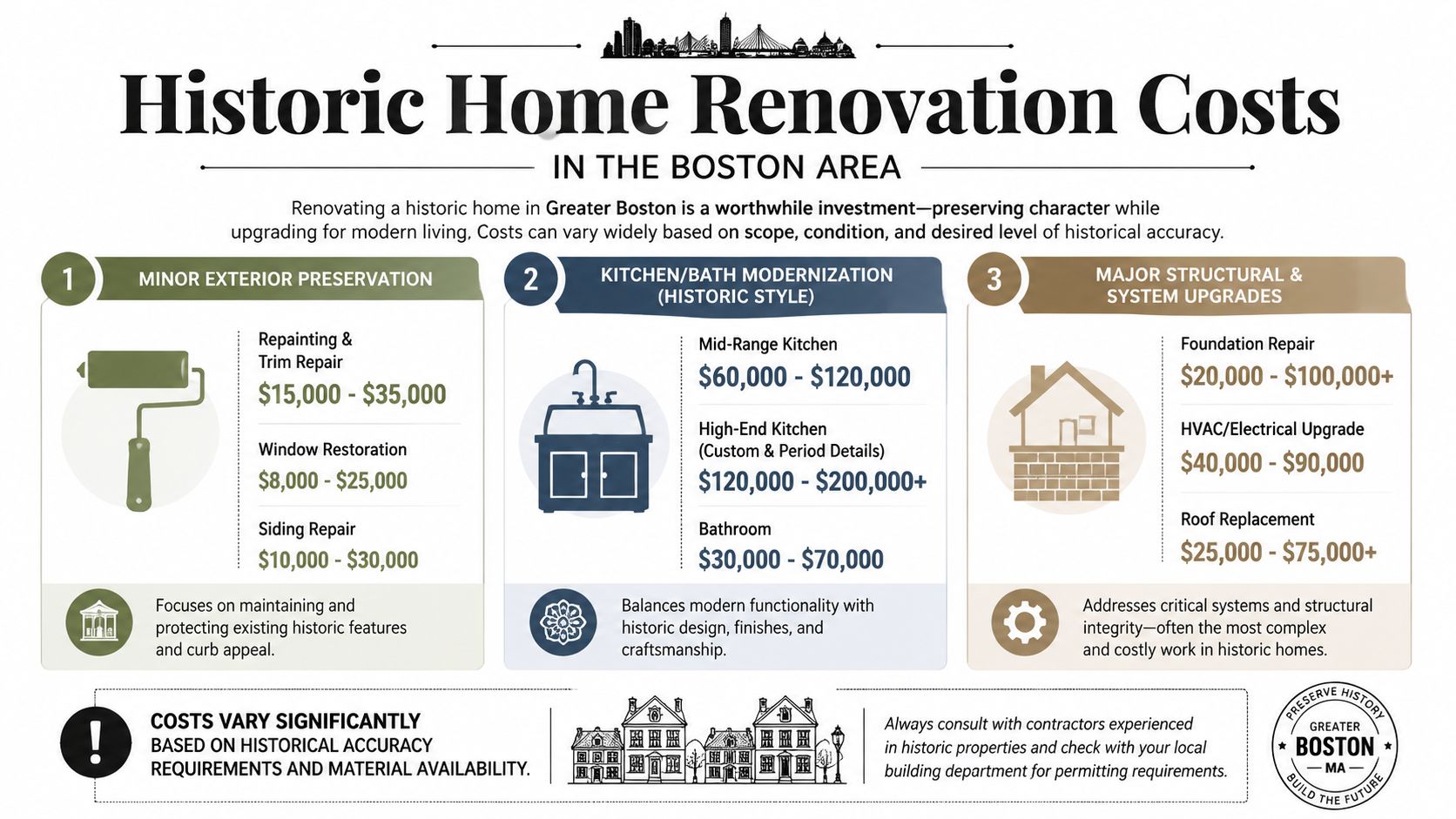
Historic home renovation costs in Greater Boston are usually driven less by visible finishes and more by the layers behind them. Specialized labor, approvals, documentation, selective demolition, matching materials, and hidden repairs all push the project beyond a standard remodel budget.
Industry guidance says homeowners should expect 20–50% more than a typical remodel, with full historic restoration often around $250–$500+ per square foot, and recommends at least a 20% contingency for unknowns, according to Palm Club Design Group's historic home restoration cost guide.
Where budgets move first
In the Boston area, these are usually the first cost drivers we flag:
| Cost driver | Why it matters in a historic house |
|---|---|
| Existing-condition uncertainty | Scope changes when walls, floors, and roof assemblies are opened |
| Custom carpentry and trim work | Historic profiles often need repair or fabrication, not off-the-shelf replacement |
| Structural correction | Older framing can require reinforcement before layout changes happen |
| Mechanical modernization | Electrical, HVAC, and plumbing upgrades often have to be threaded through finished areas |
| Permit and review work | Historic districts and local review boards can add drawing and approval time |
A kitchen in a newer house might be mostly cabinet, countertop, and appliance work. A kitchen in a Cambridge or Brookline historic home can include structural work, floor leveling, plaster transitions, wiring replacement, and custom millwork just to get the space ready for the visible upgrade.
What this means for kitchens, baths, and whole-house work
That's why we tell homeowners to separate finish budget from house budget. The tile and fixtures matter, but they aren't usually what surprises you first.
If you're pricing related scopes, our Massachusetts construction cost guide gives a useful local overview. For room-specific work, it also helps to compare the renovation category itself, such as kitchen remodeling Arlington or bathroom renovation Medford, because older homes often stack those scopes with system upgrades.
We generally recommend budgeting in this order:
- Stabilization first: Structure, roof leaks, drainage issues, and envelope failures.
- Systems second: Electrical, plumbing, HVAC, and insulation strategy.
- Historic fabric third: Windows, trim, flooring, plaster, masonry, and restoration carpentry.
- Finish selections last: Cabinets, tile, fixtures, paint, and hardware.
That order isn't glamorous, but it's what keeps historic projects from becoming expensive rework jobs.
Navigating MA Building Codes and Historic Commissions
In Massachusetts, a historic renovation usually runs on two separate tracks. One track is code and life safety. The other is historic review. Homeowners often assume one approval covers both. It doesn't.
Two approval tracks on one project
The building department looks at code compliance under 780 CMR, the Massachusetts State Building Code. If you're changing structure, egress, insulation assemblies, plumbing, electrical, or mechanical systems, permit review and inspections come into play.
A local historic district commission, when applicable, is looking at something different. They care about visible materials, window replacement, trim details, additions, doors, roof elements, siding, and how changes affect the architectural character of the property and streetscape.
That means a project can be code-compliant and still not be historically approvable. It can also be historically acceptable but require major plan revisions to satisfy structural or safety requirements.
For homeowners trying to understand the permit side more broadly, our guide to understanding building codes and permits for home additions gives a useful framework for how Massachusetts approvals are typically sequenced.
Where projects get delayed
The most common friction point is the repair versus replace question. Preservation guidance often favors repairing original windows, flooring, and other historic features, and even simple swaps may need justification and permits, as described in Laura U's guide to restoring a historic home for modern living.
Here's where homeowners lose time:
- Assuming exterior work is simple: A new door, replacement sash, porch rail, or siding patch may trigger review.
- Submitting incomplete drawings: Historic commissions often want enough detail to understand profiles, materials, and visibility.
- Treating code and preservation as separate jobs: The architect, engineer, builder, and trades need one coordinated plan.
- Ordering materials too early: Approval conditions can change the exact product or detail required.
In towns like Cambridge, Newton, Brookline, and Somerville, the approval path matters almost as much as the construction scope. A strong submission package saves weeks of avoidable back-and-forth.
On the code side, inspections still matter in the usual way. Framing, electrical, plumbing, insulation, and final inspections have to align with the approved scope before closeout. Historic status doesn't waive that. It usually makes early coordination more important.
Smart Energy Efficiency Upgrades for Your Older Home
A lot of homeowners think an older house has only two choices. Leave it drafty, or gut it. In most cases, that's the wrong framing.
The better approach is targeted performance work that improves comfort without sacrificing historic material. In a Boston-area historic house, we usually get the best results by tightening the building strategically and upgrading systems where they're least disruptive.
What usually works better than replacement
We like to start with areas that don't erase character:
- Air sealing attics and basements: These are often the biggest comfort wins because unconditioned spaces drive a lot of heat loss and air leakage.
- Mechanical upgrades with careful routing: High-efficiency equipment helps, but only if the distribution plan respects the house.
- Window restoration with storms: Original wood windows can often perform far better after repair, weatherstripping, and proper storm installation.
- Targeted insulation strategy: Insulate where assemblies can handle it, not where trapped moisture will create new problems.
For homeowners comparing insulation options, our article on the importance of proper insulation in whole-home remodeling or additions is a helpful starting point.
We also pay attention to lessons from other climates because the building-science principles still matter. A resource on solutions for Florida's intense heat is useful for understanding how older homes behave when insulation and air sealing are handled without enough regard for moisture, ventilation, and assembly compatibility.
What we avoid in older houses
We're cautious about gutting plaster walls just to chase blanket insulation goals. That can create a long list of losses all at once. You spend more, disturb original finishes, complicate trim and casing restoration, and sometimes trap moisture in assemblies that were designed to dry differently.
Instead, we look for upgrades that are compatible with the house:
Save the visible craftsmanship. Improve the invisible performance.
That's often the right balance in a historic home renovation. Better comfort. Better control of drafts. Better system performance. Less unnecessary removal.
FAQ for Your Massachusetts Historic Renovation
Can we live in the house during construction
Sometimes, yes. Often, only for part of the job.
If the work is limited to one area and the utilities can stay active safely, some homeowners remain in place. If the project involves major structural changes, kitchen removal, multiple bathrooms offline, heavy dust, or whole-house electrical and plumbing work, living there usually becomes impractical. In older houses, temporary conditions are harder to control because systems are already less flexible.
What happens if you find rot, old wiring, or other hidden problems
We assume the house will reveal something once selective demolition starts. The right response is not panic. It's documentation, pricing, and a clear decision path.
We typically stop that area of work, expose enough to understand the issue, coordinate with the needed trade or engineer, and issue a change order if the scope falls outside the original contract. That keeps the decision documented and prevents field improvisation from becoming expensive finish damage later.
How long does a major historic renovation take in Greater Boston
Approval time and existing conditions often drive the schedule as much as construction itself. A straightforward scope with limited exterior review moves differently from a project that needs commission approval, structural redesign, custom millwork, and staged inspections.
What matters most is whether the contractor has allowed enough time for drawings, procurement, permit review, material lead times, and the unknowns that older houses tend to expose. A compressed schedule on a historic project usually creates mistakes, not savings.
How do change orders work if we want to adjust the plan
Change orders should be written, priced, and approved before the added work moves ahead. That includes scope, material, labor impact, and any schedule effect.
The most common homeowner-driven changes involve kitchen layout shifts, bathroom fixture upgrades, window decisions, built-in storage, and finish substitutions after demolition reveals a better or worse existing condition. The cleaner the paperwork, the fewer disputes later.
Is it worth renovating the basement or adding an ADU in an older home
Sometimes it is, but only if the existing structure, moisture conditions, ceiling height, and egress path support the plan. Historic homes can make great use of underused space, but basement finishing and ADU work in Massachusetts need careful code review.
Homeowners exploring those paths often compare them with a broader remodel. Depending on the property, a basement finishing Cambridge MA project or work with an ADU builder Massachusetts may fit the house better than a larger addition.
Ready to talk through your historic home renovation the right way? Contact Aureli Construction for a free estimate at homeadditionma.com.