
In Newton MA, a lot of homeowners reach out to us at the same point. Cabinets are selected, tile is getting close, and then countertop pricing starts to feel slippery. One website shows a cheap material price, a showroom gives a different number, and a fabricator starts talking about edges, cutouts, seams, and template appointments.
That confusion is normal. The biggest mistake we see in Greater Boston kitchen remodels is treating countertop materials cost like a simple per-square-foot purchase. It isn't. You're paying for the surface, but you're also paying for fabrication, transport, labor, access into an older home, coordination with plumbing, and the reality that Boston-area installation work costs more than the broad numbers you see online.
For homeowners in Cambridge, Belmont, Arlington, Medford, Wellesley, and the surrounding towns we serve, the right question isn't just "What does quartz cost?" The better question is "What's the installed countertop cost for my kitchen, in my house, with my layout and my finish choices?" That's the number that matters when you're planning a real renovation budget.
Table of Contents
- Choosing Your Kitchen Countertops in Newton MA
- Why Per-Square-Foot Pricing Is Misleading for Boston Homeowners
- A Head-to-Head Comparison of Popular Countertop Materials
- The Workhorses Granite vs Quartz Costs in Massachusetts
- Specialty Surfaces Soapstone, Concrete, and Recycled Glass
- Our Process for Countertop Selection and Installation in Medford MA
- Sample Countertop Project Budgets for a Greater Boston Home
- FAQs on Countertop Costs and Remodeling
Choosing Your Kitchen Countertops in Newton MA
In Newton and Wellesley, most kitchens we remodel aren't blank-slate new construction. They're lived-in homes with older walls, floors that may not be perfectly level, cabinet runs that need to be checked carefully, and families trying to balance budget, durability, and style. That's why countertop decisions need to be made in the context of the full kitchen renovation, not as a last-minute finish pick.
What homeowners usually get wrong
The first trap is assuming the online material number is the project number. It rarely is.
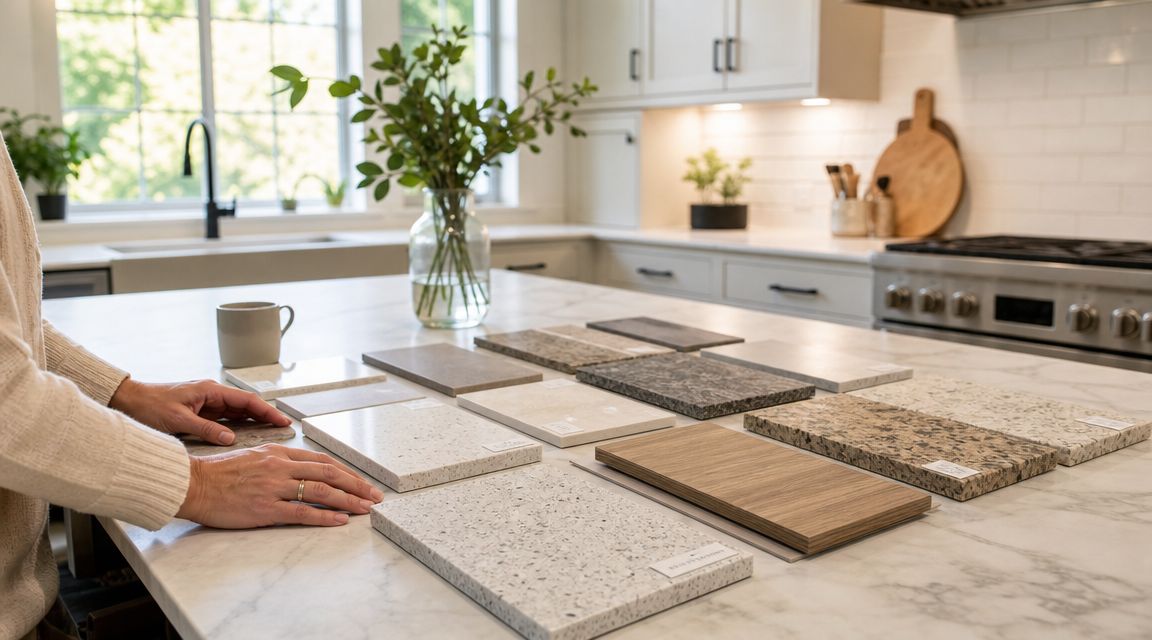
The second trap is comparing a laminate top, a stock quartz color, and a premium natural stone as if the only difference is appearance. In practice, each one creates a different chain of work. Some are lighter, some need more support, some hide seams better, and some make sink and cooktop details much more expensive to execute cleanly.
Practical rule: Buy countertops the same way you'd buy windows or cabinets. Judge the full installed scope, not the sticker on the base material.
How we frame the decision
We start with how you use the kitchen. A family cooking every night in a custom kitchen Newton project usually needs a different surface than a homeowner updating a rental unit or a light-use condo kitchen. We also look at cabinet condition, layout complexity, appliance plan, and whether the project includes backsplash work, lighting, plumbing relocation, or structural changes that trigger permits under the Massachusetts State Building Code, 780 CMR.
If you're already planning a broader kitchen renovation, it helps to look at countertops as one part of the full scope. Our team handles that coordination on kitchen remodel Newton MA projects so the countertop choice fits the cabinet layout, sink plan, and finish schedule.
For another practical read on full replacement pricing, homeowners sometimes compare notes with SouthRay Kitchen & Bath countertop estimates to see how all-in pricing discussions are framed beyond simple material quotes.
Why Per-Square-Foot Pricing Is Misleading for Boston Homeowners
A homeowner in Newton or Cambridge sees an online price of $70 to $90 per square foot for quartz, multiplies it by the size of the counters, and expects a clean, simple budget. Then the actual quote comes in much higher. The gap usually is not markup for the sake of markup. It is the installed scope that the online number leaves out.
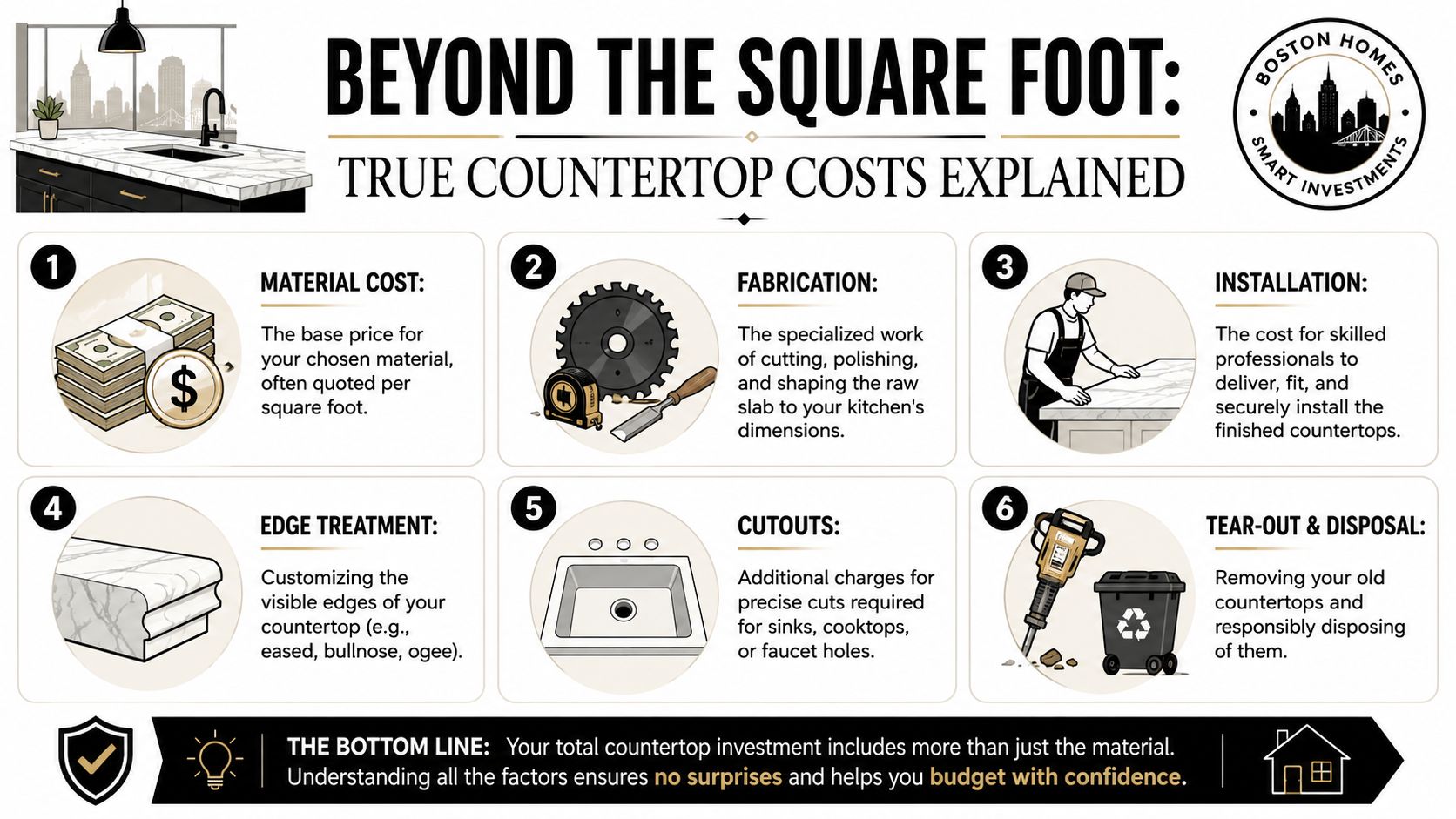
In Greater Boston, countertop cost is tied to the job around it. We price the template visit, fabrication details, delivery conditions, install labor, tear-out, disposal, and coordination with plumbing and backsplash work. A material-only number does not capture any of that, and it definitely does not reflect the extra labor that older local homes often require.
What the installed price actually includes
When our team builds a countertop proposal for a Boston-area remodel, we are pricing a sequence of work, not just a slab:
- Material selection: Color, pattern consistency, slab availability, and finish all affect final cost, especially if a specific look requires larger or cleaner slabs.
- Template and fabrication: The fabricator measures the finished cabinet layout, cuts sink and cooktop openings, finishes the edge profile, and plans seams that will look right in the room.
- Delivery and site access: Carrying heavy tops into a Back Bay brownstone, a Somerville triple-decker, or a tight second-floor condo takes more time and more crew than a simple first-floor walk-in job.
- Installation labor: Older homes around Boston rarely give you perfectly level cabinets and flat walls. Getting a good fit takes field adjustment and careful setting.
- Tear-out and disposal: Existing laminate, tile, or stone tops have to be removed without damaging cabinets, floors, or finished walls that are staying.
- Trade coordination: Plumbers disconnect and reconnect fixtures. Tile timing matters if a backsplash is part of the same project. Appliance specs need to be confirmed before fabrication is locked in.
Those are real costs. They are also the difference between a countertop that looks fine in a photo and one that fits the kitchen properly for the next fifteen years.
Why this hits Boston-area projects harder
Local labor is expensive, and access is often difficult. Parking restrictions, narrow streets, old framing, out-of-plumb walls, and limited staging space all show up in installed pricing. That is especially true in Brookline, Arlington, Cambridge, and many parts of Medford and Somerville, where the house itself adds labor before the stone ever comes off the truck.
We also see homeowners miss the connection between countertops and the rest of the renovation. If cabinets are being modified, if an apron-front sink needs extra support, or if the backsplash material changes the sequence, the countertop price changes with it. That is why we treat countertop selection as part of the full remodel scope, not as a stand-alone shopping exercise.
If two bids are far apart, ask each contractor to spell out what is included. One quote may include tear-out, sink cutouts, plumbing reconnection, and disposal. Another may only cover fabrication and basic install.
Homeowners who want a clearer picture of how builders structure pricing can also review Constructo Marketing's pricing guide. It does a good job explaining why labor, scheduling, supervision, and responsibility are built into a legitimate installed number.
A Head-to-Head Comparison of Popular Countertop Materials
Most homeowners we work with in Arlington, Belmont, Lexington, and Medford narrow the field to a handful of practical options. The right pick depends on maintenance tolerance, how hard the kitchen gets used, and whether this is a value-driven update or a long-term custom renovation.
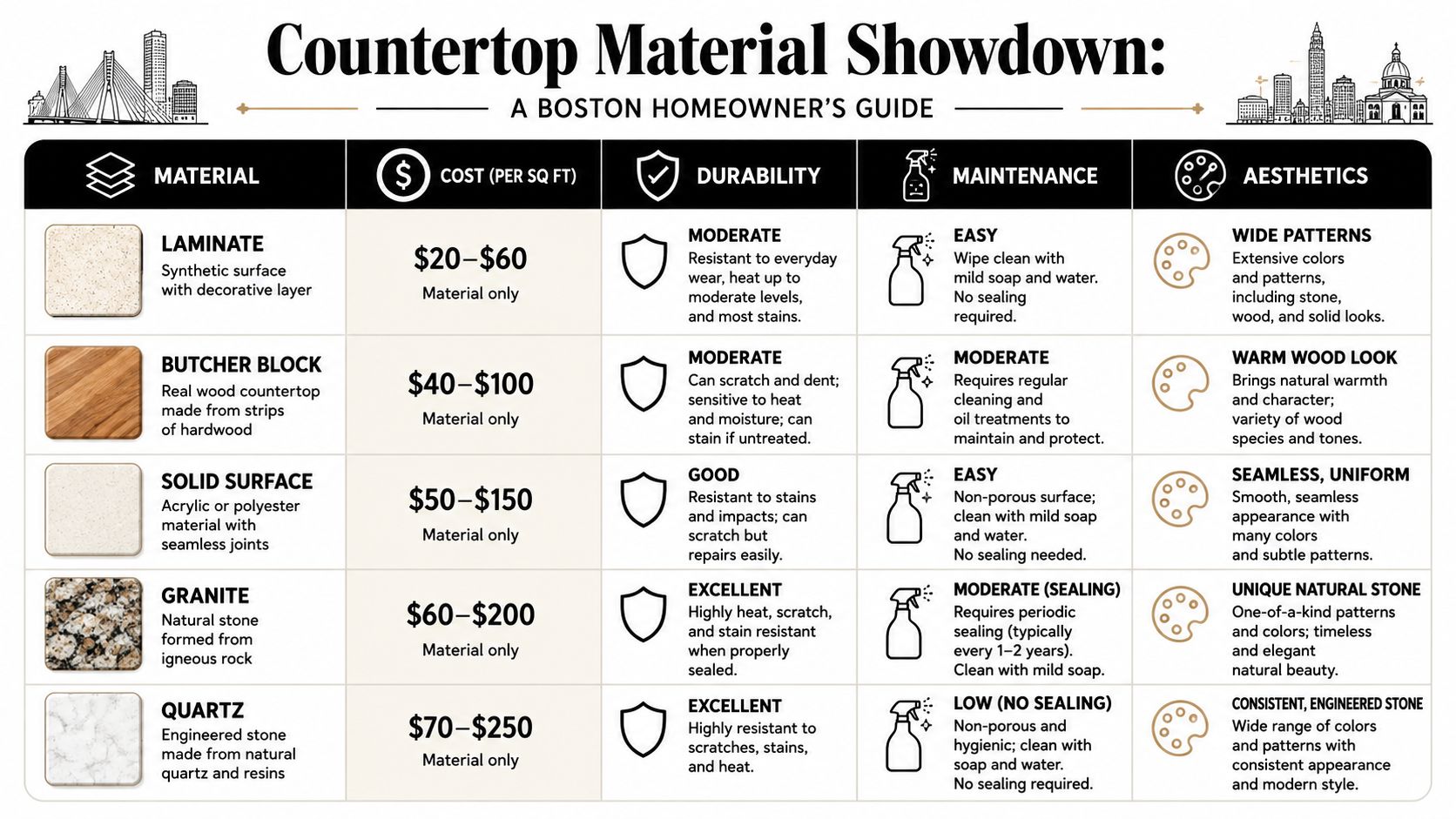
Quick comparison table
| Material | Installed cost position | Best for | Main drawback | Builder's take |
|---|---|---|---|---|
| Laminate | Lowest-cost category | Budget-conscious remodels, rentals, secondary kitchens | Doesn't deliver the same durability or premium feel as stone | Good when budget is tight and expectations are realistic |
| Butcher block | Mid-range, variable by wood and detailing | Warm, classic kitchens and accent areas like islands | Needs regular care and can show wear | Great in the right design, less ideal for low-maintenance households |
| Solid surface | Mid-range | Seamless looks, simple modern kitchens, integrated sinks | Less natural depth than stone | Practical, clean-looking, and easier to repair than many people realize |
| Granite | Premium category | Homeowners who want natural stone movement and heat tolerance | Color variation and sealing expectations | Still a strong choice for traditional and transitional kitchens |
| Quartz | Premium category | Busy households that want consistency and low maintenance | Can be less forgiving around heat | The most common request we see in full kitchen remodels |
How each material behaves in a real kitchen
Laminate is still the budget benchmark. It makes sense when the goal is a clean visual update without pushing the kitchen budget too far. It works well in condos, rental properties, and modest remodels where the cabinets and layout are straightforward. It doesn't fool anyone into thinking it's stone, but current patterns are better than what many homeowners remember from older homes.
Butcher block gives a kitchen warmth that stone can't. We like it most as an accent, especially on an island or coffee station, rather than across every counter in a heavy-use kitchen. Around sinks, Boston humidity swings and daily water exposure can turn a beautiful top into a maintenance item fast if the homeowner isn't committed to upkeep.
Solid surface doesn't get enough credit. If you want a smooth, understated look with simple maintenance and less visual noise, it's a smart option. It can also be a good fit in smaller kitchens where heavy patterning would make the room feel busy.
This video gives a useful visual overview of common countertop considerations:
Granite remains popular because every slab is different. Some homeowners want exactly that. In a custom kitchen Arlington or Belmont project, natural movement can be the feature that anchors the whole room. Granite does ask homeowners to accept variation. The slab in the yard isn't a printed sample. That's the point, but it isn't for everyone.
Quartz is the easiest recommendation for many families because it balances appearance, durability, and simpler upkeep. It fits a lot of local remodel styles, from clean contemporary spaces in Cambridge to more classic kitchens in Wellesley and Newton.
We usually tell homeowners to choose the material that matches how they actually live, not the one that only looks best under showroom lighting.
If you're comparing finish choices inside a broader local renovation, our kitchen remodeling Arlington service is one example of how we coordinate cabinetry, layout, and finish selections as one scope instead of treating countertops like an isolated purchase.
The Workhorses Granite vs Quartz Costs in Massachusetts
For most Greater Boston kitchen remodels, the decision comes down to granite or quartz. Both sit in the premium tier, and both can work very well. The difference is usually less about quality and more about how you want the kitchen to perform and look over time.
In major residential markets, laminate is the low-cost benchmark at about $20 to $50 per square foot installed, while engineered quartz and granite typically land in the $80 to $200 per square foot installed range, putting quartz and granite at roughly 4x to 10x the installed price of laminate based on this countertop pricing comparison. That spread is exactly why material choice has such an outsized effect on the final kitchen budget.
Where the price gap really shows up
The first layer is the surface itself. Some granite slabs are relatively straightforward. Others have more movement, rarity, or color characteristics that push them higher. Quartz is more controlled visually, but brand, pattern depth, finish, and slab size all matter.
Then there are fabrication decisions. A simple eased edge is one thing. Waterfall ends, thick miters, full-height slab backsplashes, oversized islands, and tight seam planning all push the installed number upward. That's true for both materials.
For a custom kitchen Belmont homeowner, we usually talk through three questions early:
- Do you want consistency or variation: Quartz gives more predictability. Granite gives one-of-a-kind movement.
- How much maintenance will you tolerate: Quartz generally asks less of the homeowner day to day.
- What part of the kitchen is the visual centerpiece: If the island is the focal point, the slab character matters more.
Which one we usually recommend
Quartz tends to win for busy families. It fits the way a lot of people cook now. It also works well in kitchens with painted cabinets, cleaner lines, and more controlled palettes.
Granite still has a strong place, especially in homes where natural materials matter to the design. We often see it chosen in more traditional kitchens, renovations where the homeowner wants authentic stone character, or projects where heat tolerance and natural variation are part of the appeal.
Heavy stone tops aren't just a finish choice. Cabinet condition, levelness, and support matter before the slab ever arrives.
That's one reason professional installation matters. In older Massachusetts homes, we often need to verify that cabinet runs are sound, islands are adequately built, and the substrate conditions are right before templating moves ahead.
Specialty Surfaces Soapstone, Concrete, and Recycled Glass
Some kitchens need something less common. In Cambridge, Brookline, and parts of Lexington, we work with homeowners who want the countertop to feel tied to the house itself, not just current showroom trends. That's where specialty surfaces come in.
The broader U.S. countertop market is estimated at $86.4 billion in 2025 and projected to reach $156.2 billion by 2035, implying a 6.1% CAGR, while another projection says U.S. kitchen countertop demand will increase 5.0% per year to 662 million square feet in 2026 with market value reaching $37.3 billion. That same market outlook identifies engineered quartz as the leading material segment in the Future Market Insights U.S. countertop industry analysis. In plain terms, mainstream materials dominate volume, which is one reason specialty options can involve more sourcing friction and longer lead coordination.
Where specialty materials make sense
Soapstone works especially well in older homes. It has a softer, quieter character than polished granite or bright quartz. In a historic Cambridge kitchen, that can be exactly the right move. Homeowners do need to be comfortable with a lived-in look. Soapstone develops character over time. That's a benefit if you want authenticity, not a flaw.
Concrete is custom by nature. It can be shaped for unusual layouts, integrated details, or a more architectural look. We usually steer homeowners toward it when the design concept is strong and the kitchen is being built around that material choice. It isn't a casual finish decision.
Recycled glass is for homeowners who want color, sparkle, or a clearly contemporary statement. It can look excellent in a modern kitchen with flat-panel cabinetry and controlled lighting.
Where they can go wrong
Specialty tops can disappoint when they're picked for novelty rather than fit.
- Soapstone: Great if you like patina. Wrong if you want a static, untouched appearance.
- Concrete: Strong design statement. Less forgiving if you expect a perfectly uniform factory finish.
- Recycled glass: Visually striking. Harder to integrate in kitchens that already have busy cabinet and backsplash selections.
In a custom kitchen Melrose or Somerville remodel, specialty materials usually work best when the rest of the room is restrained. If every finish is competing for attention, the countertop won't read as intentional.
Our Process for Countertop Selection and Installation in Medford MA
In Medford MA, countertop work goes smoothly when the decisions happen in the right order. Problems usually start when homeowners pick a slab before cabinet dimensions, sink specs, appliance openings, and support conditions are fully settled.
What happens before fabrication
We begin by confirming the scope of the kitchen itself. If cabinets are being replaced, they need to be fully installed, fastened, and leveled before templating. If the project includes plumbing or electrical changes, those are coordinated first. When structural work is part of the renovation, we also account for permit and inspection requirements under 780 CMR, along with local building department procedures.
Our team checks several practical items before the countertop fabricator ever templates:
- Cabinet support: Heavy materials need proper bearing, especially at sink bases, dishwashers, and island overhangs.
- Appliance fit: Slide-in ranges, cooktops, and farmhouse sinks can all change cutout planning.
- Wall conditions: Older walls are rarely perfect, which affects scribe lines and backsplash transitions.
- Finish sequencing: Countertops can't be treated as separate from tile, plumbing trim, and paint touch-ups.
For homeowners planning kitchen remodel Medford MA work, that's where having one team coordinate the cabinet layout, permitting, inspections, and finish schedule helps avoid expensive rework.
What happens on install day
Once the tops are fabricated, the install is usually fast, but the preparation is what makes it go well. Existing countertops are removed if needed. The new pieces are brought in carefully, dry-fit, set, seamed, and secured. After that, plumbers reconnect sinks and faucets, and backsplash or finish work proceeds in the correct order.
A clean install isn't only about the slab. It's about what was verified before the truck arrived.
Aureli Construction handles this as part of a broader kitchen remodeling scope, including coordination with local inspectors and trade partners across Greater Boston. That matters in older homes where small field adjustments are common and cabinet support isn't something you want guessed at.
Sample Countertop Project Budgets for a Greater Boston Home
A homeowner in Newton or Arlington might price a slab online, multiply by square footage, and assume the budget is set. Then the proposal comes in after templating, fabrication, delivery, cutouts, and install coordination, and the number looks very different. In Greater Boston, installed countertop cost is shaped as much by labor, access, and layout as by the material itself.
Three realistic budgeting examples
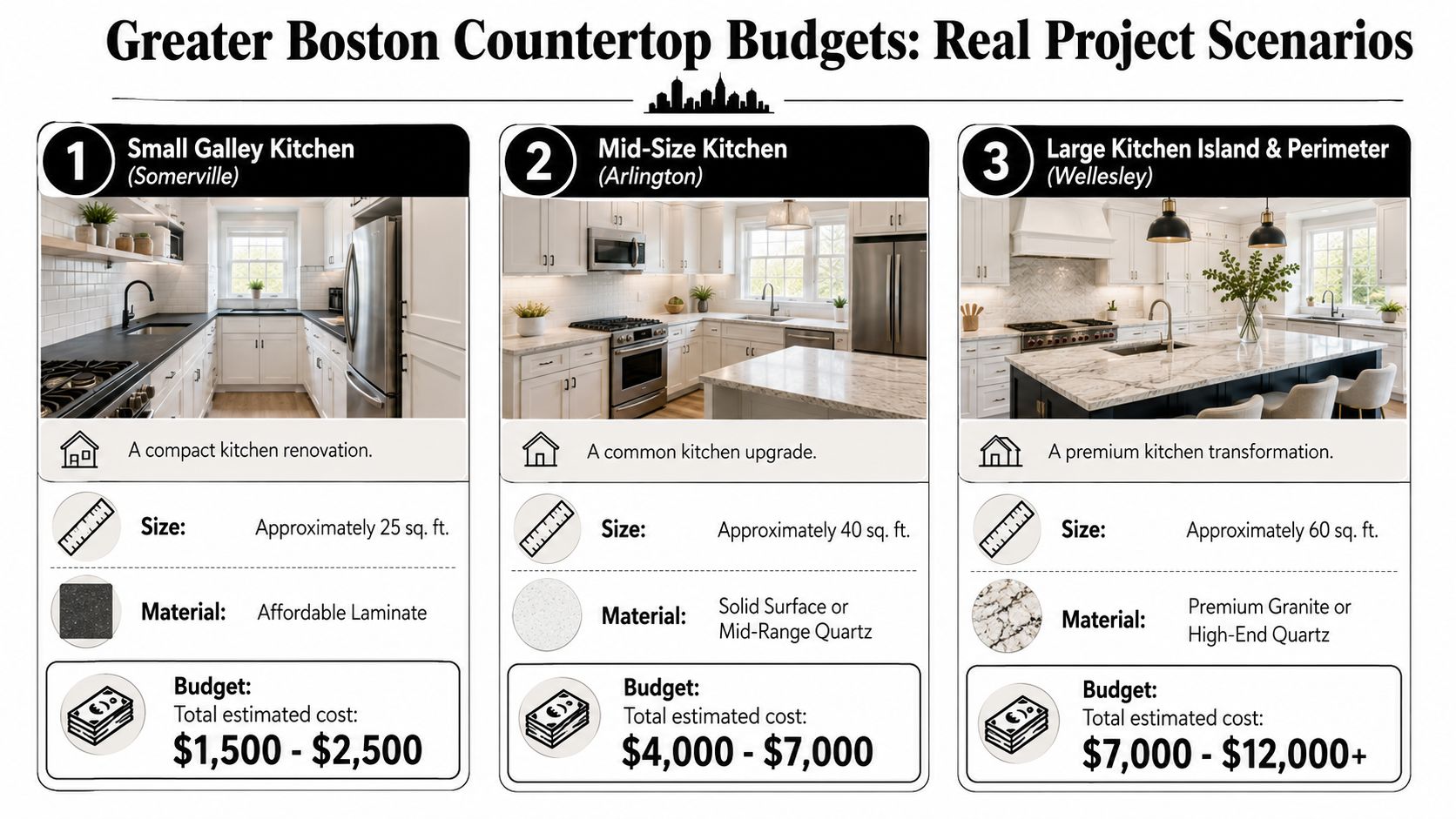
These are planning examples based on the installed ranges discussed earlier and what our team sees across the Boston suburbs. They are meant to help you set a realistic renovation budget before final selections and field measurements.
| Project type | Approximate size | Material direction | Likely budget takeaway |
|---|---|---|---|
| Small galley kitchen in Somerville | Compact footprint | Laminate or another budget-driven choice | Usually the most cost-controlled path, especially with fewer seams and simple cutouts |
| Mid-size family kitchen in Wakefield or Arlington | Standard perimeter plus some working space | Granite or quartz | A common range for homeowners updating cabinets, counters, and finishes together |
| Large kitchen with island in Wellesley | Bigger perimeter and island coverage | Premium granite, quartz, or specialty slab | Countertop cost becomes a major part of the overall kitchen investment |
The biggest pricing jumps usually come from project conditions, not just from upgrading the slab. An island adds coverage fast. Waterfall ends, full-height splashes, mitered edges, tricky sink details, and difficult access into an older Boston-area home all raise the installed number. A straight run with a simple undermount sink is one budget. A large kitchen with multiple pieces and detailed fabrication is another.
We walk homeowners through that difference early because countertops are rarely a stand-alone decision. They affect cabinet layout, backsplash scope, plumbing trim, appliance clearances, and how the full renovation gets sequenced. If you are weighing whether a higher countertop allowance makes sense in the bigger picture, our kitchen remodel ROI guide gives useful context on where that money tends to matter.
One practical note. Homeowners often find remodelers by researching local project costs and comparing firms online. If you are curious about that side of the business, contractors use content like this to get more contractor leads.
FAQs on Countertop Costs and Remodeling
How long does countertop installation take
The physical install is often the shortest part of the process. The longer portion is measuring, approving details, fabricating, and coordinating with plumbing and backsplash work. In a full kitchen remodel, countertop timing has to line up with cabinet completion and any required inspections.
Can new countertops go on old cabinets
Sometimes, yes. Sometimes, no.
We check cabinet condition, levelness, fastening, water damage, and whether the boxes can properly support the new material. Heavier tops make this more important. If the cabinets are weak or out of plane, replacing the countertop alone can create a poor result even if the slab itself is high quality.
Do I need a permit just for countertops
A countertop-only swap often doesn't trigger a building permit by itself. But if the work includes plumbing changes, electrical changes, structural modifications, or broader kitchen remodeling scope, permits may be required. In Massachusetts, that can also mean rough and final inspections depending on the work involved and the local building department.
How do you handle unexpected issues during installation
We look for them before installation. That's the point of site review, cabinet checks, and coordinated templating.
If something still comes up, such as hidden cabinet damage, wall irregularities, or a plumbing conflict, we stop and address it in the field before pushing ahead. That approach is the same one we use across kitchens, bathrooms, basements, and additions throughout Greater Boston.
Are countertops a good place to save money in a remodel
They can be, but not blindly. Saving money by choosing a simpler edge, a more straightforward layout, or a practical material can be smart. Saving money by forcing a premium look into a weak cabinet setup or by comparing incomplete quotes usually backfires.
Ready to sort out the actual installed cost for your kitchen, not just a material allowance? Contact Aureli Construction for a free estimate.