
In Arlington MA, a basement that started as a dumping ground for holiday tubs, kids' gear, and old tools can turn into the most useful part of the house once it's organized the right way. The catch is that older New England basements often bring damp concrete, low beams, and awkward utility layouts, so the first move isn't buying shelves, it's figuring out what the space can safely support.
That's where basement storage solutions have to be practical, not pretty. In Greater Boston, we see homeowners use the basement as the first overflow zone because storage demand keeps climbing, self-storage inventory in the U.S. exceeded 2 billion square feet in 2025, and 33% of Americans currently use self-storage while another 18% plan to rent in the future (StorageCafe self-storage industry statistics). The same market context is visible in homes, where built-in storage keeps replacing the old habit of pushing everything off-site.
Table of Contents
- Why Basement Storage Matters in Greater Boston Homes
- Assessing Your Basement Storage Constraints
- Planning a Basement Storage Layout That Won't Block Future Renovations
- Choosing Moisture-Smart Storage Materials and Systems
- When Moisture Control Matters More Than Adding More Shelves
- DIY Versus Hiring a Contractor for Basement Storage Projects
- Frequently Asked Questions About Basement Storage Solutions
Why Basement Storage Matters in Greater Boston Homes
A typical Arlington basement tells the story fast. There's a stack of paint cans from three owners ago, a ski bin that's been in the same corner since February, and a water heater that you need to get to without moving half the room. That's not just clutter, it's a planning problem, because the basement ends up carrying the overflow from the kitchen, the garage, the closets, and the rest of the house.
Homeowners already treat basements as part of a layered storage strategy. One industry source notes that 33% of U.S. self-storage renters have a basement in their home, which fits what we see on job sites in Belmont, Cambridge, Newton, and Somerville. People aren't ignoring the basement, they're relying on it, even when it's unfinished or only partly finished (Boxbee self-storage statistics).
Storage demand has shifted from temporary to built-in
That shift matters because the market around storage has changed too. The broader garage and storage products market is projected to keep growing, with Grand View Research estimating the global garage organization and storage market at USD 28.17 billion in 2025 and USD 54.97 billion by 2033. That projection points to a long-term move toward purpose-built household storage infrastructure rather than pure off-site renting.
Practical rule: if a basement keeps absorbing overflow year after year, it should be treated like a storage system, not a spare room with boxes in it.
The other reason this matters in Greater Boston is value protection. A basement that's organized, dry enough, and easy to move around in supports everyday life and keeps belongings from getting damaged by bad airflow, floor moisture, or simple neglect. For homeowners considering future basement finishing, smart storage now also keeps the space from becoming a demolition problem later.
Assessing Your Basement Storage Constraints
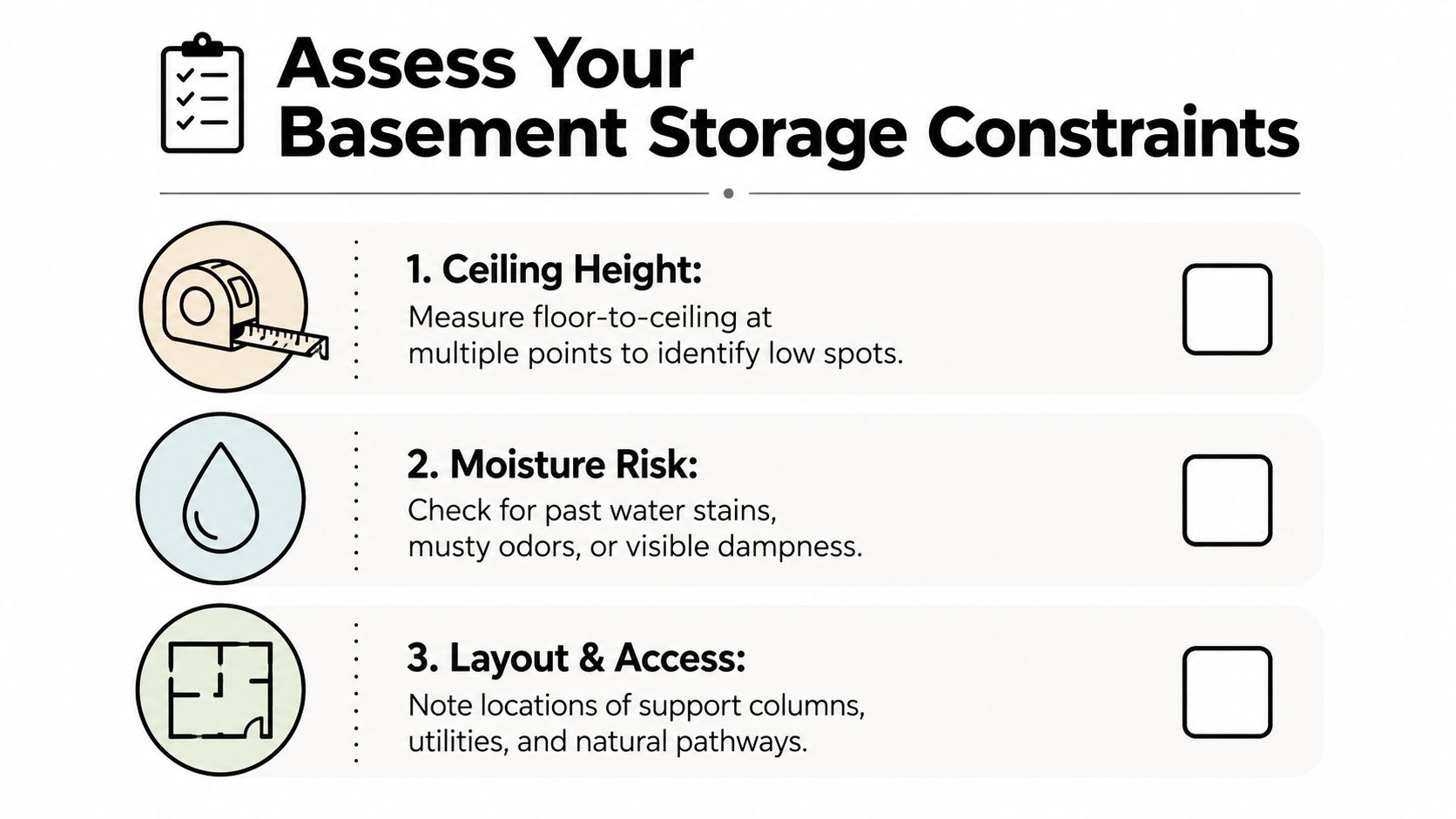
The first walk-through should be done with a tape measure, a flashlight, and a clear head. Measure floor-to-ceiling height at several points, not just the center of the room, because older foundations often sag, and low joists or ducts can kill a shelving plan that looked fine in the showroom. We also check where the electrical panel, furnace, water heater, sump, and shutoffs live before we touch a single bin.
Moisture comes next. FEMA says basements are among the most flood-prone parts of a home, and even a small amount of water can damage stored items; it also advises keeping valuables off the floor and using raised shelving or waterproof containers in flood-prone spaces (FEMA-related basement storage guidance). In a real Cambridge or Wellesley basement, that means looking for past water lines, musty odors, efflorescence on the walls, damp corners, and areas where condensation forms after a wet stretch.
Map the room before you buy anything
A simple sketch helps avoid expensive mistakes.
Measure the space, then measure the risk. If the room has seepage, rising humidity, or a known flood history, storage needs to be chosen around that fact, not around ideal conditions.
Use the sketch to mark three zones. One zone is for storage, one is for clear access to systems, and one is left open for circulation or future renovation. If you want a useful outside reference on making sense of tight footprints, space constraints solutions is a solid companion read because the logic is the same, use the room you have without blocking the function you'll need later.
Planning a Basement Storage Layout That Won't Block Future Renovations
The biggest mistake we see is permanent storage installed in the wrong part of the basement. A homeowner wants order today, but two years later they want a guest room, a bathroom, or a family room, and the old storage wall now sits where the new layout needs to go. That's why we plan flexible storage first, especially in homes that may later need a permit-driven remodel under the Massachusetts State Building Code, 780 CMR.
Leave the future living space open
If a section of the basement might become finished space, treat it as a no-storage zone now. Keep that area clear for future circulation, wall framing, insulation, and code-required clearances around egress, utilities, and fire separation. In many homes, it's easier to protect a future renovation path than to undo a bad storage wall later.
Wall-mounted shelving and shallow units work better than deep fixed cabinets when the room might change. Under-stairs cubbies can be useful, but they should stay out of the path of future plumbing runs or doorway openings. We also like freestanding modular units because they can be shifted without tearing into finished surfaces.
Aureli Construction uses this same planning-first approach when we handle basement finishing Cambridge MA projects and other basement builds across Belmont, Brighton, Brookline, Burlington, Lexington, Medford, Melrose, Newburyport, Newton, Arlington, Reading, Somerville, Stoneham, Wakefield, and Wellesley, MA. That matters because a storage plan should survive the day the basement becomes something more than storage.
Clear access to mechanicals isn't optional. If you can't reach a panel, water heater, or HVAC component without moving stored items, the layout is working against the house.
Design for change, not permanence
Keep the storage that's most likely to move in handled bins, not glued-in cabinetry. Use the basement's edges for organization and preserve the center for open passage. That gives you a room that can evolve without a full reset.
Choosing Moisture-Smart Storage Materials and Systems
A basement in Greater Boston can look dry on a cold day and still punish the wrong storage setup once summer humidity rolls in or a storm pushes moisture through the foundation. Shelves that swell, rust, or sag stop being storage pretty fast. They become a replacement job. The table below reflects the materials we rely on when a basement has to hold up through New England moisture swings.
| Basement Storage Material Comparison | Moisture Resistance | Load Capacity | Best For |
|---|---|---|---|
| Metal shelving | Good if coated and kept off standing water | High when properly braced | Cans, tools, plastic bins |
| Plastic bins | Strong for moisture resistance | Bin-dependent | Clothing, décor, papers, keepsakes |
| Treated wood | Moderate | Moderate to high | Custom built-ins in drier basements |
| Particleboard | Poor in damp conditions | Often lower and prone to bowing | Not recommended for basements with humidity exposure |
For serious use, technical guidance recommends units with 3,000+ lb total capacity and 600+ lb per shelf, plus double-leg construction, reinforcing ribs, and diagonal or lateral support bars to limit wobble and torsional flex. Light particleboard systems rated below 200 lb per shelf are much more likely to bow under cans, tools, and liquids, especially when the basement is humid (basement storage systems guidance).
Pick the structure that matches the load
Paint, tile leftovers, a drill kit, holiday bins, and bulk household supplies all put different demands on a basement. The frame matters more than the finish. Metal shelving with a decent powder coat usually holds up better than bargain wood products in a damp room, and plastic bins beat cardboard every time for moisture resistance. If the basement is part of a larger remodel plan, it also makes sense to look at a basement vapor barrier installation before you commit to a heavy storage build.
The same moisture-first logic shows up in the humidity controlled storage guide. If a material cannot tolerate the room it sits in, it does not belong there.
When Moisture Control Matters More Than Adding More Shelves
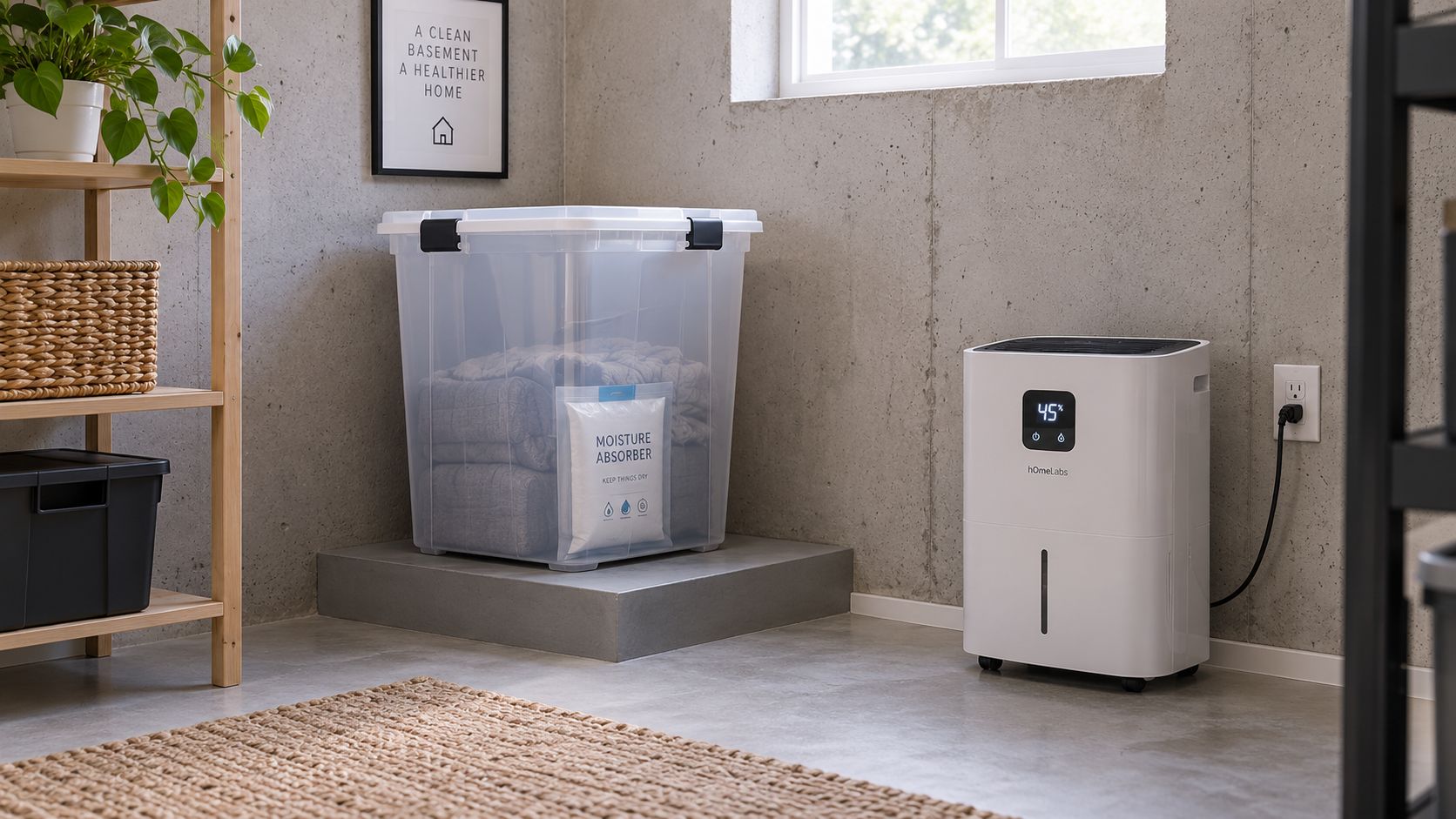
In a dry basement, more shelving makes sense. In a damp basement, more shelving can just mean more things to protect, and that's the wrong priority. Cardboard, textiles, paper records, and family keepsakes all suffer when the room has humidity swings or seepage, even if the items are off the floor.
The better move is often to reduce stored volume and improve moisture control first. Waterproof containers, raised shelving, and dehumidifiers give belongings a fighting chance, but they work best when the basement itself isn't fighting you. A homeowner in Newton or Medford doesn't need a wall of bins if the room is still holding moisture after storms or during summer humidity.
Store less, protect more
That sounds counterintuitive, but it's how we handle real basements. If a box holds sentimental items, tax records, or textiles, it belongs in sealed plastic, raised off concrete, and away from the coldest wall surfaces. If it's cardboard, replace it before the cardboard becomes the weak link.
A moisture-focused plan is even more important when the basement is being readied for future use. The same logic that drives basement moisture control also protects storage, because the safest storage system in a wet basement is the one that doesn't depend on perfect conditions.
For homeowners looking into condensation behavior in bins and sealed containers, stop mould in container storage is a useful perspective. It reinforces what we see on site, moisture management beats overpacking every time.
DIY Versus Hiring a Contractor for Basement Storage Projects
A simple shelving install is usually a DIY job. Once the project starts changing walls, adding outlets, relocating plumbing, improving egress, or turning part of the basement into usable living space, you're in permit territory under 780 CMR. In Massachusetts, finished-basement work often triggers review because it can change the use of the space, add habitable area, or require egress, fire separation, and moisture-control compliance, and local building departments handle permits and inspections.
What homeowners can usually handle themselves
Painting, labeling bins, assembling freestanding racks, and using plastic storage systems are straightforward. So is cleaning out the basement and deciding what stays. If the work stays organizational and doesn't touch structure, wiring, plumbing, or fire-rated assemblies, DIY often makes sense.
When a licensed contractor should be involved
The moment you're framing walls, rerouting utilities, building permanent storage into a future living area, or chasing a code-compliant finish, hire a licensed contractor. Rough framing, electrical, and plumbing inspections typically come before the final inspection, and that process matters because it catches issues while they're still easy to fix. In Greater Boston, Aureli Construction coordinates that permitting and inspection path with the local building department.
For homeowners budgeting a larger project, basement work in the Boston area usually lands in a mid-to-high local contractor range because of labor, material, and code requirements. If you're comparing a storage-only cleanup with a full remodel, how much to remodel a basement is the right place to gauge the jump in scope before you commit.
Frequently Asked Questions About Basement Storage Solutions
How long does basement storage work usually take? Simple organization can be done in a day or two. A finished-basement storage plan tied to framing, moisture control, or permits takes longer because inspections and sequencing matter.
Do I need a permit for shelves and bins? Usually not for basic freestanding storage. You do need permit review when the work changes structure, wiring, plumbing, egress, or finished space under Massachusetts rules.
What's the smartest first purchase? Start with moisture-resistant bins and sturdy shelving, not decorative cabinets. If the room feels damp, fix that first.
Can I keep using the basement while work is going on? Yes, if the layout stays phased and clear. A good contractor keeps access paths open so the house still functions.
How are change orders handled? We document them before the work changes, so the scope, cost, and schedule stay clear.
Aureli Construction helps Greater Boston homeowners turn damp, crowded basements into storage that works with the house instead of fighting it. If you want a practical plan for a basement in Cambridge, Arlington, Newton, or anywhere nearby, visit Aureli Construction for a free estimate and we'll look at the space the right way from the start.