
A Newton homeowner is standing at the kitchen counter with a contractor's estimate open on the table and a savings balance that falls well short of the project total. That's a familiar moment across Greater Boston, whether you're comparing kitchen remodeling Newton, a custom kitchen Belmont, or a full kitchen renovation in Cambridge.
After more than 30 years building and remodeling homes in Greater Boston, we've learned that the answer to how to pay for a kitchen remodel isn't a catalog of loan products. It's a decision based on three things: project size, available equity, and how long you expect to stay in the house. Cash, unsecured financing, and home equity each have a place. Borrowing against your home isn't automatically the smartest choice.
Table of Contents
- When the Estimate Lands and the Budget Question Starts
- What a Kitchen Remodel Actually Costs in Greater Boston
- Paying Out of Pocket, on Plastic, or Through the Contractor
- Borrowing Against Your Home in Massachusetts
- When Skipping a HELOC Is the Smarter Move
- Monthly Payments, ROI, and the Resale Math
- Your Financing Game Plan and Questions to Ask Before Signing
When the Estimate Lands and the Budget Question Starts
A six-figure kitchen estimate can make homeowners jump straight to a HELOC. That's usually too fast. First, separate the amount you want to spend from the amount you need to finance.
A firm contractor estimate should show demolition, cabinetry, counters, appliances, electrical work, plumbing, permits, finish work, and the payment schedule. If the estimate is still a rough allowance, financing decisions are premature. You may borrow too much, or worse, commit to a loan before you've made the design choices that control the final price.
Our practical rule: Choose the payment method only after the scope is defined and the budget ceiling is firm.
Cash remains the foundation for most renovation budgets. A 2026 financing study found that nearly three-quarters of homeowners use some type of financing for at least part of a renovation or repair project, while earlier Houzz surveys found cash and savings were still the dominant funding source, used by 83% of homeowners in 2020 and 91% in 2016. The pattern is straightforward. Homeowners usually start with savings, then add financing when the project grows beyond comfortable cash flow. The 2026 financing study documents that shift.
We recommend asking yourself three blunt questions:
- How much cash can I spend without damaging my emergency reserves?
- How much equity do I have after the existing mortgage?
- Will I still own this property when the financing is paid off?
A smaller refresh may work with savings and a short-term unsecured loan. A clearly scoped, major remodel may justify a fixed home equity loan. A phased project may suit a HELOC. If you expect to relocate, refinance, or sell soon, keeping the home free from another lien may matter more than securing the lowest advertised rate.
What a Kitchen Remodel Actually Costs in Greater Boston
Kitchen budgets have moved well beyond casual spending. Current market guides place a minor kitchen remodel around $28,458, a major midrange remodel around $82,793, and a major upscale remodel around $164,104. Other 2026 guides place typical full kitchen projects at roughly $30,000 to $50,000, with premium coastal markets such as Boston running 15% to 35% above national averages. These figures come from Block Renovation's kitchen remodel cost guide.
Those ranges are useful for orientation, but a Cambridge kitchen in an older house isn't priced like a straightforward suburban replacement. Access, plaster walls, outdated wiring, structural changes, tight staging space, and permit coordination can all affect the estimate. A kitchen that appears cosmetic may become a substantial renovation once walls open and the existing plumbing and electrical systems are visible.
For a closer look at the factors that shape a local estimate, see our kitchen renovation cost guidance. Countertop selection deserves particular attention too, especially when comparing natural stone, quartz, edge profiles, and slab availability. This guide to what drives quartz slab pricing is useful background when you're evaluating material allowances.
| Project scope | Greater Boston cost reference | Typical financing fit |
|---|---|---|
| Minor kitchen remodel | Around $28,458 | Savings, card paid promptly, or unsecured loan |
| Major midrange remodel | Around $82,793 | Personal loan, home equity loan, or HELOC |
| Major upscale remodel | Around $164,104 | Home equity loan, HELOC, or carefully structured combination |
| Full project in a higher-cost coastal market | Roughly $30,000 to $50,000 for typical projects, with Boston premiums possible | Depends on final scope and equity position |
The payment strategy changes as the scope changes. A project near the lower end may not justify appraisal costs, lien paperwork, or a second mortgage. A remodel above the midrange needs a serious conversation about cash flow, equity, contingency funds, and the risk of securing debt against your home.
That's why we price the work before we recommend a financing direction. The contractor's scope should lead. The loan product should follow.
Paying Out of Pocket, on Plastic, or Through the Contractor
Cash is still the cheapest money available, but it shouldn't leave the household exposed. We recommend preserving a meaningful emergency reserve rather than draining every dollar into cabinetry and appliances. A kitchen is important, but a depleted reserve turns an ordinary repair into a financial crisis.
Personal loans are often the cleanest middle option. They're unsecured, so the house isn't collateral, and fixed payments make the budget easier to understand. Current personal-loan offers can range from roughly 6% to 36%, depending on credit and lender terms, as described in the financing comparison from Fluent Contracting. Pre-qualification lets you compare terms before committing, and some lender guidance identifies 690 or higher as a good-credit threshold used by certain lenders. See NerdWallet's home-improvement loan guidance for that qualification context.
Credit cards make sense only for a controlled, smaller purchase or a promotional offer that you can repay within its payoff window. Carrying a large balance after the promotional period is a poor way to finance a kitchen.
Contractor financing can be convenient because the application and project schedule sit close together. Read the terms carefully, especially deferred-interest language, promotional expiration dates, origination charges, and what happens if the construction schedule changes.
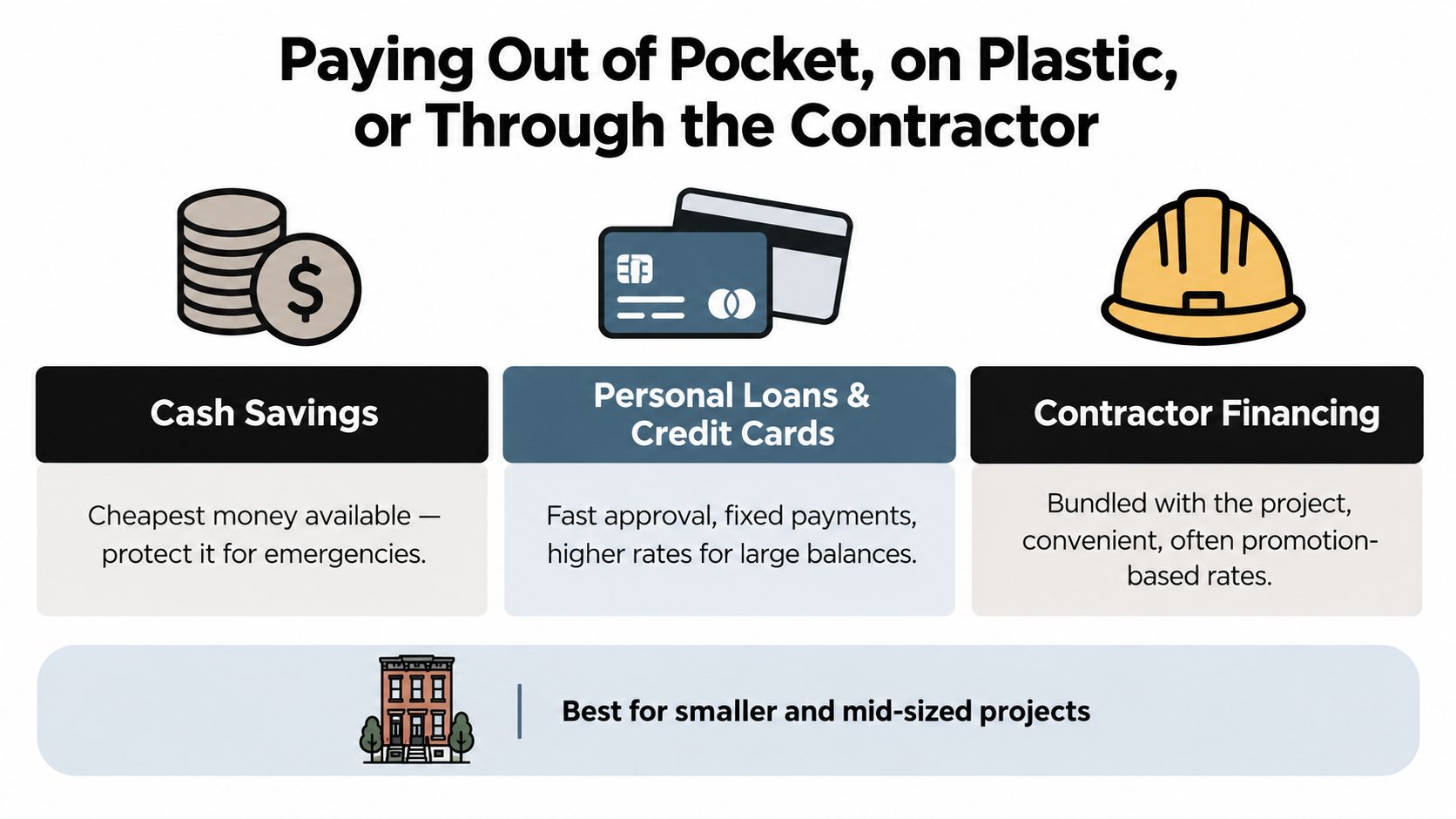
Our rule is simple. If the remodel is modest, your credit is strong, and using home equity would require extra closing work, compare unsecured financing first. If the project is large or will be built in phases, secured borrowing may become more practical, but only after you understand the risk.
Borrowing Against Your Home in Massachusetts
Home equity borrowing can be appropriate for a large, well-defined remodel. It isn't free money. A HELOC, home equity loan, and cash-out refinance all use the property as part of the lender's security structure.
A HELOC is a revolving line tied to available equity. It suits a kitchen that will be funded in stages, particularly when cabinet, countertop, appliance, and finish payments occur at different points. The variable-rate structure creates uncertainty, so compare the margin, draw period, repayment period, annual charges, and conversion options.
A home equity loan provides a fixed lump sum. It fits a firm bid where you want a predictable repayment schedule. Home equity loan terms can run from about five to 30 years, according to Credible's kitchen remodel loan guide.
A cash-out refinance replaces the first mortgage with a larger loan and releases the difference as cash. It can make sense in a narrow set of circumstances, but closing costs, the new interest rate, and the effect on the existing mortgage must be measured carefully. Refinancing can also reset the repayment timeline.
| Feature | HELOC | Home equity loan | Cash-out refinance |
|---|---|---|---|
| Funding structure | Revolving line | Fixed lump sum | New first mortgage with cash released |
| Best fit | Phased work and changing draw needs | Defined scope and payment certainty | Significant equity with a compelling mortgage case |
| Main concern | Variable rate and future payment changes | Borrowing more than the final need | Closing costs and replacing the existing mortgage |
| Property risk | Home secures the line | Home secures the loan | Home secures the new mortgage |
Massachusetts lenders commonly review loan-to-value, income, credit, title, and property value. Low-cost equity borrowing generally requires an 80% or lower loan-to-value ratio before renovations, and renovation or home-improvement loan denial rates have been reported around 43% to 44%, compared with roughly 10.6% for purchase loans, according to the Urban Institute's renovation financing analysis.
The lender may require an appraisal and title review. A Massachusetts homestead review can also matter. Compare APR, not just the note rate, and ask about appraisal charges, draw fees, annual fees, prepayment terms, and lien position. Homeowners considering investment property should also review this guide to rental home equity loans.
For broader project planning, our guide to financing a home addition covers the same budget discipline that applies to a large kitchen renovation.
When Skipping a HELOC Is the Smarter Move
A HELOC often looks cheaper because the advertised rate may be lower than an unsecured loan. That comparison can be incomplete. Appraisal costs, closing work, draw fees, variable payments, and the cost of putting another lien on the property all belong in the calculation.
We're especially cautious when the project scope is uncertain. If cabinets are still being redesigned, the plumbing layout may change, or the homeowner hasn't decided whether to include structural work, a revolving line can encourage borrowing before the actual budget is known.
Urban Institute data shows that only about 5.4% of homeowners overall used cash-out refinancing or home equity loans and lines of credit to finance renovations, with usage at 2.4% among households earning under $50,000. That doesn't mean equity products are wrong. It shows they aren't a universal solution, even though renovation articles often present them as the default. The same analysis also identifies the loan-to-value barrier that limits access for homeowners without substantial equity.

Consider avoiding a HELOC when:
- Your equity position is limited: A second lien may not be available on attractive terms.
- Your move is likely: Selling or relocating can become more complicated when the project debt is tied to the property.
- The scope is unsettled: An unsecured loan for a controlled phase may limit over-borrowing.
- Your reserves matter more than your rate: A fixed unsecured payment may preserve flexibility without pledging the house.
- A refinance is already under consideration: A new lien can affect a future refinance strategy in Cambridge, Newton, or another high-value market.
The psychological tradeoff matters too. Unsecured debt can feel expensive because the monthly payment is visible. Secured debt can feel comfortable because the rate appears lower. But secured borrowing puts the home behind the obligation. If flexibility is the priority, the higher visible payment may be the more responsible choice.
Monthly Payments, ROI, and the Resale Math
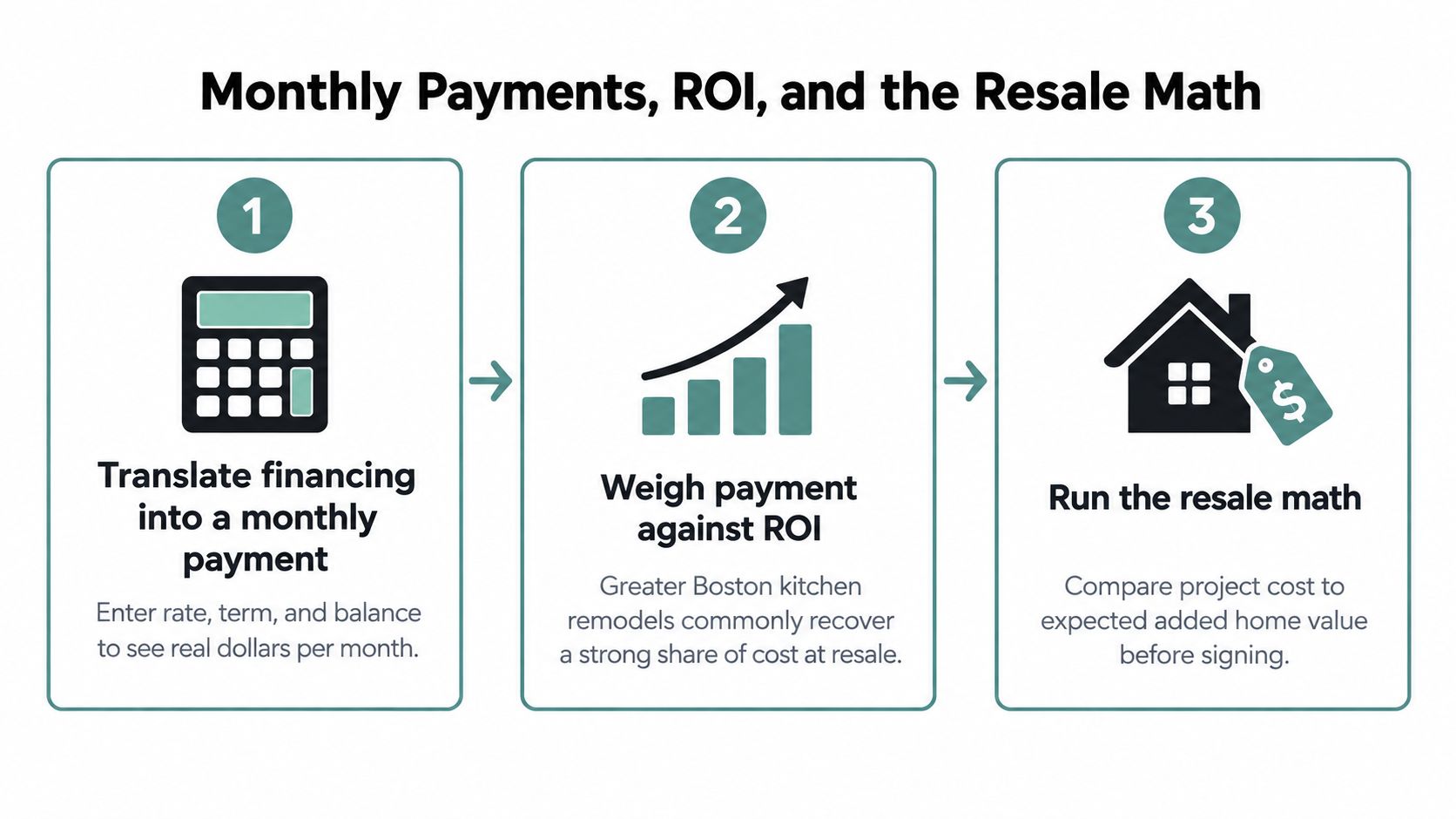
A remodel has two separate financial questions. First, can you comfortably make the payment? Second, will the finished kitchen support the home's value and marketability? Don't confuse the second question with a promise that the project will pay for itself.
Start with the payment. Ask the lender to show the balance, APR, term, fixed or variable structure, minimum payment, and the payment after any interest-only period ends. Compare that number with the household budget after taxes, insurance, utilities, and routine maintenance. A payment that works only if every month goes perfectly is too high.
For larger projects, a fixed home equity loan can make the payment easier to forecast. A HELOC may offer flexibility during construction, but its payment can change. An unsecured loan may cost more in interest while keeping the property outside the collateral structure. The right choice depends on the complete terms, not the headline rate.
The resale case is strongest when the kitchen solves a real market problem. Better circulation, durable counters, adequate storage, modern electrical capacity, and a sensible connection to the dining or living area can help a home compete. A highly personalized luxury package can be harder to recover if it exceeds what buyers expect in the neighborhood.
Use our kitchen remodel ROI guidance as a planning reference, then ask a local real estate professional how buyers in your specific part of Greater Boston respond to renovated kitchens.
A renovation can also reduce buyer objections. A finished kitchen may shorten the list of visible work, reduce inspection negotiations, and make the home easier to show. None of that guarantees a particular sale price. It does mean design and financing decisions should support the neighborhood, the house, and the likely buyer.
Your Financing Game Plan and Questions to Ask Before Signing
Put the decision in this order. Don't let a lender's available product dictate the construction scope.
- Confirm the scope: Get a written estimate that separates allowances, fixed prices, exclusions, permits, and change-order procedures.
- Lock the budget ceiling: Decide what you can spend, what you can finance, and what amount stays untouched for household reserves.
- Choose the payment tier: Use cash first where it's comfortable, unsecured financing for manageable mid-sized work, and equity borrowing for a large, defined project when the lien risk makes sense.
- Pre-qualify with more than one lender: Compare APR, term, payment, funding speed, and whether the credit inquiry is a soft pull.
- Schedule draws around construction: Match payments to completed milestones, not vague calendar dates.
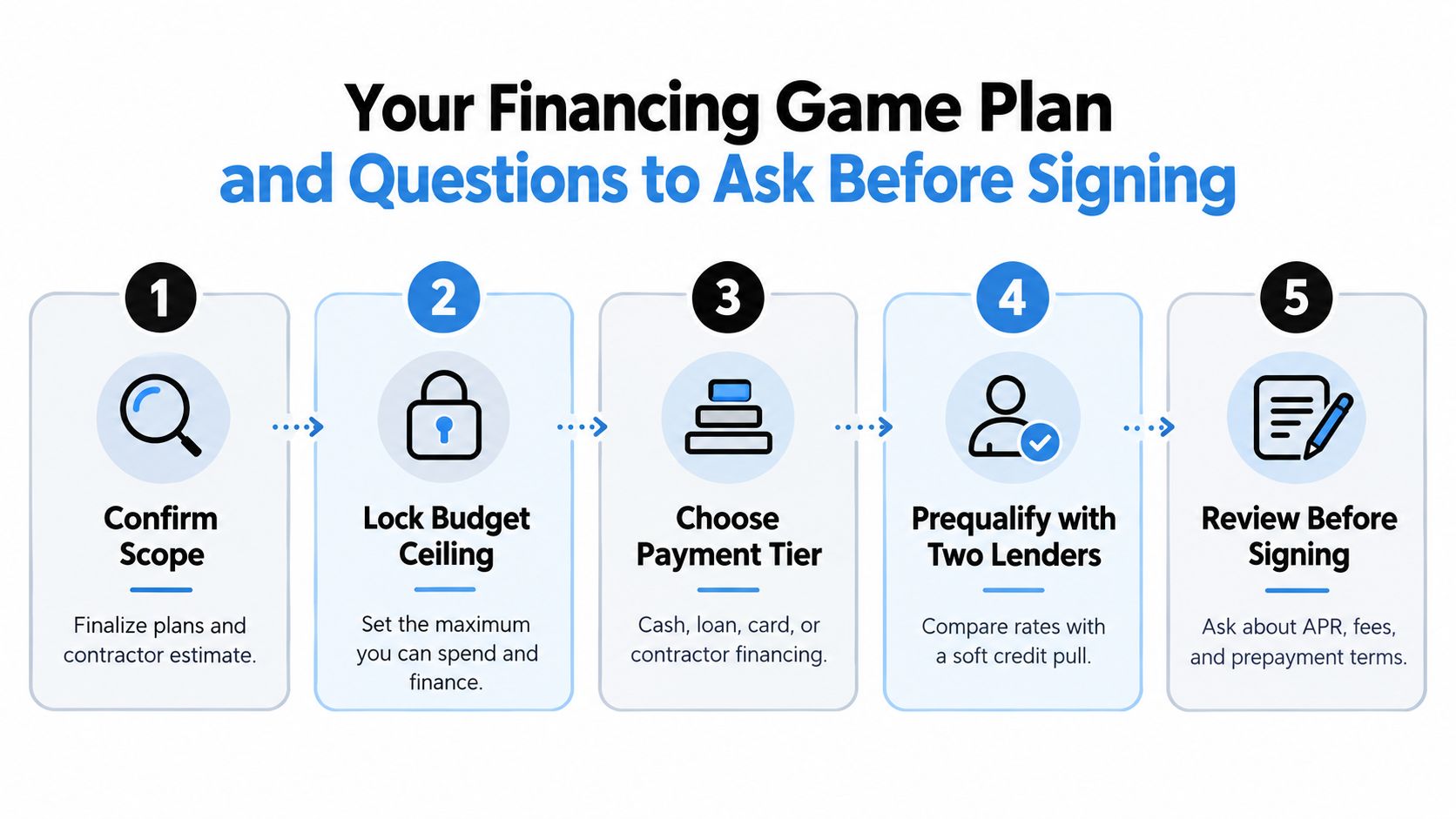
Ask every lender these questions before signing:
- Is the APR fixed or variable?
- What is the draw period and when does full repayment begin?
- Are appraisal, origination, annual, or draw fees charged?
- Is there a prepayment penalty?
- Will the lien position affect a future refinance?
- What happens if the project costs less than the approved amount?
- What documents are required for income, assets, mortgage balance, and property ownership?
In Massachusetts, structural kitchen changes, electrical work, plumbing work, moving walls, or changing a building's use typically require a building permit under 780 CMR, the Massachusetts State Building Code. Electrical and plumbing work may require separate permits, and the project can involve rough inspections for framing, electrical, and plumbing followed by final inspections before closeout. Massachusetts kitchen permit guidance explains the common permit triggers.
We're a Massachusetts licensed general contractor, and Aureli Construction coordinates permitting and local building department communication across Greater Boston. That includes work in Belmont, Brighton, Brookline, Burlington, Cambridge, Lexington, Medford, Melrose, Newburyport, Newton, Reading, Somerville, Stoneham, Wakefield, and Wellesley. Homeowners comparing kitchen remodeling Somerville, kitchen remodeling Lexington, kitchen remodeling Stoneham, kitchen remodeling Burlington, kitchen remodeling Wellesley, or a kitchen renovation near me should verify contractor licensing, insurance, scope, and change-order terms before comparing prices.
Frequently asked questions about kitchen remodel financing
Should I use cash or borrow for a kitchen remodel?
Use cash when it won't compromise your household reserves or other financial priorities. If paying cash would leave you exposed, combine a reasonable cash contribution with financing rather than emptying the account.
Is a HELOC good for a kitchen renovation?
A HELOC can fit a phased project where the final draws are uncertain. It's less attractive when the scope is unsettled, the rate is variable, or you don't want another lien against the property.
Do kitchen remodels require permits in Massachusetts?
Structural changes, wall removal, electrical work, plumbing work, and changes in building use commonly require permits under 780 CMR. Local building departments may also require separate electrical or plumbing permits and inspections.
How should contractor payments be scheduled?
Tie payments to defined milestones, such as completed demolition, rough inspections, cabinet delivery or installation, countertop templating, and final completion. Avoid a schedule that asks you to fund work well before materials or labor are provided.
What should I bring to a lender?
Gather income documentation, asset statements, mortgage information, property details, and the contractor's written estimate. The lender may also request an appraisal, title review, insurance information, and details about the planned improvements.
We help Greater Boston homeowners turn kitchen plans into a defined scope, realistic payment schedule, and permitted construction project. Contact Aureli Construction for a free estimate and a straightforward conversation about the right way to fund your remodel.