
In Greater Boston, a meaningful kitchen remodel most often lands between $60,000 and $180,000 in 2026, with luxury scopes and structural changes pushing past that. A smaller cosmetic update can cost less, but the moment you move walls, plumbing, gas, or major electrical systems, the budget changes quickly.
In Cambridge, Belmont, and nearby communities, homeowners often start with a simple question: why do two contractors quote dramatically different prices for what appears to be the same kitchen? The answer usually sits behind the cabinets and plaster. Existing conditions, structural work, appliance selections, finish quality, and local labor logistics all affect kitchen renovation costs.
The national benchmarks are useful, but they aren't a Greater Boston bid. National remodeling data lists a minor midrange remodel at $28,458, a major midrange remodel at $82,793, and a major upscale remodel at $164,104 (HomeAdvisor kitchen remodeling cost data). In Massachusetts, older housing stock, tighter job sites, higher trade costs, permitting, and parking constraints can move a project toward the upper end of those benchmarks or beyond them.
Table of Contents
- What a Real Greater Boston Kitchen Project Actually Costs
- The Line Items That Make Up a Kitchen Renovation Budget
- Scope Tiers From Minor Refresh to Full Gut Remodel
- Massachusetts Permits and Code Requirements That Affect Cost
- Kitchen Renovation ROI and Resale Value in Greater Boston
- Practical Ways to Control Costs Without Cutting Corners
- Planning Your Kitchen Renovation Budget the Right Way
What a Real Greater Boston Kitchen Project Actually Costs
A homeowner in an Arlington 1950s ranch recently asked why one contractor quoted $48,000 and another quoted $96,000 for what looked like the same work. On paper, both bids mentioned cabinets, counters, flooring, lighting, and painting. The lower proposal assumed the existing electrical service could support the new appliances, the sink would remain close to its current location, and no structural opening would be needed. The higher proposal included engineering, upgraded circuits, more complete demolition, better cabinetry, and allowances for conditions common in older homes.
That gap isn't unusual. Four factors drive most Greater Boston kitchen renovation costs:
- The existing layout: Keeping the sink, range, and dishwasher near their present locations limits plumbing and electrical work.
- What the walls conceal: Framing changes, old wiring, damaged sheathing, and previous unpermitted work can surface during demolition.
- The finish and appliance package: Stock cabinets and standard appliances price very differently from custom cabinetry, natural stone, and professional-grade equipment.
- Local labor and logistics: Dense neighborhoods require careful deliveries, debris removal, parking coordination, and trade scheduling.
A national guide also notes that geography can materially change a comparable project. One cited comparison puts a midrange major overhaul at $56,639 in Titusville, Florida, versus $77,460 in San Francisco, illustrating how labor, permits, and regional conditions alter pricing (Home Depot kitchen remodel cost guide).
Greater Boston kitchen remodel cost ranges
| Project type | Typical range | What you get |
|---|---|---|
| Cosmetic work | $25,000 to $40,000 | Paint, hardware, fixtures, selected cabinet or counter updates, and the existing layout |
| Midrange full remodel | $60,000 to $120,000 | New cabinetry, counters, appliances, updated electrical, flooring, and controlled layout improvements |
| Luxury gut renovation | $150,000 to $300,000+ | Structural changes, custom cabinetry, premium appliances, extensive mechanical work, and reconfigured space |
These are practical planning bands for Greater Boston, not guaranteed bids. For homeowners comparing materials and early design decisions, it can also help to browse kitchen renovation tips before requesting estimates. The useful comparison is not just the lowest number. It is whether every contractor priced the same demolition, permits, rough-ins, finish level, and contingency.
The Line Items That Make Up a Kitchen Renovation Budget
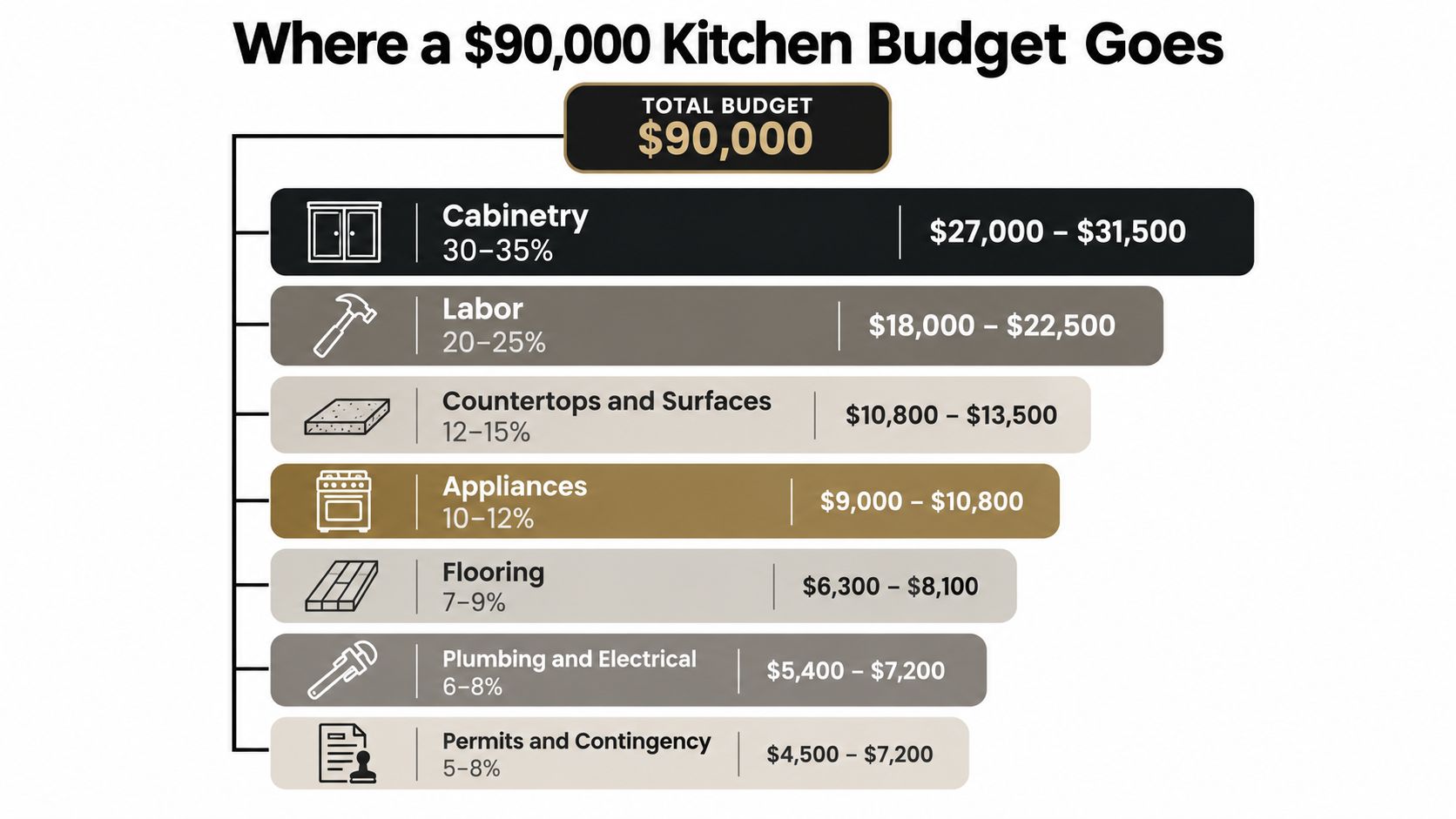
A $90,000 midrange kitchen renovation gives us a useful way to understand where the money goes. The following planning allocation is based on the specified scope assumptions for this example, not a universal price formula.
| Line item | Share of budget | Example amount |
|---|---|---|
| Cabinetry | 30% to 35% | $27,000 to $31,500 |
| Labor and installation | 17% to 22% | $15,000 to $20,000 |
| Quartz or granite countertops | 10% to 15% | $9,000 to $13,500 |
| Appliances | 10% to 15% | $9,000 to $13,500 |
| Electrical and lighting | 8% to 10% | $7,000 to $9,000 |
| Plumbing rough-in and relocation | 5% to 10% | $4,500 to $9,000 |
| Flooring | 5% to 8% | $4,500 to $7,200 |
| Design and engineering | 3% to 7% | $2,700 to $6,300 |
| Permits and inspections | 1% to 3% | $900 to $2,700 |
| Contingency | 10% to 15% | Held for hidden conditions |
Cabinetry usually controls the center of the budget because it combines material, hardware, fillers, panels, installation, and finishing details. A stock or semi-custom line can preserve money for electrical and structural work. Custom sizing, inset doors, specialty storage, and matching panels raise the cabinet allowance quickly.
Electrical is another frequent miss. Modern kitchens may require dedicated circuits, new lighting, under-cabinet wiring, and enough panel capacity for the range, dishwasher, refrigerator, microwave, and disposal. Older Greater Boston houses can also require investigation of asbestos-containing materials or knob-and-tube wiring, while narrow streets create dumpster and delivery costs that a quick showroom estimate may omit.
Plumbing costs rise when the sink, dishwasher, or range moves. Labor also doesn't scale neatly. Once framing, plumbing, electrical, drywall, flooring, and cabinetry all enter the same room, trades must work in sequence. They can't all work at once, so each added scope item can extend supervision, protection, cleanup, and scheduling.
For homeowners comparing surface options, our guide to countertop materials and costs provides a useful place to organize that decision before bids are finalized.
Scope Tiers From Minor Refresh to Full Gut Remodel
Contractors price kitchens by scope, not by appearance. Two kitchens can look similar when finished, while one required only cabinet replacement and the other required structural engineering, new circuits, relocated plumbing, and a full permit process.
| Scope tier | Price range | Scope definition | Common upgrade trigger |
|---|---|---|---|
| Cosmetic refresh | $20,000 to $40,000 | Refacing or replacing doors, counters, paint, fixtures, and hardware with the layout untouched | New cabinet boxes, extensive flooring, or relocated services |
| Midrange refresh | $45,000 to $80,000 | New cabinet boxes, mid-grade appliances, and updated electrical without moving walls | Plumbing relocation, higher-grade cabinetry, or wall opening |
| Major midrange remodel | $80,000 to $140,000 | Selective wall removal, relocated sink or range, upgraded cabinetry, quartz or natural stone | Structural engineering, custom cabinetry, premium appliances |
| Full gut upscale remodel | $150,000 to $300,000+ | Structural changes, custom cabinetry, professional appliances, new windows, and mechanical relocation | Bespoke details, imported finishes, or extensive additions |
A cosmetic refresh works when the cabinet boxes are sound, the layout functions, and the electrical and plumbing systems don't need substantial alteration. It doesn't work if the doors are being replaced to disguise warped boxes, damaged flooring, poor storage, or an undersized electrical service.
A midrange refresh is often the practical choice for a kitchen remodeling project in Medford, Somerville, Lexington, Arlington, Belmont, Stoneham, Melrose, Wakefield, Burlington, Winchester, Weston, Wellesley, or Newton when the walls stay in place. Homeowners searching for kitchen remodeling Medford or kitchen remodeling contractor Medford can review kitchen remodeling services in Medford while comparing what each contractor includes. The same principle applies to kitchen remodeling in Somerville, especially where access and parking affect staging.
Some upgrades move a project sharply upward. The specified planning assumptions include $15,000 for a Sub-Zero refrigerator, $3,500 to $6,000 for moving a gas line, and $8,000 to $20,000 for load-bearing wall removal and related engineering and framing. Those items don't merely add a product. They trigger labor, coordination, inspections, protection, and often changes to several other line items.
Massachusetts Permits and Code Requirements That Affect Cost
Massachusetts treats a kitchen remodel differently depending on what changes. Painting, cabinet refacing, and a straightforward appliance swap may be ordinary repairs when they don't affect regulated systems. Work involving substantial wall removal, structural supports, required egress, mechanical systems, or public health and safety falls under permit requirements described in 780 CMR 105.2 (Massachusetts permit requirements under 780 CMR 105.2).
The current 10th edition of the Massachusetts State Building Code took effect on October 11, 2024. Local building departments issue permits, and applications must state the proposed work's valuation (Massachusetts home improvement and building permit guidance). Electrical, plumbing, and gas work may also require their own trade permits. If the project changes exterior conditions, setbacks, or building use, local zoning review, a special permit, or a variance may apply.
Belmont permit fees as a planning model
Belmont's published schedule charges $15 per $1,000 of construction cost, with a $50 minimum (Belmont building permit fee schedule).
| Declared valuation | Belmont permit fee | What it typically covers |
|---|---|---|
| $40,000 | $600 | Building permit fee calculated from declared construction value |
| $80,000 | $1,200 | Building permit fee calculated from declared construction value |
| $140,000 | $2,100 | Building permit fee calculated from declared construction value |
The fee is usually a small part of a complete kitchen budget, but the permit process still affects scheduling. Drawings may need review, and inspections typically occur at rough framing, rough electrical, rough plumbing, and final stages before closeout. Older homes may also need lead-paint or asbestos testing before demolition.
In Brookline, Cambridge, and Somerville, tight streets can add delivery restrictions, working-hour limitations, parking permits, and debris logistics. A contractor who includes permitting and department coordination in the proposal is pricing the actual job, not just the visible finishes.
Kitchen Renovation ROI and Resale Value in Greater Boston
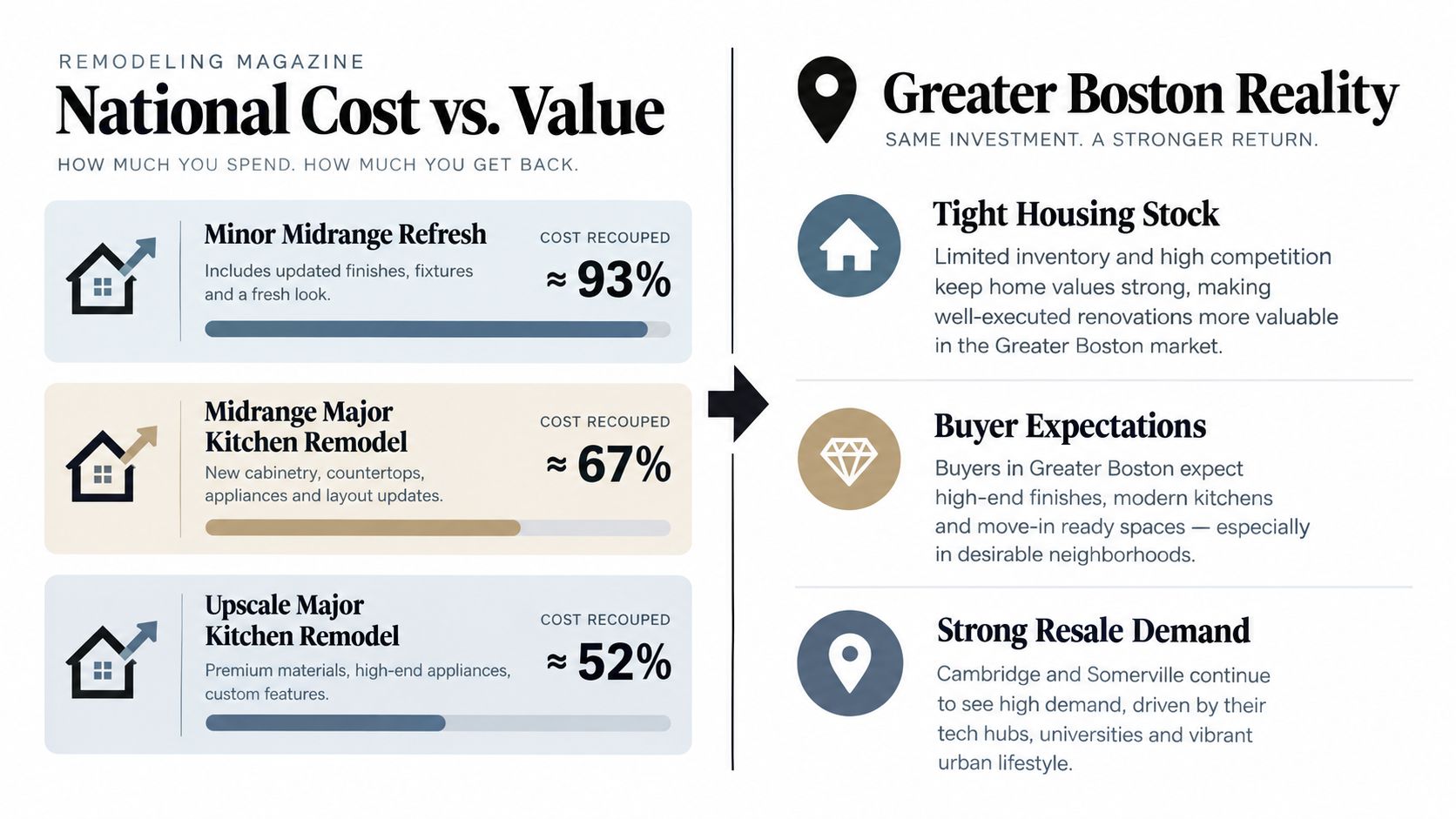
A kitchen can be worth a great deal to the people living in the house without returning the same amount at resale. The most useful benchmark separates those two ideas. Recent coverage of Cost vs. Value data lists a minor kitchen remodel at $28,458 with a 112.9% resale return, a major midrange remodel at $82,793 with a 50.9% return, and a major upscale remodel at $164,104 with a 35.7% return (Zillow's kitchen remodel ROI data).
Those percentages don't mean every Greater Boston home will perform identically. They show the direction of the trade-off. A focused refresh can recover a high proportion of its cost, while a major luxury project usually serves lifestyle goals more than dollar-for-dollar resale recovery.
Houzz reporting cited in recent coverage places median minor-remodel spending at $53,000, median major-remodel spending at $60,000, and the 90th percentile at at least $180,000 (NerdWallet's 2026 kitchen remodel cost coverage). That gap helps explain why homeowners often experience budgets well above headline averages. Labor, layout changes, cabinetry, and premium finishes turn a simple category into a much larger project.
How local buyers judge the work
In Belmont, Arlington, and other established neighborhoods, buyers notice whether the kitchen fits the house. In Wellesley, Newton, and Lexington, a premium kitchen may make sense when the surrounding homes support that finish level. In Cambridge and Somerville, efficient layouts, durable materials, and careful use of limited space may matter more than a large appliance package.
Broad-appeal choices usually protect resale better than highly personal ones. Neutral cabinetry, well-executed quartz or natural stone, sound lighting, and practical storage can serve both current owners and future buyers. Imported cabinetry, unusual color schemes, and appliances chosen mainly for status can be excellent lifestyle decisions, but they don't guarantee equivalent resale value.
The supplied comparison graphic offers a visual way to think about national recovery figures and local factors.
For a deeper look at how scope and neighborhood expectations interact, review this guide to kitchen remodel ROI.
Practical Ways to Control Costs Without Cutting Corners
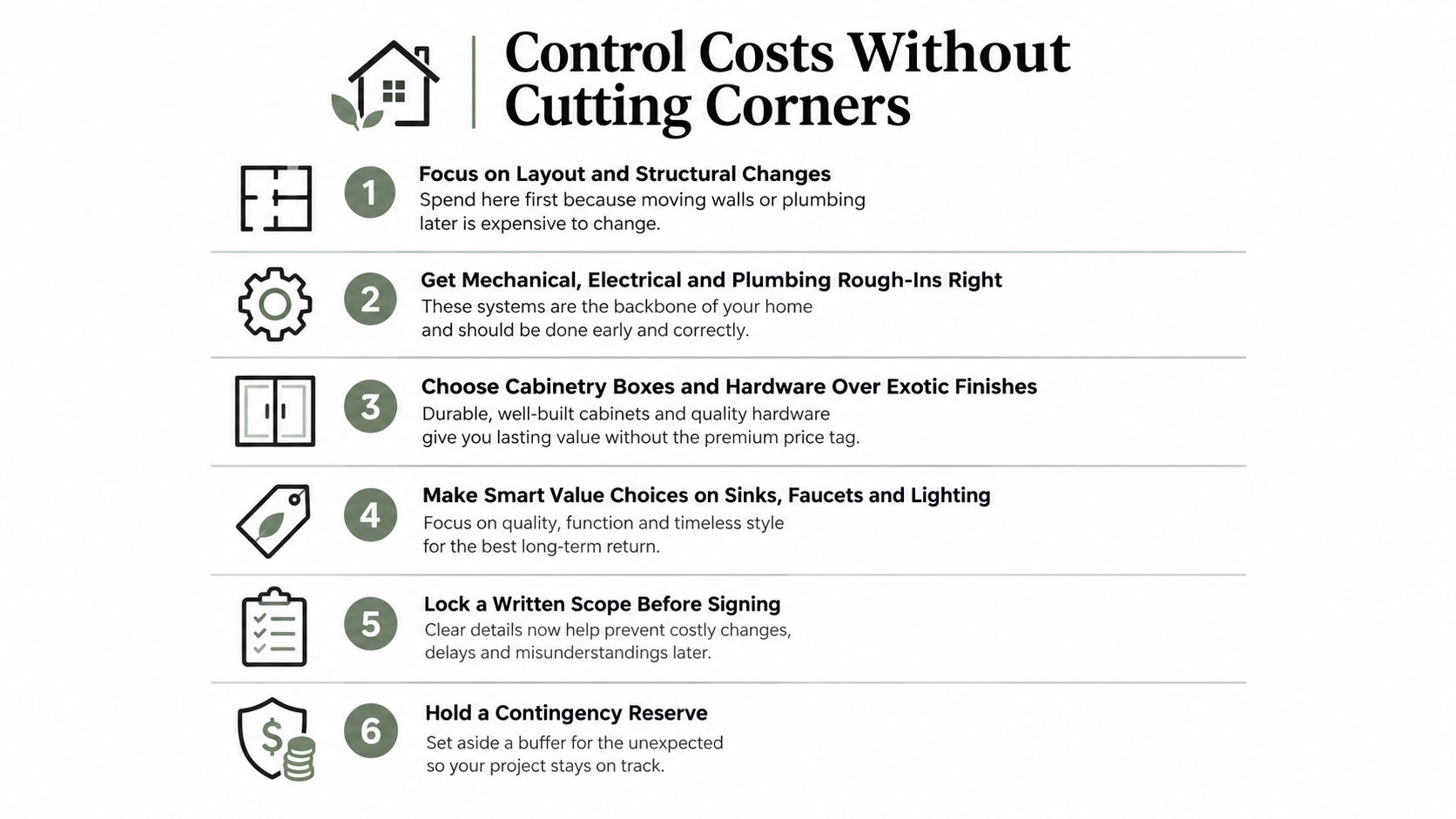
The cheapest kitchen isn't the one with the lowest initial allowance. It's the one that avoids paying twice for work that should have been settled before demolition.
Spend first on what becomes expensive to change. Layout, structural framing, panel capacity, and plumbing rough-ins deserve more attention than decorative hardware.
Keep the footprint when it works. A small bump-out can require foundation, framing, exterior finish, roofing, insulation, and additional permits. If the kitchen functions with the existing walls, improving storage and circulation inside that envelope may create more value than expanding it.
Put money into the hidden work
Electrical and plumbing rough-ins disappear behind finished surfaces, but they determine whether the room performs reliably. We recommend confirming appliance loads, lighting locations, ventilation, water lines, drain paths, and panel capacity before cabinets are ordered.
Test older materials before demolition. Lead paint and asbestos concerns can affect how the crew protects the house, removes materials, and disposes of debris. Knob-and-tube wiring also needs a proper assessment before anyone assumes an existing circuit can serve a modern kitchen.
Protect the schedule
Order long-lead cabinets and appliances early, but don't let deliveries arrive before the site can receive and protect them. Demo should happen after the scope, selections, permits, and material schedule are sufficiently settled. Cabinets and countertops should be staged together when possible, which reduces repeated delivery and handling.
A written scope matters more than a verbal promise to “handle the details.” Ask each bidder to show demolition, framing, rough plumbing, rough electrical, insulation, drywall, flooring, cabinetry, countertops, appliances, permits, inspections, cleanup, and exclusions.
For homeowners comparing kitchen renovation Medford, custom kitchen Somerville, kitchen renovation Lexington, or kitchen makeover services Newton, the same rule applies. Search terms such as kitchen remodeling near me are useful for finding local options, but they don't tell you whether contractors priced the same scope. Compare documents, allowances, licensing, permit responsibility, and change-order procedures.
Aureli Construction is a Massachusetts licensed general contractor that coordinates design, construction, trade work, and permitting for kitchens and broader remodeling projects. Homeowners can also compare a kitchen-only contractor with a home addition contractor in Boston, a basement finishing contractor in Cambridge, or an ADU builder in Massachusetts when the kitchen is part of a larger plan.
Planning Your Kitchen Renovation Budget the Right Way
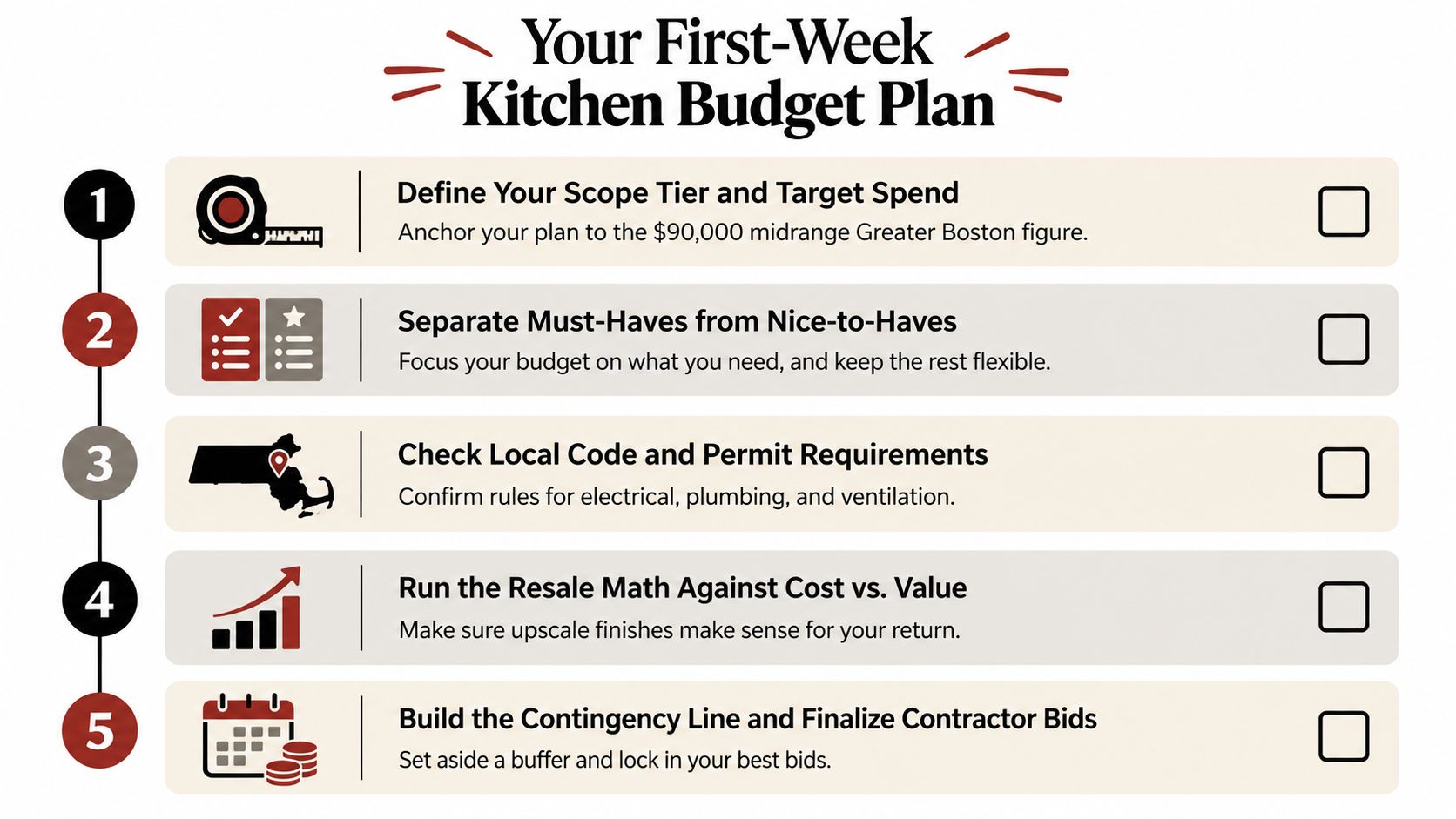
A Cambridge homeowner can make the first week productive without choosing tile or cabinet colors yet. The early objective is to define the work clearly enough that three contractors can price the same project.
Start with a written scope
Write down what stays, what changes, and what you don't know. Identify whether the project is a cosmetic refresh, a midrange remodel, a major reconfiguration, or a full gut. Include appliance models or realistic allowances, cabinet quality, counter material, flooring, ventilation, lighting, and whether walls or openings change.
Separate necessities from preferences
A must-have might be better storage, a safer electrical system, or a relocated sink. A preference might be a specialty finish, decorative hardware, or an appliance upgrade. This distinction lets you protect the essential scope if bids come in above the initial target.
Request comparable bids
Get at least three written proposals from licensed builders. Each should state who pulls the building permit, who obtains electrical and plumbing permits, how inspections are handled, what allowances cover, and how changes are approved. A lump-sum total without line-item clarity makes it difficult to understand why bids differ.
Check code and valuation
Ask the contractor to identify the Massachusetts code issues that apply to your project under the 10th edition and 780 CMR 105.2. Confirm that the declared valuation and Belmont-style fee calculation are represented accurately where applicable. Rough framing, electrical, and plumbing inspections should be scheduled before walls close, followed by final inspections and permit closeout.
Stress-test the budget and calendar
The planning assumptions for a substantial project include a 15% to 20% contingency for uncertain conditions, but that range is a budgeting recommendation, not a statewide rule. Older homes deserve particular scrutiny for structural framing, electrical systems, lead paint, asbestos, and previous unpermitted alterations.
Don't order stone or appliances on a final basis before the layout, permits, and dimensions are settled. Don't overlook the temporary kitchen. A refrigerator, microwave, washing area, and protected path through the house make the construction period more manageable and help prevent rushed decisions.
Our kitchen renovation checklist can help organize selections, permits, inspections, and contractor questions before signing. The final decision is personal: what is the project worth to your daily life compared with its eventual sale value, and which scope tier matches that answer?
Aureli Construction helps Greater Boston homeowners plan and build kitchen remodels with clear scopes, Massachusetts permit coordination, trade scheduling, and practical material guidance. We serve Belmont, Brighton, Brookline, Burlington, Cambridge, Lexington, Medford, Melrose, Newburyport, Newton, Reading, Somerville, Stoneham, Wakefield, and Wellesley. Visit Aureli Construction to request a free estimate and discuss your kitchen renovation costs with a licensed local contractor.