
A client in Arlington recently told us, “We love our neighborhood, but we don't love our kitchen.” That's a story we hear all the time across the Greater Boston area. You've got a home with character, but the kitchen is stuck in another decade, too small, too dark, or just laid out wrong for how your family lives.
Before you start looking for a new house, consider what's possible right where you are. A well-planned renovation can completely change how you use your home, especially when the layout, storage, and permitting are handled properly from the start. If you're gathering ideas, start with a guide for kitchen renovations, then compare that inspiration against what really works in older Massachusetts homes. Here are five kitchen renovation examples and one featured Greater Boston contractor option that show what holds up in practical settings.
Table of Contents
- 1. Aureli Construction
- 2. Houzz Kitchen Photos Gallery
- 3. This Old House Kitchen Transformations
- 4. HGTV Before-and-After Kitchen Makeovers
- 5. Dwell Kitchen Remodels
- 6. Sweeten Kitchen Renovation Case Studies with Budgets
- 7. The Kitchn Before and After Reader Remodels
- 7-Source Kitchen Renovation Comparison
- Kitchen Remodel Costs in Greater Boston MA
- Kitchen Remodel Contractors in Cambridge MA and Nearby Towns
- FAQ for Kitchen Renovation Examples in Massachusetts
- Final thoughts on kitchen renovation examples in Greater Boston
1. Aureli Construction

A kitchen project in Greater Boston usually looks straightforward on day one. Then the plaster comes off in a 1920s Arlington colonial, we find old wiring, the floor drops half an inch toward the exterior wall, and the plan has to adjust before cabinets are ordered. That is why our own work belongs in this list. These are not inspiration-only examples. They reflect actual decisions, permit hurdles, and field conditions that shape cost and schedule in Massachusetts.
Aureli Construction is our design-build team serving Cambridge, Arlington, Belmont, Newton, Lexington, Medford, and nearby towns. We keep planning, engineering coordination, permitting, and construction in one process because kitchen remodels here rarely stay limited to finishes. A homeowner may start with new cabinets and counters, but once the scope includes moving plumbing, opening a wall, changing a window, or adding recessed lighting, the job becomes about sequencing, inspections, and code compliance.
That shift matters.
In older Greater Boston homes, the kitchen problem is often tied to the rest of the house. We regularly trace poor kitchen layouts back to bearing walls, undersized electrical service, sagging framing, or tight circulation between the kitchen, dining room, and mudroom. A photo gallery will not show that part. Our project examples do, because homeowners need a realistic blueprint, not just polished after photos.
Why Aureli Construction stands out for kitchen remodel Greater Boston projects
Our team also handles additions, bathroom remodels, basements, ADUs, and whole-home renovations. That broader experience helps when a kitchen remodel triggers larger house issues. If a wall needs a beam, if the panel cannot support new circuits, or if venting has to be rerouted through an existing roof structure, we can address the full scope instead of patching around it.
We also price projects as they are built. We do not use flat package numbers because Massachusetts kitchens vary too much by existing conditions, town requirements, and how far the renovation reaches beyond the room itself. A cosmetic refresh, a full gut, and a structural rework may all start with the same wish list, but they do not carry the same permit path or risk profile. Homeowners comparing layouts and finish priorities often benefit from reviewing kitchen upgrades that add style and value before deciding where to spend and where to hold the line.
What to expect on a Massachusetts kitchen project
A smooth project usually comes down to early decisions in a few areas:
- Drawings that match the house: We coordinate layout, framing, and utilities early so conflicts show up on paper instead of during demolition.
- Town permitting: Permit requirements and inspection timing vary across Greater Boston, and those differences can affect the construction calendar.
- Clear scope boundaries: We define early whether the job is a finish-driven remodel or a larger structural renovation, because that choice changes budget, permits, and downtime.
- Existing-condition planning: Older homes often hide patched plumbing, obsolete wiring, uneven floors, and venting problems that need correction before finish work starts.
Our strongest kitchen renovation examples are the ones where the layout works better, storage improves, lighting is handled properly, and the inspections close out without costly surprises at the end.
From a resale standpoint, we give homeowners the same advice again and again. Put money into function first. In many homes, a well-planned midrange remodel with better workflow, better storage, and corrected infrastructure makes more sense than a high-end finish package built on a weak layout. That is especially true in Greater Boston, where hidden conditions and permit-driven scope can consume budget fast.
2. Houzz Kitchen Photos Gallery
Houzz Kitchen Photos Gallery is the fastest way to build a visual brief before meeting with a contractor. If you're overwhelmed by cabinet styles, island sizes, backsplash choices, or layout directions, Houzz helps narrow your taste quickly.
For homeowners, the main value is filtering. You can sort by layout, style, color, and room size, then save ideas into ideabooks so your selections are in one place when it's time to price the work. That saves time in design meetings because we can react to specific images instead of trying to decode words like “classic but modern” or “bright but warm.”
Best use for homeowners in Cambridge MA and Arlington MA
Houzz is especially useful when you're trying to compare cosmetic preferences with actual renovation priorities. According to the 2025 U.S. Houzz Kitchen Trends Study, 81% of renovating homeowners change their kitchen style during a project, and wood cabinets slightly edge out white cabinets, with 29% choosing wood and 28% choosing white. That tells you two things. Homeowners are still using renovations to make a visible design shift, and the all-white kitchen isn't the automatic default it used to be.
A second benefit is that many photos credit the builder or designer behind the work. That gives you a path from inspiration to hiring.
- Best for visual sorting: Good when you need to compare painted cabinets, wood tones, island shapes, and hardware styles.
- Best for prep work: Useful before a design-build consultation so the conversation starts with examples, not guesses.
- Watch out for gaps: Budgets and technical details are inconsistent, so don't assume a look is easy to build just because it photographs well.
If you're still trying to sort out which upgrades add value, our own breakdown of kitchen upgrades that add style and value is a practical companion.
3. This Old House Kitchen Transformations
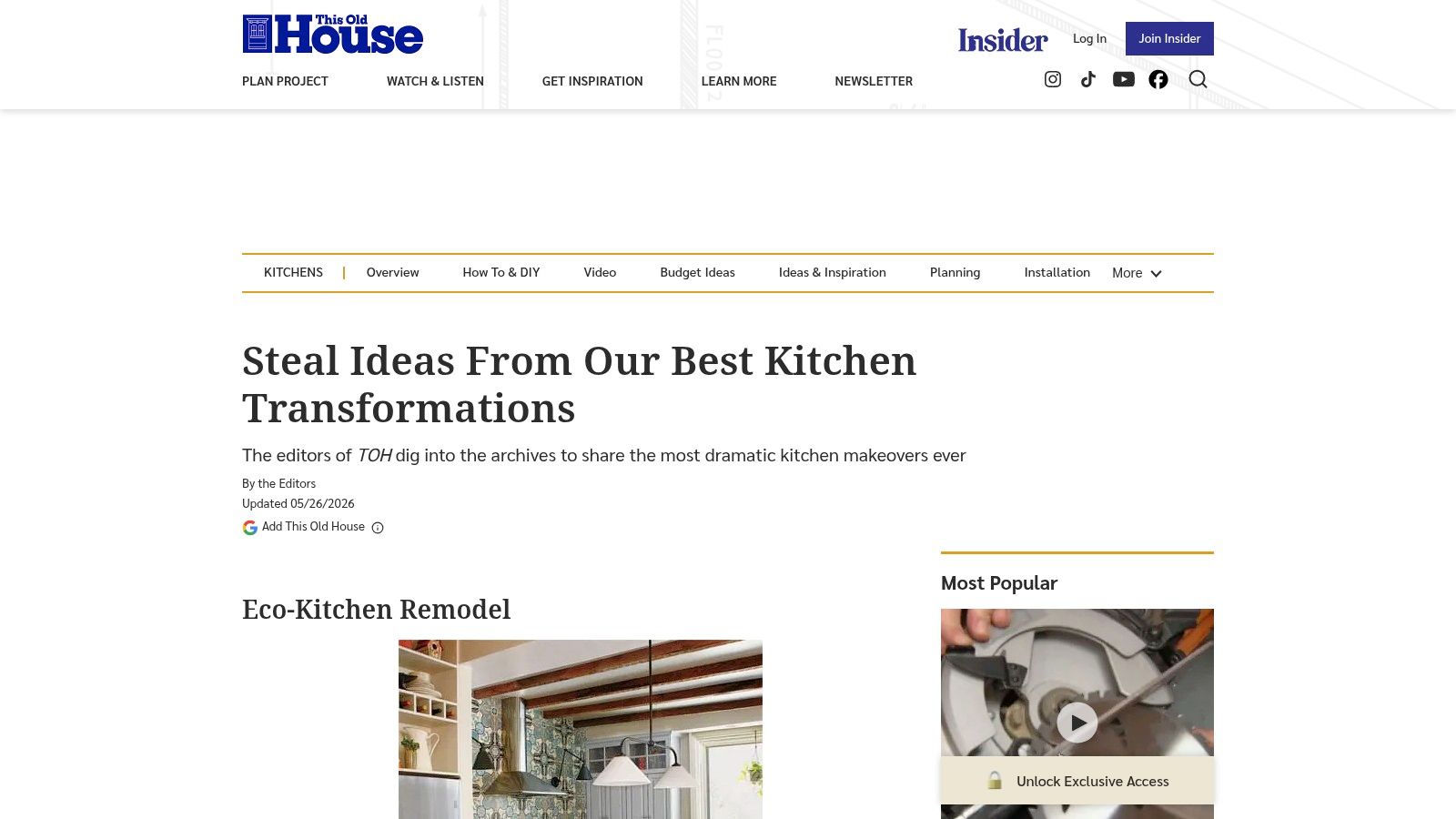
This Old House Kitchen Transformations is one of the better resources for homeowners with older New England housing stock. That includes a lot of homes we work in across Cambridge, Belmont, Newton, and Medford.
The reason it holds up is simple. It usually explains why a wall moved, why storage changed, or why a layout was corrected. That's much closer to the way we look at a real project than a pure image gallery.
Why it works well for older Greater Boston homes
A lot of Massachusetts kitchens aren't straightforward rectangles. They have chimney offsets, old pantry walls, sloped floors, boxed-in pipes, dropped soffits, and support points that newer homes don't. Design coverage often ignores those issues, but practical kitchen planning can't.
Corners, angled walls, beams, pipes, and vents shape the floor plan more than the finish selections do. If the geometry is awkward, the layout has to solve that first.
That lines up with independent design coverage on creative corners and difficult kitchen geometry in Houzz's kitchen corner ideas article. We see the same thing on site. Blind corners, vent chases, and structural obstructions often cause a kitchen to feel cramped or inefficient.
This Old House won't always give you the cost depth homeowners want, but it does a better job than most inspiration sites at showing sensible fixes for old-house constraints. Pair it with our local advice on kitchen remodel tips if you're trying to translate inspiration into an actual Massachusetts scope of work.
4. HGTV Before-and-After Kitchen Makeovers
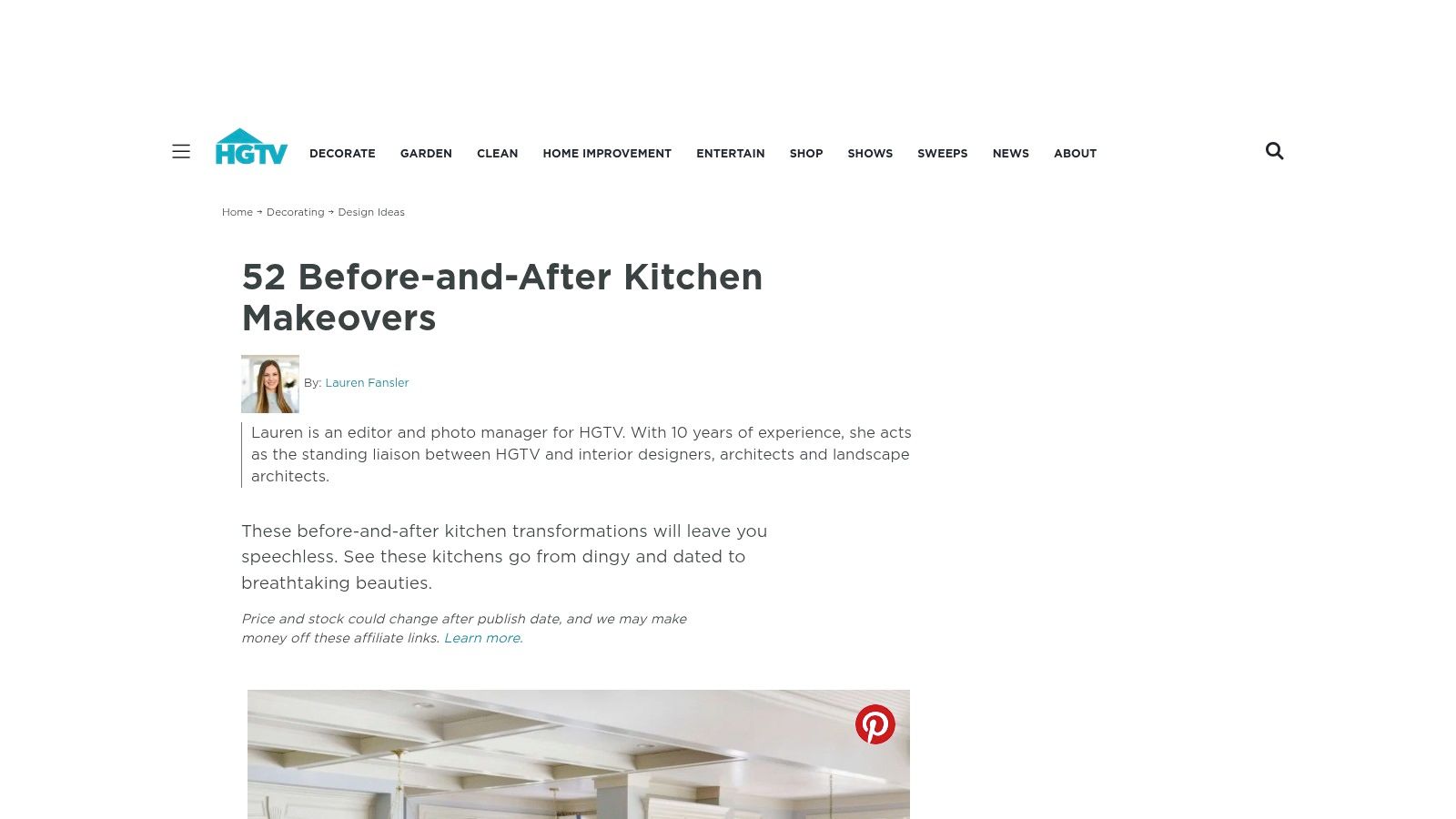
HGTV Before-and-After Kitchen Makeovers is useful when you need fast, high-impact visuals. It's good at showing dramatic change. Homeowners can usually identify within a few minutes whether they're drawn to a large island, open shelving, darker cabinetry, or a brighter perimeter layout.
Where HGTV helps most is communication. If a homeowner says, “I want this kind of transformation,” we can immediately start separating the visual effect from the actual construction steps behind it.
Where the inspiration helps and where it falls short
The weak spot is realism. Entertainment-first renovation content often compresses the hard part, which is everything behind the walls. In Massachusetts, especially in older homes, moving a sink, relocating a range hood, or opening a load-bearing wall can affect permit review, electrical coordination, framing details, and inspection sequencing.
That doesn't make the gallery less useful. It just means you should treat it as inspiration, not a scope document.
Field note: A dramatic before-and-after photo might represent a straightforward refresh, or it might represent a full structural remodel. The photo won't tell you which one.
HGTV is strongest early in the process when you're trying to react to style and layout possibilities. Once you narrow in, bring those ideas into a contractor conversation and test them against your house, your permit path, and your budget. If you want more visual inspiration in that same before-and-after spirit, this before and after remodeling guide is another place homeowners often browse.
5. Dwell Kitchen Remodels
Dwell Kitchen Remodels is a strong choice if your taste leans modern, minimal, or midcentury. It's more editorial than gallery-driven, which can be a good thing when you want a kitchen renovation example that includes actual material references and buildable details.
We like Dwell for clients who know they want cleaner lines but aren't sure how to translate that into cabinetry, lighting, and finish selections that still fit a New England home. That's a common challenge in towns like Lexington, Wellesley, and Brookline, where homeowners want the kitchen to feel current without making the rest of the house feel disconnected.
Best fit for modern and midcentury kitchen renovation examples in Massachusetts
Dwell also helps homeowners think more critically about what should stay and what should go when modernizing. That matters because a lot of outdated kitchen features aren't just a style issue. They affect storage continuity, cleaning, and visual flow.
Recent design guidance points to outdated choices such as short upper cabinets, mismatched upper cabinet heights, and framed detailing in many remodels, as discussed in this outdated kitchen design features review. We see that in the field all the time. A kitchen can get expensive fast if you spend heavily on counters and appliances while leaving the cabinet layout and wall elevations stuck in an older pattern.
A few reasons Dwell is useful:
- Material specificity: Product and finish callouts help with spec planning.
- Buildable ideas: The projects usually feel designed for real life, not just styled for photos.
- Aesthetic limitation: It tends to skew modern, so it's less useful if you want a traditional Arlington or Newton look.
6. Sweeten Kitchen Renovation Case Studies with Budgets
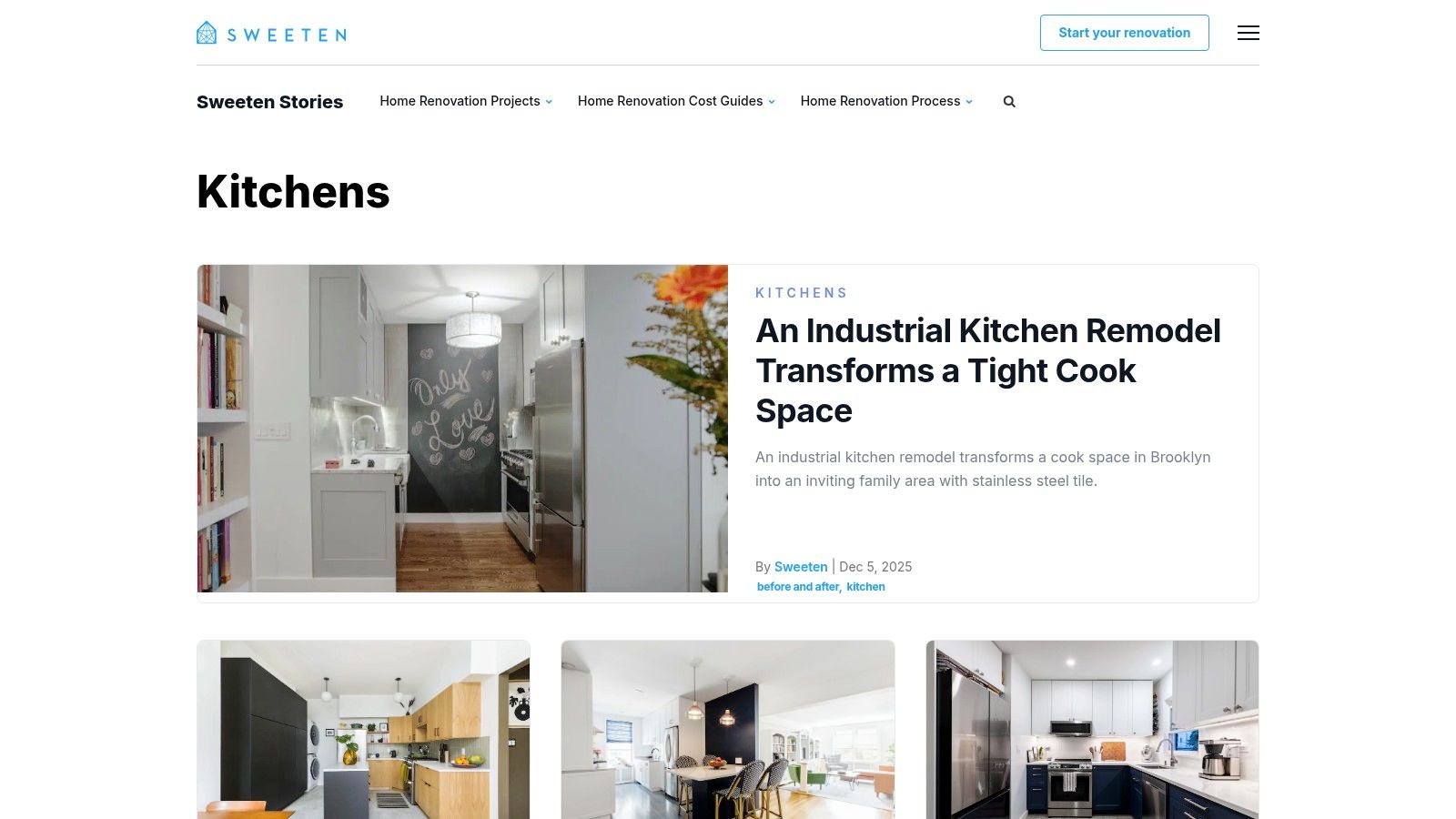
Sweeten Kitchen Renovation Case Studies is one of the more practical places to study real-world project constraints. It tends to focus on urban homes and condos, which makes it more relevant than suburban mansion content for many Greater Boston homeowners.
That's helpful in Somerville, Cambridge, Brookline, and parts of Boston where kitchens often sit inside tighter footprints, multifamily buildings, or older structures with less flexibility. The stories usually explain the pain points, what changed, and where the project got complicated.
Why urban layout case studies matter in Somerville MA and Brookline MA
The strongest feature here is expectation-setting. Even when a case study isn't Boston-based, urban Northeast kitchen problems repeat themselves. Tight galleys, old wiring, building access, delivery limits, and limited staging space all affect how a renovation gets built.
The Houzz-based trend summaries cited in the verified data also reflect how many homeowners are making larger planning moves, not just swapping finishes. In that summary, 42% opt for islands 7 feet or longer and 45% reconstruct their entire kitchen layout, which reinforces what we see on real projects. Once homeowners start chasing better function, the layout conversation gets bigger fast.
If you're trying to price that kind of shift locally, our Arlington MA kitchen remodel cost guide gives a more Massachusetts-specific lens than a national case-study platform can.
7. The Kitchn Before and After Reader Remodels
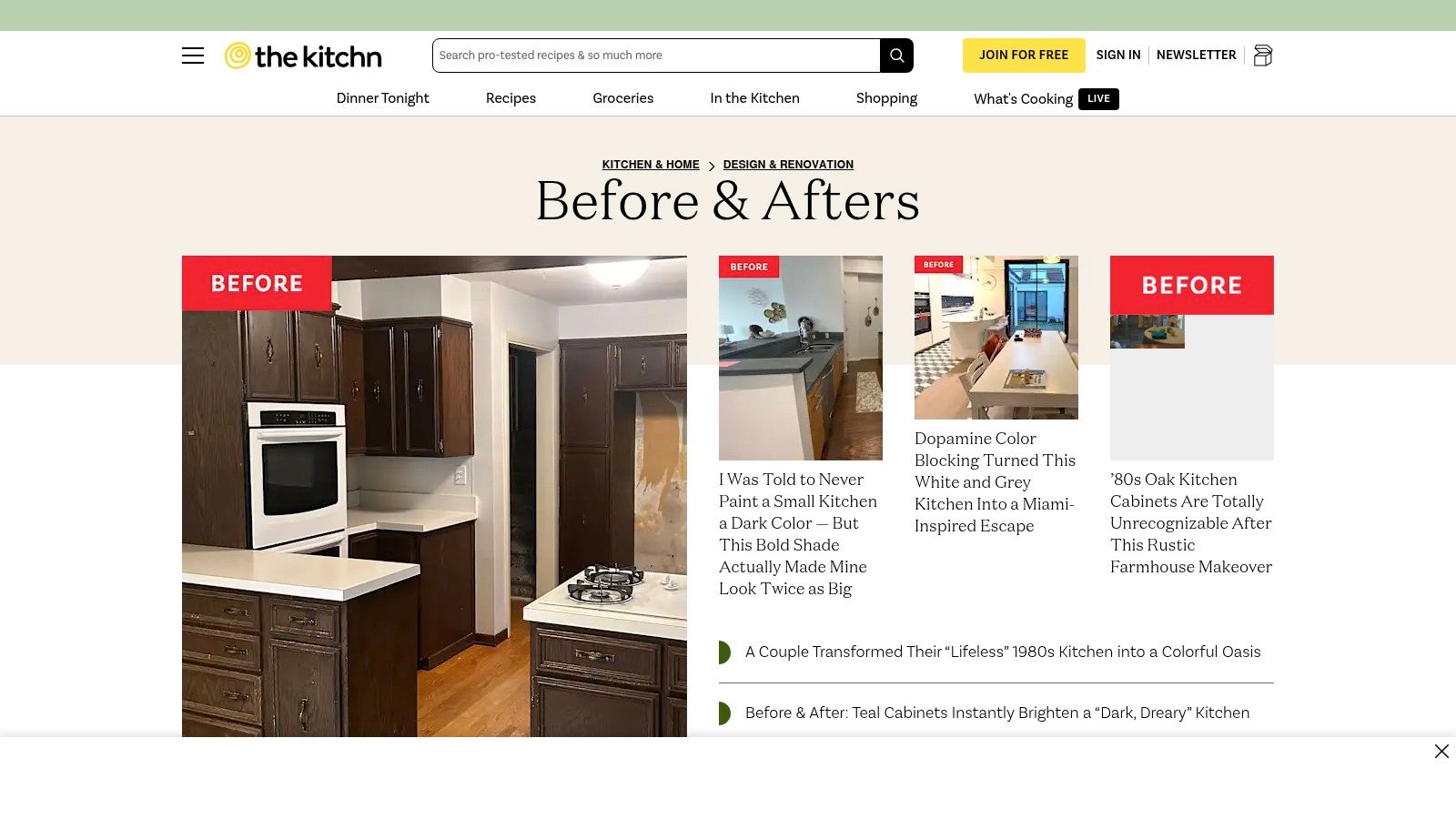
A lot of Greater Boston kitchens do not need a full gut job on day one. We see that in the field all the time. A family in an older Melrose or Wakefield house may need better task lighting, safer wiring at the countertop runs, and more workable storage now, even if the full layout change waits a year or two.
That is why The Kitchn Before and After collection earns a spot here. The projects feel closer to what homeowners experience. You see selective upgrades, budget limits, awkward existing conditions, and finish choices that improve the room without pretending every kitchen starts with a blank slate.
Good source for phased upgrades and smaller kitchen remodel ideas
For homeowners trying to plan in stages, this collection is useful because it shows what partial scope can realistically accomplish. That matters in Massachusetts, where the smartest first phase is often the one that fixes function and code exposure before cosmetic work. Our team has handled projects where the first round focused on electrical corrections, lighting, appliance replacements, and durable counters because those items delivered the biggest day-to-day improvement for the money.
It also helps set expectations. National remodeling coverage often separates minor and major remodels, as noted earlier in the article. That distinction is real on local projects too, but the line is not just about budget. It is about how much of the kitchen you are opening up, whether permits get triggered, and how many existing problems show up once demolition starts.
In Cambridge, Somerville, and Boston triple-deckers, a phased approach can be the right call when the footprint works well enough and the goal is to buy time. We may keep the cabinet boxes if they are structurally sound, then replace doors, improve lighting, add ventilation, and update finishes. In other homes, that same strategy makes less sense because old flooring heights, failing cabinets, or undersized circuits would force us to redo the work later.
Use this source for ideas on scope control, not construction planning.
- Useful for budget discipline: It helps homeowners see how much visual and functional change a targeted upgrade can deliver.
- Useful for compact kitchens: Many examples deal with small rooms, limited storage, and everyday organization problems.
- Less useful for local execution: It will not walk you through Massachusetts permits, inspection steps, or the code issues we handle on real Greater Boston renovations.
7-Source Kitchen Renovation Comparison
Homeowners usually reach this point after bouncing between inspiration photos, TV makeovers, and case studies that all look useful for different reasons. A simpler question is: which source helps you make a better decision before you spend money in a Greater Boston kitchen.
We use these sources differently in practice. Some are good for defining style. Some help a client understand likely scope. A few are useful for older Massachusetts housing stock because they show the kind of space constraints, outdated wiring, and layout problems we run into in Cambridge, Somerville, Brookline, and Boston. Very few help with local permitting, inspection sequencing, or code-driven cost changes, so the table below focuses on how each source performs in the actual planning stage.
| Provider | 🔄 Implementation Complexity | ⚡ Resource Requirements | ⭐ Expected Outcomes | 📊 Ideal Use Cases | 💡 Key Advantages/Tips |
|---|---|---|---|---|---|
| Aureli Construction | High, full design-build coordination and permitting | Significant, in-house architects/engineers, trades, site visits | High, code-compliant, durable results with clear scope control | Full-home renovations, additions, ADUs in Greater Boston | Single point of responsibility and strong local permitting experience |
| Houzz – Kitchen Photos Gallery | Low, browse and save visuals | Minimal, web access and time to sort through examples | Variable, strong for ideas but uneven for build quality and cost realism | Style discovery, finish comparison, early mood boards | Large searchable photo library and product tags. Filter carefully because polished photos can hide layout and construction limits |
| This Old House – Kitchen Transformations | Low, practical editorial guidance | Minimal, reading time and some judgment about what applies to your house | High for functional lessons, especially in older homes | New England homes with storage issues, dated layouts, and age-related constraints | Useful explanations of why changes improved the room. Budget detail is usually limited |
| HGTV – Before-and-After Kitchen Makeovers | Low, visual browsing | Minimal, mostly time and patience with ads | Strong visual ideas, lighter on specifications and execution detail | Homeowners who need to react to examples and narrow their taste quickly | Good photos and designer commentary. Use it for direction, not for pricing or construction planning |
| Dwell – Kitchen Remodels | Medium, design-forward case studies with material focus | Moderate, research into finishes, suppliers, and details | High for modern design ideas that can be built with the right budget | Modern, contemporary, and midcentury-inspired remodels | Helpful material callouts and cleaner detailing than many gallery sites. The aesthetic is narrower than what many Boston homes need |
| Sweeten – Kitchen Renovation Case Studies | Medium, project stories tied to budgets and contractor matching | Moderate, time to compare scopes, budgets, and timelines | Practical for early budgeting and expectation setting | Condo remodels, city kitchens, and homeowners comparing cost versus scope | Better budget visibility than most inspiration sites. Local Massachusetts permit and code issues still need separate review |
| The Kitchn – Before & After (Reader Remodels) | Low, informal reader projects from DIY updates to fuller remodels | Minimal, especially for budget-conscious homeowners | Good for phased upgrades and smaller-scope improvements | Modest budgets, compact kitchens, and homeowners testing ideas before a full remodel | Useful product lists and practical fixes. Technical depth is limited, so treat it as idea gathering rather than build guidance |
No single source covers the full job.
For homeowners in Greater Boston, the most useful approach is to combine one image-heavy source with one source that shows scope and one contractor-led review of what permits, inspections, and existing conditions can do to cost and schedule. That mix gives a more honest starting point than a gallery alone.
Kitchen Remodel Costs in Greater Boston MA
In Massachusetts, local kitchen pricing depends on scope more than style. A straightforward update with existing plumbing locations, modest electrical work, stock or semi-custom cabinetry, and standard finish selections will land very differently than a project that opens walls, moves mechanicals, or changes the footprint.
For planning purposes, we usually break kitchen work into three bands in the Greater Boston market:
- Targeted kitchen refresh often falls around the lower end of the market when the layout stays largely intact and the work focuses on surfaces, cabinetry updates, countertops, tile, lighting, and finish work.
- Full kitchen remodel typically lands in the middle range when cabinets are replaced, trades are coordinated, permits are pulled, and the room gets rebuilt within a similar footprint.
- Structural kitchen renovation reaches the upper range when walls move, beams are installed, windows change, or the kitchen is tied into an addition or whole-home remodel.
Permits, inspections, and local code compliance are not optional line items here. In Massachusetts, electrical, plumbing, and building inspections can affect both timeline and sequencing, and some towns are stricter or slower than others. If you're in Cambridge, Arlington, or Brookline, don't assume a neighboring town's process will match yours.
Kitchen Remodel Contractors in Cambridge MA and Nearby Towns
A Cambridge homeowner once showed us three beautiful inspiration photos and one floor plan that did not work. The island looked great on paper, but the clearances were too tight for two people to cook, the refrigerator door would have fought the pantry, and the permit path would have changed if we touched the wall behind the range. That is how kitchen contractor selection should work in Greater Boston. Start with how a team thinks, not just what their finished photos look like.
The contractors worth meeting will talk through sequence, risk, and town-specific approvals early. In Cambridge, Somerville, Arlington, Brookline, and nearby towns, the questions are practical. Is the wall bearing? Do we need an engineer? Who produces the drawings? Who files with the building department? How will electrical, plumbing, and insulation inspections affect the schedule? What is the plan if demolition exposes old wiring, out-of-plumb framing, or patched plumbing from prior work?
We tell homeowners the same thing on nearly every kitchen consult. You are hiring a team to make hundreds of decisions in the right order, under real site conditions, with Massachusetts code and local inspectors shaping the work.
That is why design-build often makes sense here.
Our team prefers fewer handoffs between designer, estimator, permit runner, cabinet supplier, and field crew, because each handoff creates another place for scope to drift or details to get missed. If a project includes wall removal, beam work, makeup air questions, or appliance changes that affect electrical load, the value is not just convenience. It is better control over budget, timeline, and accountability.
A good contractor should also be honest about trade-offs. Keeping the existing layout usually saves money and shortens the schedule, but it can lock in a cramped prep zone or poor pantry storage. Opening the room can improve how the kitchen works every day, but it may trigger structural review, more patching outside the kitchen, and a longer permit process. In older Greater Boston homes, the right answer usually comes from the house itself, not from the inspiration photo.
FAQ for Kitchen Renovation Examples in Massachusetts
Do I need a permit for a kitchen remodel in Massachusetts
If the work includes structural changes, electrical updates, plumbing changes, or anything beyond simple finish replacement, you'll usually need permits. Each town handles the process a little differently, so permit timing in Cambridge may not match Arlington, Newton, or Belmont.
How long does a kitchen remodel usually take
It depends on scope, permitting, product lead times, and how much hidden work shows up after demolition. A cosmetic update moves much faster than a project involving wall removal, utility relocation, or custom millwork.
Is it better to do a minor remodel or a full gut renovation
That depends on your goals. If resale efficiency matters most, smaller targeted updates often make more sense than a high-end gut remodel. If the layout fails your daily routine, a larger renovation may be justified even if the financial return isn't as strong on paper.
What should I bring to a contractor meeting
Bring photos you like, rough room dimensions if you have them, a list of problems you want solved, and a realistic idea of your priorities. Save kitchen renovation examples that show layouts, not just finishes.
Can you keep part of the existing kitchen to control cost
Yes, sometimes. Keeping the same plumbing wall, appliance locations, or parts of the layout can reduce complexity. But we only recommend partial retention when it doesn't compromise the function of the finished kitchen.
Final thoughts on kitchen renovation examples in Greater Boston
A photo can sell a finish. It cannot tell you whether we had to reframe a floor for level cabinets, reroute a vent stack, or wait on a town inspection before closing walls. That gap is where kitchen remodel budgets in Greater Boston often drift.
The examples in this article are useful for different reasons. Houzz helps homeowners sort out style preferences. This Old House shows how older homes get repaired and updated. HGTV is good for quick visual ideas. Dwell pushes material and layout thinking. Sweeten gives a clearer look at budget ranges and city constraints. The Kitchn is helpful if you are weighing a phased remodel instead of a full gut.
Our team at Aureli Construction uses inspiration differently. We compare the photo to the house in front of us, then price the work around real conditions in Cambridge, Somerville, Arlington, Belmont, Newton, and nearby towns. That means asking harder questions early. Can the existing layout stay without compromising function? Will the electrical service support the new appliance package? Does the framing allow for the opening you want, or does that trigger structural engineering and a longer permit path?
That is the part homeowners need most. Pretty kitchens are easy to save. Realistic planning is harder.
A good remodel starts with honest priorities, a workable budget range, and a clear understanding of what the house will allow. Some projects justify full demolition because the layout, storage, and traffic flow are wrong from the start. Others get better results by keeping the plumbing wall, tightening the cabinet plan, and spending money where it changes daily use.
If you want more inspiration while sorting out finishes and layout ideas, browse these 2026 Long Island kitchen trends and bring the useful parts back to a contractor who works on older Greater Boston homes.
If you are planning a kitchen remodel, home addition, bathroom renovation, basement finish, or ADU project, contact Aureli Construction for a free estimate. We will walk the space, explain the Massachusetts code and permit issues that apply to your scope, and outline a plan with realistic cost and timeline expectations.