In Medford, most mid-range gut bathroom remodels run $30,000 to $55,000 in 2026, while cosmetic refreshes start around $12,000 and primary-suite upgrades can reach $80,000 or more. The final bathroom remodeling cost depends less on the vanity you choose than on plumbing, waterproofing, electrical work, permits, tile labor, and what demolition uncovers.
A homeowner in a Medford triple-decker might begin the day comparing tile samples at the kitchen table and end it reviewing a $47,000 estimate for a mid-range gut remodel. That price isn't unusual for Greater Boston. Tight access, older framing, local labor rates, inspection requirements, and code upgrades can move a bathroom far beyond a national-average estimate.
We build bathroom renovations throughout Cambridge, Medford, Arlington, Belmont, Brighton, Brookline, Burlington, Lexington, Melrose, Newburyport, Newton, Reading, Somerville, Stoneham, Wakefield, and Wellesley. The useful question isn't, “What does a bathroom remodel cost?” It's, “Which project type fits this bathroom, this house, and this neighborhood?”
Table of Contents
- What a Bathroom Remodel Really Costs in Greater Boston
- Cost Ranges by Bathroom Type and Size
- Where the Money Actually Goes in a Boston-Area Remodel
- Layout Changes, Plumbing, and Permits That Move the Price
- Realistic Timelines From Demo to Final Inspection
- Resale Value and How to Budget Your Own Project
- Smart Ways to Save Without Cutting Corners
- Frequently Asked Questions From Greater Boston Homeowners
What a Bathroom Remodel Really Costs in Greater Boston
At 7 a.m. in Medford, the homeowners are sketching tile patterns on a napkin while we review the existing bathroom footprint. They want a better shower, more storage, and cleaner finishes, but they don't want to move the toilet or open the ceiling below. That decision keeps the project within a realistic mid-range gut budget of $30,000 to $55,000, assuming the framing and plumbing are serviceable.
For Greater Boston homeowners, we generally separate projects into three tiers:
- Cosmetic hall bath refresh: $12,000 to $22,000, usually keeping the plumbing locations and replacing visible finishes.
- Mid-range gut remodel: $30,000 to $55,000, including demolition, new waterproofing, tile, fixtures, ventilation, and code-compliant electrical work.
- Primary-suite upgrade: $55,000 to $80,000-plus, often involving a larger footprint, custom glass, heated flooring, premium fixtures, or a revised layout.
Those figures reflect local project conditions rather than a national average. Union work, difficult material delivery, older triple-deckers, lead-paint or asbestos procedures in pre-1978 homes, and inspector-required upgrades can all affect the estimate. In Cambridge, Somerville, Brookline, and similar older communities, demolition often reveals galvanized piping, damaged subflooring, insufficient ventilation, or wiring that can't remain concealed behind new walls.
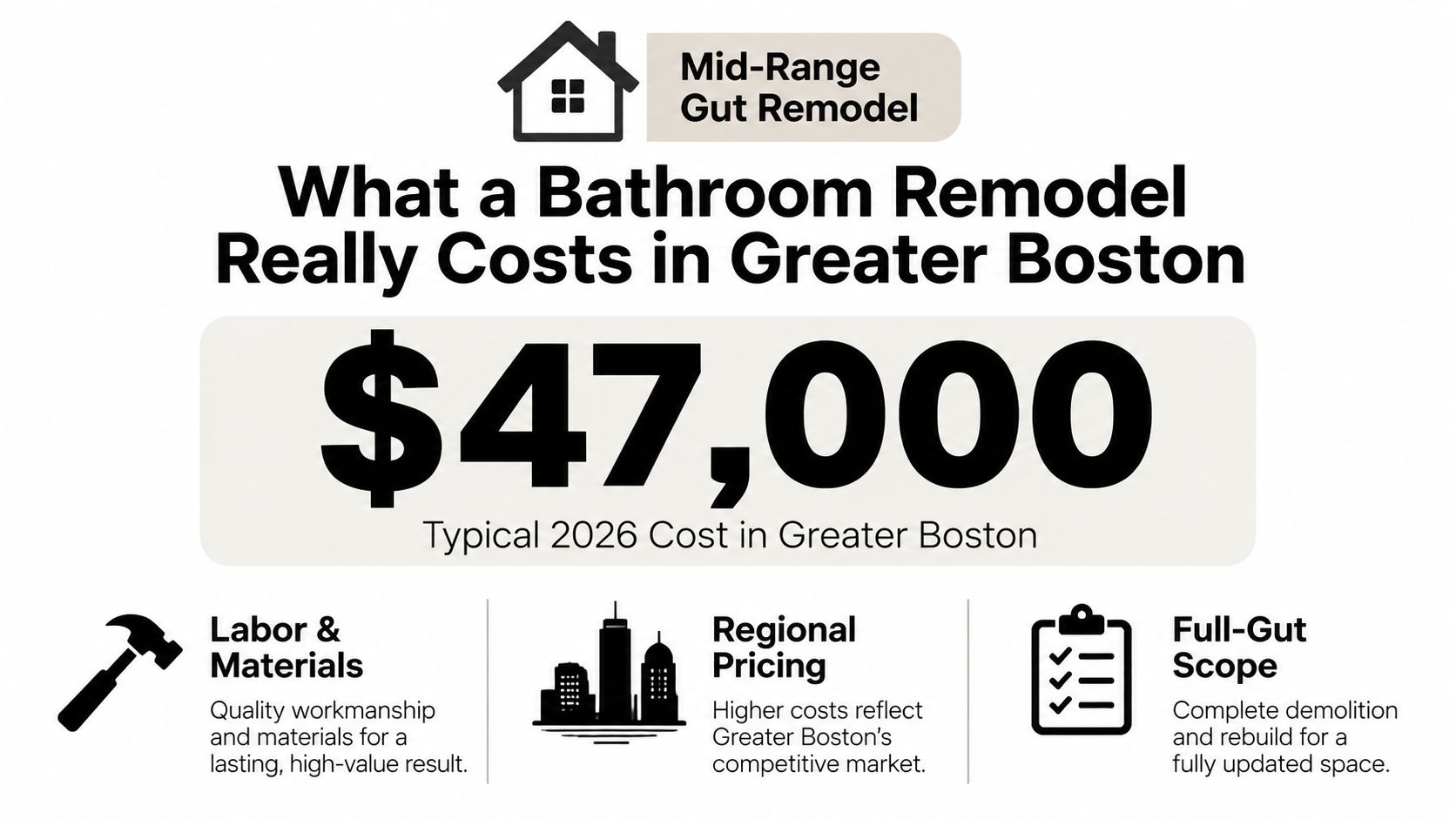
The rest of the estimate comes down to labor, bathroom size, layout, wet-area construction, fixtures, permits, and hidden conditions. A bathroom renovation in Arlington with the same tile and vanity as one in Somerville may still price differently because access, inspection scheduling, and existing construction aren't identical.
Cost Ranges by Bathroom Type and Size
The most practical way to estimate bathroom remodel cost is to classify the room by scope and square footage, not by a single national average. A 5-by-8 hall bathroom has different labor demands from a 100-square-foot primary suite, even when both use similar porcelain tile.
| Project Type | Price Range | Typical Scope | Cost Per Sq Ft |
|---|---|---|---|
| Hall bath refresh | $12,000 to $22,000 | Existing plumbing, new vanity, tub or shower surround, paint, basic porcelain tile | Not applicable |
| Mid-range gut | $30,000 to $55,000 | Full demolition, same-footprint layout, tiled shower, new pan, fixtures, ventilation, wiring | $300 to $650 |
| Primary-suite upgrade | $55,000 to $80,000-plus | Walk-in or curbless shower, freestanding tub, heated floor, custom glass, premium fixtures | $850 to $1,200 |
A hall bath refresh usually works when the room functions properly and the homeowner wants a cleaner appearance. Keeping the toilet, vanity, and tub in place limits plumbing labor. The scope may include a replacement vanity, new flooring, a tub or shower surround, painted walls, and standard fixtures.
A mid-range gut is different. We remove the old finishes, inspect framing and subflooring, install a new waterproofing assembly, set tile, upgrade ventilation, and bring electrical work up to current requirements. A 40-to-60-square-foot bathroom can still require substantial coordination because the room contains multiple licensed trades in a compact area.
A primary-suite upgrade carries the highest bathroom remodeling cost because homeowners typically add multiple premium elements at once. Curbless showers may require detailed slope planning and joist or slab work, while custom glass, heated flooring, double vanities, and freestanding tubs increase both procurement and installation time.
For broader renovation budgeting, homeowners can also review LendingXpress investor renovation costs as a planning resource, then replace broad assumptions with a site-specific Massachusetts estimate.
Where the Money Actually Goes in a Boston-Area Remodel
A $45,000 mid-range gut remodel gives a useful way to audit a quote. Labor commonly represents 40% to 50%, or roughly $18,000 to $22,500, while materials often consume 30% to 40%, or approximately $13,500 to $18,000. Those figures reflect the local cost structure described in regional remodeling guidance, where skilled trade rates run 15% to 25% above national medians. Regional bathroom remodeling guidance provides additional context for why Greater Boston estimates can differ from national guides.
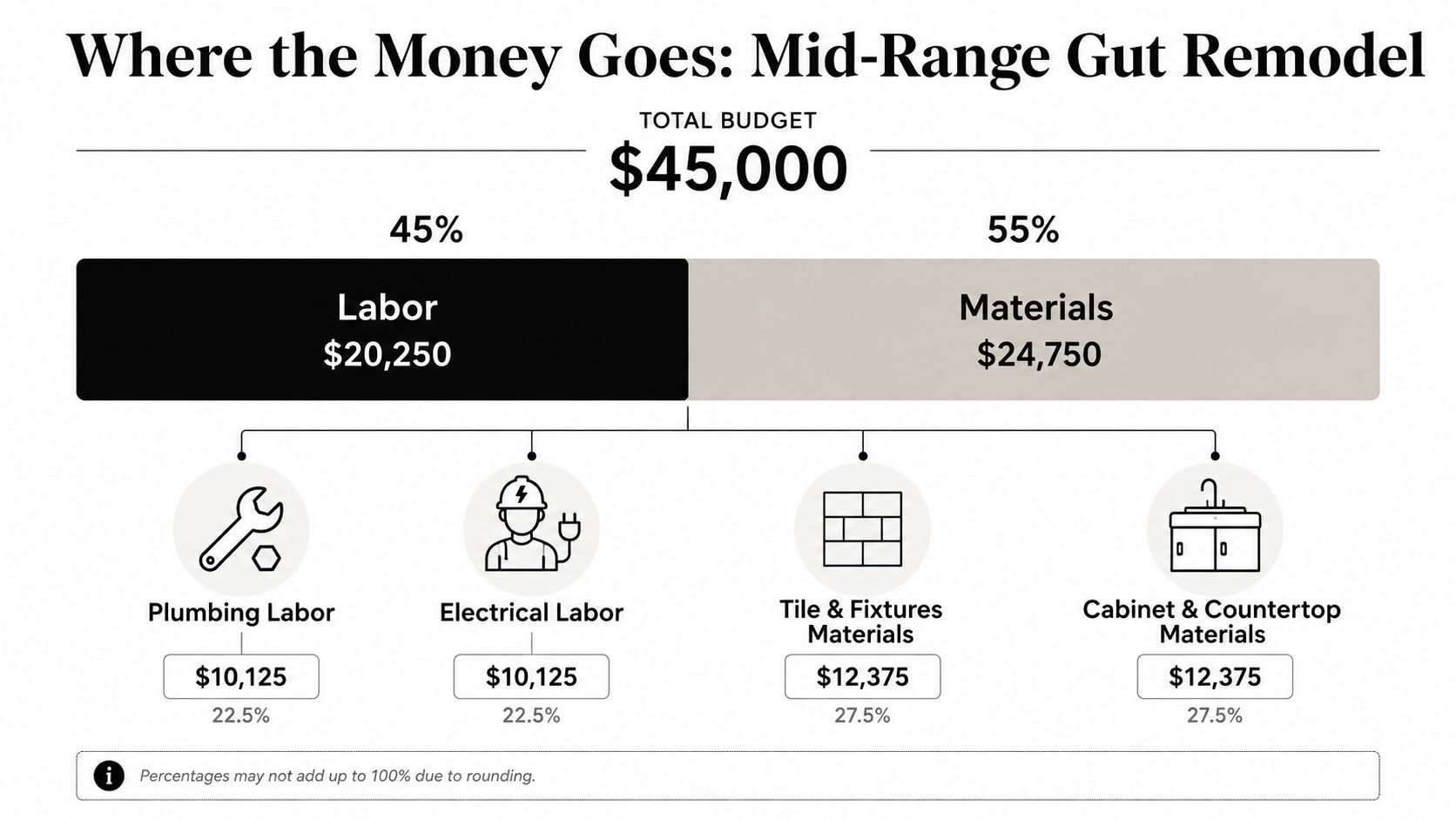
Within the materials portion, the major categories typically include:
- Tile and setting materials: About 8% to 12% of the project, depending on tile format, layout, waterproofing details, and installation complexity.
- Plumbing fixtures and faucets: About 6% to 9%, with premium valves and trim moving the figure upward.
- Vanity and countertop: About 5% to 8%, depending on whether the cabinet is stock, semi-custom, or custom.
- Glass enclosure or shower door: About 4% to 6%, especially when the design uses custom dimensions.
- Lighting and electrical trim: About 2% to 4%, excluding major panel or circuit corrections.
Permits, disposal, and design-related fees account for the remaining project allowance in many estimates. Waterproofing systems such as Schluter or Wedi, GFCI and AFCI corrections, properly ducted exhaust fans, and hazardous-material procedures can look like small line items until they become necessary to pass inspection.
Practical rule: Don't compare two bids by the fixture allowance alone. Compare demolition, waterproofing, rough plumbing, electrical inspection, ventilation, disposal, and finish carpentry line by line.
For a broader comparison between bathroom and kitchen budgets, see this kitchen and bathroom renovation cost guide.
Layout Changes, Plumbing, and Permits That Move the Price
Greater Boston homeowners often start with bathroom size, but the largest cost driver is whether the existing layout stays in place. Moving a toilet to the opposite wall can add $4,000 to $7,500 for drain relocation, vent-stack work, access through the ceiling below, and patching. Relocating a tub or building a curbless shower costs more when the work affects joists, a concrete slab, or a finished room underneath.
Structural work creates a separate pricing tier. Removing a load-bearing wall to enlarge a primary bathroom may require engineering, stamped plans, temporary support, and structural framing. That work can add approximately $3,000 to $9,000 before new finishes begin.
| Cost Driver | Typical Added Cost | Permit Required? |
|---|---|---|
| Toilet relocation | $4,000 to $7,500 | Typically yes |
| Load-bearing wall removal | $3,000 to $9,000 | Yes, with structural review |
| Plumbing or drain relocation | Thousands of dollars | Yes |
| Cosmetic finish replacement | Varies by scope | Often no, if systems remain untouched |
Massachusetts renovations fall under the MA State Building Code, 780 CMR. Bathroom work beyond ordinary repairs generally requires a permit before covered work starts, and significant alterations may require a certificate of use and occupancy. The Massachusetts 780 CMR repair and renovation requirements outlines the code and permit-review requirements.
Local building departments issue permits. There is no single statewide office handling each project. When a homeowner hires a contractor, Massachusetts law places permit and compliance responsibilities on the contractor, including requesting permits and coordinating inspections. The Massachusetts home improvement permit guidance applies to projects in Cambridge, Somerville, Brookline, Medford, and Arlington, where local review affects scheduling.
Older homes may contain inadequate venting, obsolete wiring, deteriorated piping, or concealed water damage. Confirming technical details early, including standard shower drain sizing, helps prevent a finished shower design from requiring late plumbing changes.
Realistic Timelines From Demo to Final Inspection
A mid-range gut bathroom remodel generally takes 8 to 14 calendar weeks in Greater Boston, even though active construction may occupy only part of that period. The difference comes from permit processing, inspection windows, specialty-trade coordination, and product lead times. NerdWallet's bathroom remodel cost guidance also emphasizes that size and scope materially change the project budget.
Permit issuance can take 2 to 6 weeks, depending on the municipality. Cambridge and Brookline can require more review time, while smaller communities may turn around straightforward applications faster. We order the vanity, tile, glass, and specialty fixtures before demolition whenever possible.
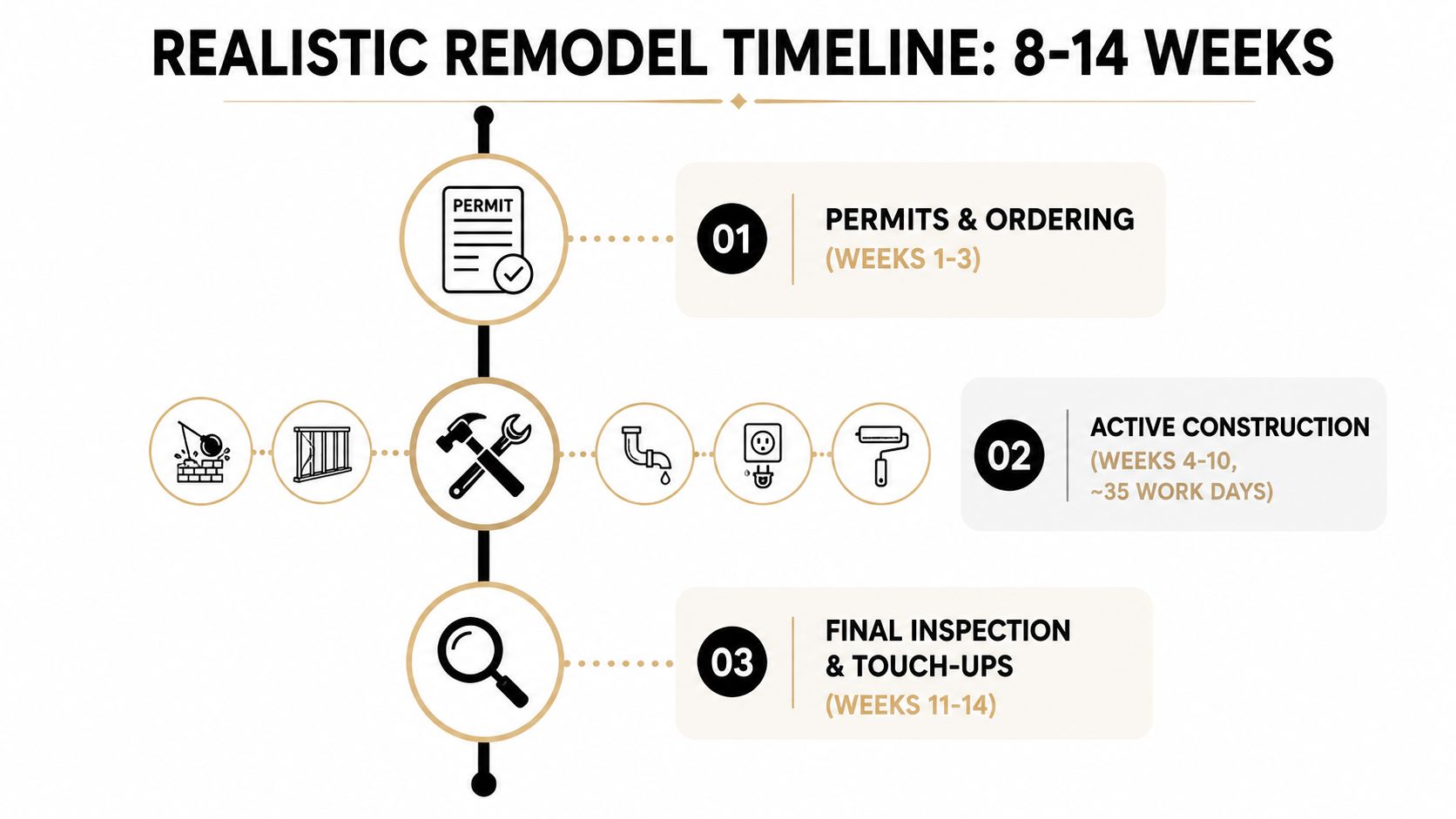
A typical sequence looks like this:
- Planning and procurement: Finalize selections, drawings, permits, and long-lead products.
- Demolition and rough work: Complete tear-out, framing corrections, plumbing, electrical, and ventilation.
- Wall closure and finishes: Pass rough inspections before insulation, drywall, waterproofing, tile, cabinetry, and glass.
- Closeout: Complete final plumbing, electrical, building inspections, punch-list work, and documentation.
Tile may require 2 to 4 weeks for common porcelain products and 6 to 10 weeks for custom or imported slabs, according to the project planning benchmarks provided for this article. A homeowner can usually remain in the house during a hall-bath renovation, but losing the only full bathroom requires a realistic temporary arrangement. Primary-suite work may require living elsewhere for 4 to 8 weeks.
Resale Value and How to Budget Your Own Project
Bathroom remodeling can support resale, but the return depends on scope, neighborhood expectations, and execution. The strongest verified benchmark is a midrange remodel costing $26,138, with approximately $20,915 in added home value, or about 80% cost recovery. The Cost vs. Value bathroom remodeling benchmark places that midrange category among the stronger interior renovation values.
The key is to spend in proportion to the property. A practical budgeting rule places bathroom remodeling around 5% to 10% of a home's value. For a $500,000 home, that implies approximately $25,000 to $50,000 for the bathroom project, depending on whether the work is a refresh or a more involved rebuild. HomeLight's bathroom remodeling budget guidance provides that framework.
| Remodel Tier | Typical Cost Range | Estimated Resale Return |
|---|---|---|
| Cosmetic refresh | $12,000 to $22,000 | Depends on condition and comparable homes |
| Mid-range remodel | $26,138 benchmark | About 80% cost recovery |
| Primary-suite upgrade | $55,000 to $80,000-plus | Depends heavily on market position and finish level |
A high-end primary bath can make sense in a high-value Cambridge, Lexington, or Newton home, but overbuilding a Medford condominium can limit recovery. We recommend comparing nearby sales and matching the bathroom to the quality buyers already expect in that property segment. For more detail, review this bathroom remodel ROI guide.
Smart Ways to Save Without Cutting Corners
The most reliable savings come from reducing disruption, not from removing waterproofing or hiring the lowest bidder. Keeping the toilet, vanity, and shower in their existing locations can save $3,000 to $6,000 in plumbing and access work, according to the verified industry guidance supplied for this article.
Use the existing tub if the cast-iron body is sound, then improve the surround, valve trim, tile, and glass. Choose standard fixture dimensions, finalize selections before contract signing, and ask whether Massachusetts tile distributors can provide the products without unnecessary retail markups. Owner-supplied tile may reduce material markup by 10% to 15%, but only when quantities, waste, delivery, breakage, and installation responsibility are clearly documented.
Spend on what protects the house: Waterproofing, properly sloped shower pans, GFCI protection, correct exhaust ducting, and sound framing aren't cosmetic upgrades. They prevent failures that force you to remove finished tile later.
Good candidates for later work include mirrors, accessories, vanity hardware, and some lighting fixtures, provided the rough electrical plan supports the future installation. Phasing a larger renovation can help cash flow, but separate scopes may create additional mobilization and inspection coordination, so we price that approach directly rather than assuming it always saves money.
We recommend comparing the scope, insurance, licensing, supervision, permit handling, and warranty terms behind every bid. Aureli Construction is a Massachusetts licensed general contractor that coordinates bathroom renovations and related home remodeling work across Greater Boston, including bathroom renovation Arlington MA, kitchen, basement, and addition projects.
Frequently Asked Questions From Greater Boston Homeowners
How long does a full bathroom remodel take in Greater Boston?
Once planning and permits are included, a mid-range project commonly occupies 8 to 14 calendar weeks. Permit processing can take 2 to 6 weeks, and rough plumbing, electrical, framing when applicable, and final inspections must be completed in sequence under 780 CMR.
Can I live in my home during the renovation?
Usually, yes, if another full bathroom remains available. If the only bathroom is offline, arrange temporary facilities or another living arrangement before demolition begins. A staged plan can reduce disruption, but it won't make an unavailable bathroom usable.
What commonly blows the budget?
The most frequent causes are hidden water damage, outdated piping or wiring that fails inspection, and finish changes after pricing is locked. Tile, glass, and vanity substitutions affect both the material allowance and the installation schedule.
Does a bathroom renovation require a permit in Massachusetts?
Cosmetic work may not require a building permit when it doesn't alter plumbing, electrical, structural components, or other regulated systems. Fixture moves, new circuits, wall changes, major alterations, and related plumbing or electrical work typically require local permits and inspections.
How should I compare contractor estimates?
Compare the written scope, not just the total. Confirm who handles permits, demolition, hazardous-material procedures, waterproofing, inspections, product ordering, disposal, change orders, and final closeout.
Aureli Construction helps Greater Boston homeowners plan bathroom remodels around actual conditions, local permit requirements, waterproofing details, fixture selections, and a realistic construction sequence. Visit Aureli Construction to request a free estimate for your bathroom renovation in Cambridge, Medford, Arlington, Belmont, Somerville, Newton, or another nearby Massachusetts community.