In Arlington, MA, a homeowner can have a well-kept interior, a sound roof, and a competitive asking price, yet still watch comparable homes attract showings first. Buyers often decide whether a property feels cared for before they reach the front door. In Greater Boston, learning how to improve curb appeal means looking beyond mulch and paint. The right sequence starts with moisture control, structural repairs, and code compliance, then moves to coordinated materials, lighting, and landscaping.
We build and remodel homes across Cambridge, Belmont, Brookline, Lexington, Newton, Somerville, and surrounding communities. Our practical rule is simple: fix what can damage the house before spending on what merely decorates it.
Table of Contents
- Why Curb Appeal Matters for Greater Boston Homes
- Assessing Your Home's Exterior Before Spending a Dollar
- Curb Appeal Projects by Budget and Expected ROI
- 2026 Exterior Design Trends Buyers Actually Want
- Massachusetts Permit Requirements for Exterior Remodels
- Seasonal Maintenance and When to Call a Contractor
Why Curb Appeal Matters for Greater Boston Homes
A homeowner in Lexington might refresh the kitchen, stage the living room, and arrange professional listing photos. If the front walk is stained, the entry door is tired, and the foundation grade sends water toward the house, buyers may still assume the property needs more work than it does. Exterior presentation shapes expectations before anyone sees the interior.
Research on house appearance found that improving curb appeal could raise a home's value by up to 17%, while a one-unit increase in curb appeal was associated with a 2.2% increase in house price. The study also found that curb appeal explained 31% of the variation in house prices after other factors were controlled. Those findings come from the 2012 landscape and house appearance study, and they support what contractors and appraisers see repeatedly: the exterior is part of the home's economic presentation, not a disposable cosmetic layer.
A 17% change translates into a substantial amount of money in Greater Boston, even without assigning a current median home price. The exact effect depends on location, condition, comparable sales, and the quality of the work. A neglected exterior has more room for improvement than one that already has sound siding, drainage, and a balanced entry.
New England weather makes appearance a maintenance issue
Freeze-thaw cycles expose weak caulking, cracked masonry, loose railings, and failing paint. Snow and ice can damage roof edges and gutters, while road salt stains hardscape and accelerates deterioration around steps and driveways. Older Greater Boston houses often combine wood trim, aging masonry, shallow site drainage, and additions built at different times. A fresh planting bed won't solve those underlying problems.
Practical rule: Buyers may forgive an outdated color. They won't be as comfortable with visible rot, standing water, or a front entry that feels unsafe.
That is why a guide to boosting your home's value with landscaping is most useful after the house's exterior envelope and drainage have been assessed. Landscaping can frame a sound home beautifully, but it shouldn't conceal water damage or postpone repairs.
Assessing Your Home's Exterior Before Spending a Dollar
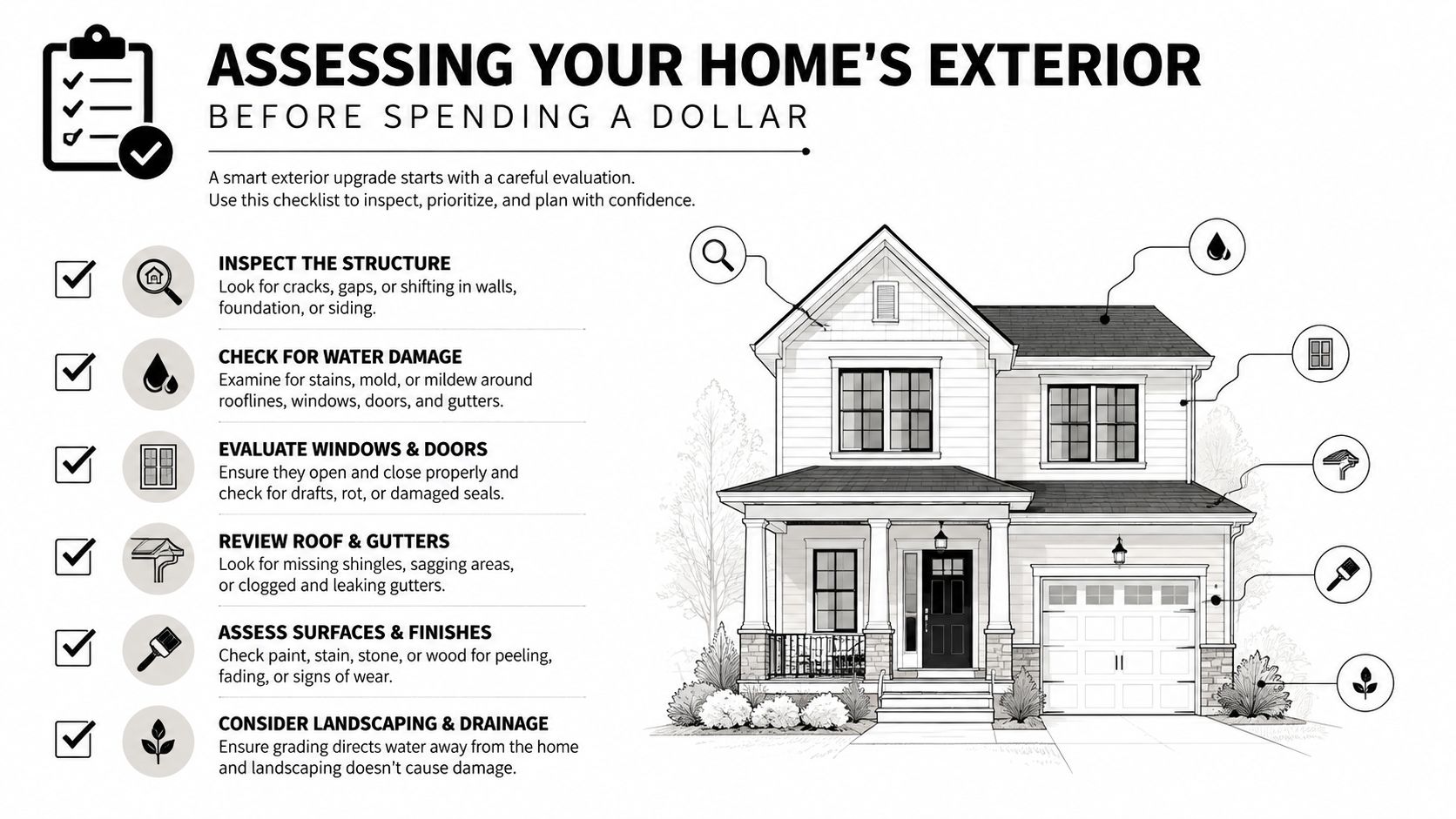
Walk the property as if you were seeing it for the first time, then inspect it as if you were responsible for keeping water out. Start at the roofline. Look for missing or lifted shingles, damaged flashing, sagging gutters, and staining below roof edges. Winter ice dams can leave moisture marks inside and loosen exterior materials, so don't treat a dark streak on fascia as a paint problem until the roof drainage is checked.
Next, inspect siding and masonry from the ground. Soft wood clapboards, bubbled paint, warped vinyl, and gaps around penetrations indicate different problems, but each deserves investigation. White deposits on brick or masonry can signal moisture moving through the assembly. You don't need to diagnose the cause from a ladder. Photograph the location and have a qualified professional evaluate it.
Follow the water
Stand at the front foundation after rain. Does the ground slope away, or does it pitch toward the wall? Older lots in Cambridge, Somerville, Medford, and nearby towns often have tight setbacks and improvised grading. Downspouts that discharge beside the foundation can undermine otherwise attractive landscaping and contribute to basement moisture.
Check windows, trim, porch posts, stairs, and railings. Peeling paint on original wood components needs extra care because older coatings may contain lead. A buyer sees peeling trim as deferred maintenance, while a contractor sees a potential surface-preparation and safety issue.
Use this short field checklist:
- Roof and gutters: Look for leaks, loose components, and poor discharge points.
- Siding and trim: Probe only accessible wood with a screwdriver, and stop if you find softness or widespread deterioration.
- Foundation and grading: Trace water from roof to downspout to soil, noting where it collects.
- Walkways and driveway: Mark heaving, cracks, slick growth, loose pavers, and trip edges.
- Entryway: Test railings, steps, door operation, lighting, house numbers, and porch drainage.
For a broader evaluation before a renovation, homeowners can review our home inspection resources. Digital planning tools, including an AI front yard design, can help visualize planting and layout options, but they can't replace an envelope, drainage, or structural assessment.
Curb Appeal Projects by Budget and Expected ROI
A sensible exterior budget starts with the most visible defect that can also cause damage. Cleaning, pruning, and entry details can change the presentation quickly. Larger work deserves a scope review, especially when siding, doors, windows, drainage, or porches connect to the building envelope.
The National Association of Realtors' 2016 Remodeling Impact Report reported 417% for reseeding a lawn, 303% for ongoing lawn maintenance, and 143% for installing new sod. It also reported 102.1% cost recouped for a steel entry door replacement and 83.9% for a mid-range garage door replacement, as summarized by Construction Dive's coverage of the report. These figures are historical report findings, not guaranteed resale outcomes for a particular Greater Boston property.
The table below uses qualitative budget tiers rather than invented local pricing or unsupported ROI estimates.
Match the scope to your selling horizon
| Project | Budget tier | Estimated cost | Expected ROI | Timeline |
|---|---|---|---|---|
| Cleaning, pruning, mulch, house numbers, and entry touch-ups | Entry level | Modest | Strong when neglect is visible | Short |
| Lawn repair or replacement | Entry to mid-range | Variable | Historically strong in the cited NAR report | Seasonal |
| Steel entry door replacement | Mid-range | Variable | 102.1% reported in the cited historical report | Short to moderate |
| Garage door replacement | Mid-range | Variable | 83.9% reported in the cited historical report | Short to moderate |
| Visible siding, trim, or drainage correction | Mid-range to investment | Variable | Depends on condition and scope | Moderate |
| Porch, portico, or coordinated façade renovation | Investment | Variable | Property-specific | Longer |
More recent summaries reported 268% cost recouped for garage door replacement, 216% for steel entry doors, and 208% for manufactured stone veneer in 2025, according to this 2025 Cost vs. Value summary. Because methodologies and project conditions differ, we use those figures as directional evidence rather than a promise.
Industry guidance also reports that 8 of the 10 highest-return home improvements are outside the home, with reported resale recapture ranging from 68% for a new composite deck to 194% for a garage door replacement. A Zillow exterior improvement guide recommends prioritizing high-visibility façade elements and using a feasibility review or appraiser-style before-and-after valuation before committing to lower-return cosmetic work.
A practical Greater Boston budget should be based on site access, existing damage, material choice, and permitting. We don't recommend promising a fixed price for siding, porches, or drainage until the assembly is opened or properly assessed.
2026 Exterior Design Trends Buyers Actually Want
The strongest exterior designs in 2026 look coordinated rather than decorated. Recent market coverage reports that beige became the most popular exterior wall color at 24%, up from 10% in 2024, while black trim rose to 39% and overtook white. It also reports that beams reached 43%, up from 19% in 2024. These figures appear in Realtor.com's 2026 buyer-expectation coverage.
For Colonial, Cape Cod, and Victorian homes, that doesn't mean applying every trend at once. A warm neutral siding color, restrained black or dark trim, and natural wood at the entry can work when the proportions suit the original architecture. On an older Cambridge or Belmont house, historically appropriate profiles usually matter more than a dramatic color contrast.
Function should lead the design
Buyers increasingly respond to exteriors that are easy to use and maintain. Native New England plantings, permeable walkways, shaded seating, and carefully aimed lighting contribute to daily function as well as appearance. Dark-sky-conscious fixtures and warm LED path lighting can make an entry safer without flooding neighboring properties with glare.
A covered porch or portico can add shelter and presence, but it also introduces structure, footings, roof drainage, and permit questions. Likewise, an outdoor entertaining zone can be useful when the lot supports it. Homeowners considering outdoor kitchens and fire pits should first confirm clearances, utilities, drainage, and local restrictions.
Durable materials can be more valuable than fashionable ones. Fiber-cement siding, composite trim, insulated cladding, and appropriately specified windows may reduce recurring maintenance, but the installation details determine performance. Poor flashing behind expensive siding still produces a failing wall.
Separate resale value from personal taste
A cohesive entry, sound walkway, functioning drainage, and clean lighting communicate care. A highly elaborate planting scheme, oversized hardscape, or strongly personalized façade may appeal to one buyer and distract another. For broader market appeal, preserve the home's architectural language and spend first on elements buyers can inspect, use, and maintain.
For homeowners combining exterior work with a larger renovation, our guide to home remodeling and addition trends provides a useful planning reference. The same principle applies throughout the project: design the exterior as one system, not as unrelated upgrades purchased at different times.
Massachusetts Permit Requirements for Exterior Remodels
Massachusetts exterior work falls under the Massachusetts State Building Code, 780 CMR. State guidance for existing buildings says a building permit is required for work regulated by 780 CMR 34, with an exception for ordinary repairs. That distinction matters because “cosmetic” work can become regulated work when it changes structure, openings, weather protection, or occupancy-related components.
A like-for-like siding replacement may be treated differently from siding replacement that adds insulation, changes structural sheathing, or exposes concealed damage. A same-size window or door replacement may follow a different path from a project that enlarges the rough opening, changes framing, or alters egress. Porches, decks, porticos, stairs, and roofed entries generally deserve a permit review because they involve structural loads, foundations, guards, stairs, and attachment details.
| Project type | Permit required? | Key code reference |
|---|---|---|
| Ordinary exterior repair | Sometimes exempt | 780 CMR 34 and local building department interpretation |
| Like-for-like siding replacement | Often reviewed as repair | 780 CMR, existing-building provisions |
| New insulation or structural sheathing | Typically requires review | 780 CMR envelope and structural provisions |
| Same-size window or door replacement | Often limited review | 780 CMR and local permit rules |
| Changed rough opening | Typically requires permit | 780 CMR structural provisions |
| New porch, deck, or portico | Typically requires permit | 780 CMR structural, stair, guard, and foundation provisions |
| Expanded driveway or walkway | May require zoning or site review | Local zoning ordinance and site requirements |
Massachusetts guidance is codified across 780 CMR 1.00 through 115.00, as shown in the Massachusetts existing-building code document. Cambridge's building permit application also requires compliance with the 8th Edition Massachusetts State Building Code and proof of zoning compliance, including a zoning analysis under Cambridge Zoning Ordinances. Review the Cambridge building permit application before changing a street-facing façade.
Local review can be as important as the building permit
Historic district or neighborhood review may affect materials, colors, windows, porches, and visible additions in Cambridge, Lexington, Concord, and other communities with preservation controls. Expanded impervious areas can also raise drainage and zoning questions. Electrical and plumbing permits may apply to hardwired lighting, exterior outlets, irrigation connections, or outdoor kitchen utilities.
Our Massachusetts permitting process guide explains the coordination homeowners should expect. Aureli Construction is a Massachusetts licensed general contractor, and our team coordinates permit applications, structural review, rough inspections, and final closeout with local building departments across Greater Boston.
Seasonal Maintenance and When to Call a Contractor
Greater Boston curb appeal is maintained through the year, not recreated during the week before listing photos. Spring exposes winter damage. Summer gives you the safest window for exterior repairs. Fall prepares the house for water, ice, and snow. Winter requires observation rather than risky ladder work.
Spring and summer priorities
In spring, clear gutters and downspouts, inspect siding and fascia, look for ice-dam staining, and clean walkways once surfaces are safely dry. Check porch steps and railings before regular outdoor use. If pressure washing is appropriate for the material, use controlled pressure and avoid forcing water behind siding, trim, or masonry joints.
Summer is the right time to renew failed caulking, repaint prepared surfaces, trim vegetation away from siding, and address small areas of rot before humidity and rain worsen them. Don't seal over damp wood or paint peeling surfaces without removing the failing coating and identifying the moisture source.
Fall and winter checks
Before freezing weather, seal driveway cracks where appropriate, inspect roof flashing, clean leaves from drainage paths, and winterize exterior hose bibs. Watch for water pooling near the foundation after heavy rain. Snow should never be allowed to conceal a recurring drainage problem.
In winter, monitor ice dams, sagging gutters, stressed porch roofs, and unusual movement in railings or porticos. Avoid climbing onto icy surfaces. A licensed contractor should inspect persistent moisture behind siding, structural rot in fascia or trim, failing foundation waterproofing, or any load-bearing exterior element.
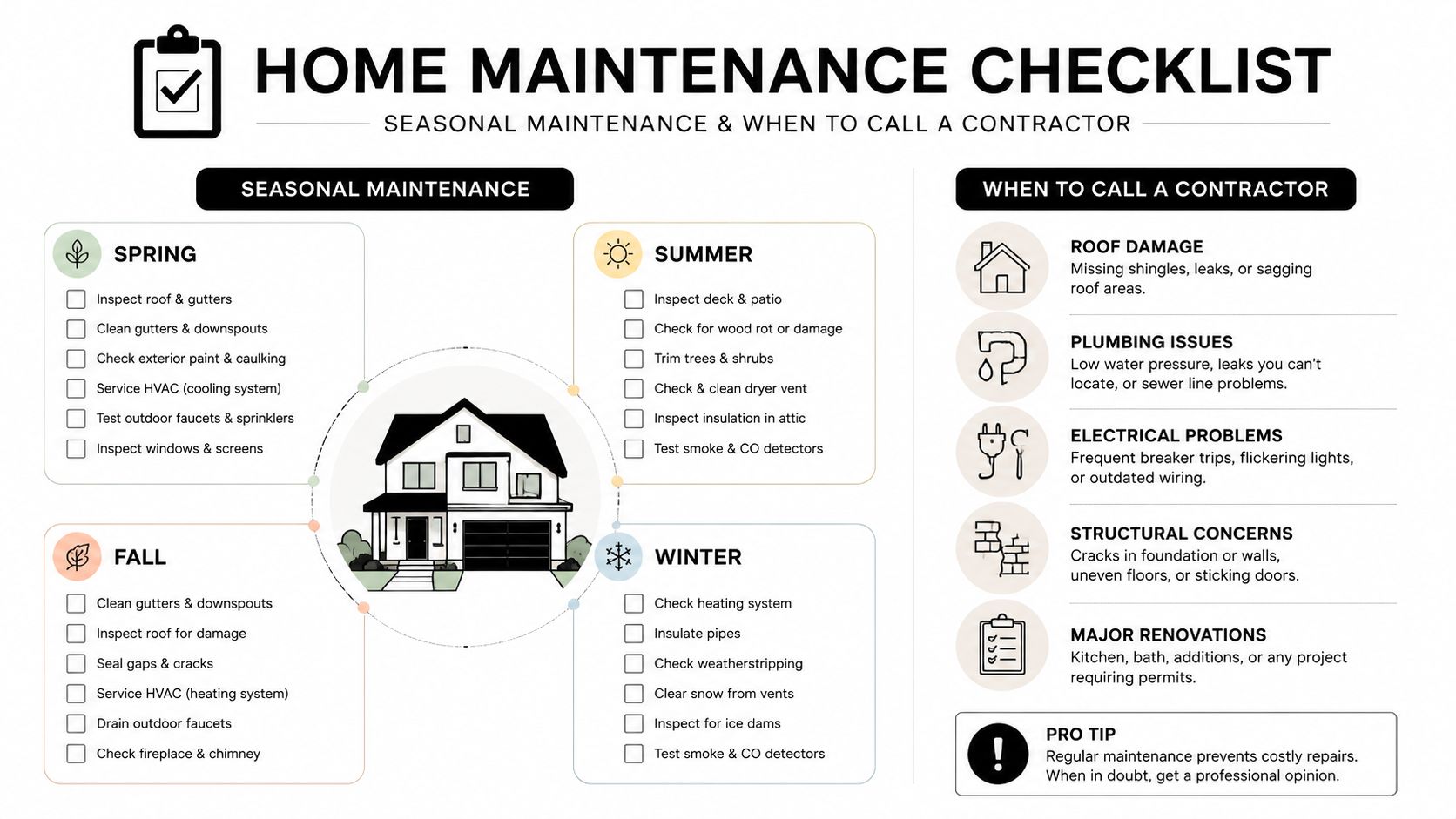
Know when to stop: If the repair changes framing, supports a roof or porch, redirects site drainage, or requires electrical or plumbing work, treat it as a contractor and permit question rather than a weekend project.
Aureli Construction can evaluate exterior repairs alongside larger home additions, kitchen remodels, bathroom renovations, basement finishing, and ADU construction. We serve Belmont, Brighton, Brookline, Burlington, Cambridge, Lexington, Medford, Melrose, Newburyport, Newton, Arlington, Reading, Somerville, Stoneham, Wakefield, and Wellesley, MA.
We can assess your home's roofline, siding, drainage, entry, and permit needs, then build a practical exterior scope that fits the property and your budget. Visit Aureli Construction to request a free estimate and discuss your curb appeal project with our Massachusetts licensed general contractor team.