A staggering 42% of Massachusetts homeowners find that their initial renovation estimates fall short because they fail to account for the structural reinforcement required by 19th-century New England foundations. It’s frustrating to plan for your family’s future when contractor quotes vary by as much as $150,000 for the exact same footprint. You deserve a clear, honest assessment of what it takes to build upward in a region where local zoning and strict building codes dictate the pace of every project.
We understand that adding a level is a significant investment in both your home’s value and your family’s peace of mind. This 2026 pricing guide and second story addition cost calculator provide a localized framework to help you budget with total confidence. We’ve analyzed current labor trends in towns like Cambridge and Medford alongside projected 2026 material costs to remove the guesswork from your planning phase. You’ll learn exactly how structural integrity requirements, specialized MA permits, and specific design choices drive your total investment so you can start your design process with a firm foundation.
Key Takeaways
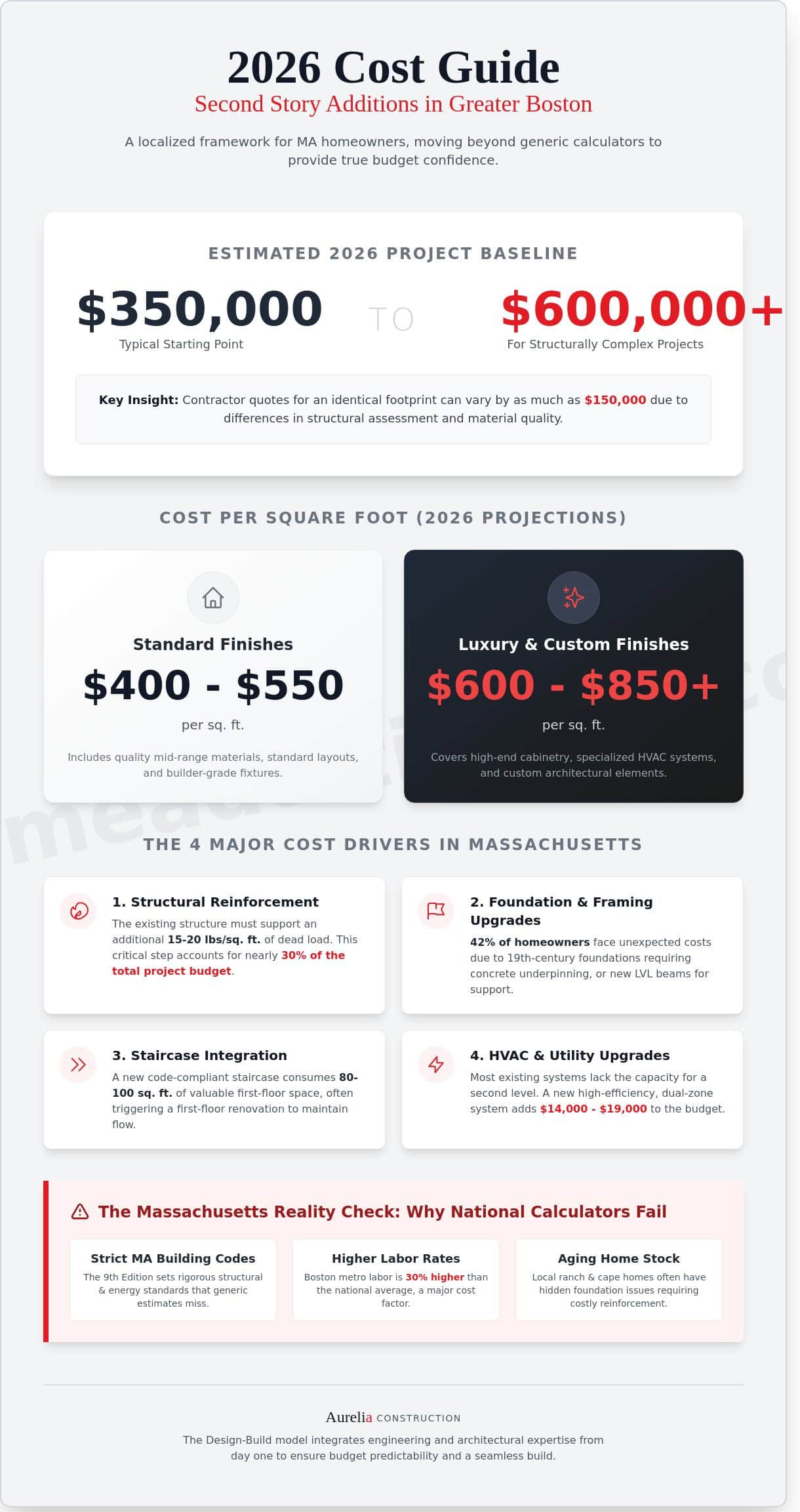
- Establish a realistic 2026 baseline for Greater Boston additions, with regional costs typically ranging from $350,000 to over $600,000 depending on structural complexity.
- Learn how to use our second story addition cost calculator framework to move beyond square footage and account for critical variables like staircase integration and structural reinforcement.
- Evaluate how your home’s existing foundation—whether slab, crawlspace, or full basement—dictates the technical requirements and overall investment of a vertical expansion.
- Compare the value-driven approach of adding basic bedrooms against luxury-tier master suites to determine which project scope best maximizes your Massachusetts property value.
- Discover how the design-build model eliminates the “calculator gap” by integrating engineering and architectural expertise from the very first sketch to ensure budget predictability.
Second Story Addition Cost in Greater Boston: 2026 Baseline
Adding a full level to your home is a significant undertaking that requires precise financial planning. For 2026, the baseline cost for a second story addition in the Greater Boston area typically ranges from $350,000 to $600,000 or more. While a second story addition cost calculator provides a helpful starting point, New England architecture demands a more nuanced approach. In our region, structural complexity often dictates the budget more than simple square footage. An older home requires a deep dive into its existing bones to ensure the foundation can safely support the massive weight of a new floor.
In high-density neighborhoods like Somerville and Cambridge, “building out” is rarely an option due to tight property lines and strict setback regulations. Homeowners in these areas must “build up” to gain the space they need. We specialize in turnkey construction, providing a seamless transition from the initial architectural drawings to the final walkthrough. This differs significantly from “shell only” projects. A shell project only includes the exterior structure, leaving the homeowner to manage the complex interior plumbing, electrical, and finishing work independently. Our start-to-finish model ensures every detail aligns with your vision and budget.
Why National Calculators Fail Massachusetts Homeowners
Standard online estimates often ignore the Massachusetts 9th Edition Building Code. This specific code sets rigorous standards for structural integrity and energy efficiency that drive up local costs. Labor rates in the Boston metro area currently sit 30% higher than the national average. Many local ranch and cape-style homes also harbor hidden structural needs. We often find that foundations laid in the 1950s require additional steel reinforcement or concrete underpinning before they can support a second level. These regional realities make generic calculators inaccurate for local planning.
Average Cost Per Square Foot in 2026
Based on current market trends and material projections, here is how 2026 pricing breaks down by quality of finish:
- Standard Finishes: $400 to $550 per square foot. This includes quality mid-range materials and standard layouts.
- Luxury and Custom Additions: $600 to $850+ per square foot. This bracket covers high-end cabinetry, specialized HVAC systems, and custom architectural glass.
Material supply chains in the North Shore and surrounding areas also impact these numbers. Fluctuations in the cost of specialized engineered lumber and local masonry can shift a budget by 5% to 10% within a single quarter. Using a localized second story addition cost calculator helps you account for these regional variables. We recommend starting your project with a clear understanding of these baseline figures to ensure your investment adds lasting value to your property.
The 4 Major Cost Drivers for Your MA Second Floor
Estimating the investment for a vertical expansion requires looking down before you look up. Your existing structure determines nearly 30% of your total budget. While a second story addition cost calculator provides a baseline, local variables in the Greater Boston area often shift those numbers. We identify four primary factors that dictate whether your project stays on budget or requires significant financial adjustments.
Structural reinforcement is the most critical variable. Your first floor must support the weight of the new level, which typically adds 15 to 20 pounds per square foot of dead load. Beyond the walls, you must account for staircase integration. A standard code-compliant staircase consumes 80 to 100 square feet of living space. This often forces a first-floor renovation to maintain a functional floor plan. Finally, your HVAC and utility systems must be sized for the doubled volume. Most existing furnaces in older Lexington homes don’t have the British Thermal Units (BTUs) required to heat an additional 1,200 square feet. Upgrading to a high-efficiency dual-zone system typically adds $14,000 to $19,000 to your 2026 project estimate.
Foundation and Framing Upgrades
In Medford and Winchester, we frequently encounter fieldstone foundations dating back to the late 19th century. These structures often require concrete underpinning or internal benching to handle the increased vertical pressure. Adding structural steel or LVL (Laminated Veneer Lumber) beams is a standard requirement to prevent floor sagging. If your home features balloon framing, which was common until the 1940s, we must install specific fire-blocking and modern insulation to meet current Massachusetts building codes. These safety upgrades ensure your home’s structural integrity for decades to come.
Local Zoning and Setback Regulations
Zoning laws in Newton and Somerville are some of the most complex in the state. Newton utilizes a Floor Area Ratio (FAR) to limit the total square footage of a home relative to its lot size. If your proposed addition exceeds a 0.35 or 0.40 FAR, you may face a lengthy special permit process. In Somerville, tight setbacks often require specialized scaffolding or cranes to deliver materials to narrow lots, increasing labor costs by 12%. Meanwhile, the Cambridge Historical Commission may mandate specific exterior materials, such as genuine cedar clapboards, which can cost $25,000 more than standard fiber cement siding.
Understanding these regional nuances is the first step toward a successful build. You can request a detailed feasibility study to see how these variables affect your specific property.
- Staircase Impact: Expect to lose 80+ sq. ft. of the original footprint.
- Utility Load: Electrical panels often need an upgrade to 200-amp service.
- Permit Timelines: Budget 3 to 6 months for municipal approvals in historic districts.
By addressing these drivers during the planning phase, you avoid the “hidden” costs that often surprise homeowners mid-construction. Our goal is to provide a turnkey experience that prioritizes transparency and long-term value.
2026 Pricing Tiers: From Master Suites to Full Levels
Every homeowner in Greater Boston starts their journey by searching for a reliable second story addition cost calculator to set realistic expectations. In 2026, we categorize project costs into three distinct finish levels that dictate the final investment. Standard finishes, typically ranging from $300 to $400 per square foot, utilize quality materials like durable luxury vinyl plank flooring and stock cabinetry. These are ideal for families focusing on functional space. Premium finishes increase the investment to $450 to $600 per square foot by introducing hardwood floors, quartz countertops, and designer lighting packages.
The Luxury Tier, which often exceeds $700 per square foot, is reserved for homeowners seeking architectural statements. This tier includes features such as:
- Vaulted or 10-foot ceilings that require advanced structural framing.
- Custom millwork and built-in storage solutions tailored to the room’s dimensions.
- High-efficiency HVAC zones specifically for the new level.
- Smart-home integration for lighting, climate, and security.
Partial Second Story (Master Suite Addition)
A partial addition typically requires an investment between $250,000 and $350,000. These projects usually focus on creating a private retreat, featuring a primary bedroom, a high-end master bath, and a spacious walk-in closet. While the footprint is smaller than a full level, the cost per square foot is often 15% higher. This occurs because our team must meticulously tie the new structure into your existing roofline, which involves complex framing and specialized flashing to ensure the home remains watertight. You can find more details on how much to add a second story and what to expect during the structural phase.
Full Second Story Expansion
For families needing maximum square footage, a full expansion typically ranges from $450,000 to over $700,000. This layout generally provides three bedrooms, two bathrooms, and a dedicated laundry room. In high-value markets like Belmont or Newton, 82% of our clients choose a full expansion because it offers a superior return on investment. Doubling your living area without increasing the home’s footprint preserves your yard space while significantly boosting the property’s market value. It’s a strategic move that transforms a modest ranch or cape into a substantial, multi-generational home. When using a second story addition cost calculator, remember that a full level allows for more efficient plumbing and electrical runs, often lowering the cost per square foot compared to smaller, isolated additions. For a comprehensive breakdown of what drives the second floor addition cost in Greater Boston, including how design-build integration keeps your 2026 budget on track, our detailed pricing guide covers every variable specific to the region.
How to Calculate Your Preliminary Budget: A 5-Step Process
Planning a vertical expansion requires more than a simple per-square-foot estimate. You need a reliable second story addition cost calculator to account for the unique structural demands of Massachusetts homes. This five step process provides the financial clarity you need before you commit to a design.
Step 1: Measuring the ‘Footprint’ vs. ‘Living Area’
Accurate budgeting begins with exterior dimensions rather than interior room sizes. Gross Square Footage under Massachusetts zoning codes represents the total floor area measured from the outside faces of the exterior walls including all mechanical spaces and stairwells. Roof pitch and dormer styles significantly impact your usable space; a steep gable provides more headroom but increases framing costs by 12% compared to a standard 4/12 pitch. We calculate the structural footprint first to ensure the budget covers the entire building envelope.
Your existing foundation dictates the initial phase of your budget. If your home sits on a 1950s slab, you may require helical piers to support the weight of a second floor. A full basement offers more stability, but a structural engineer must verify that the footings can handle the 40 pound per square foot live load required by the 2026 building code. Material selection further refines the numbers:
- Standard Finish: $385 per square foot using vinyl siding and builder-grade fixtures.
- Mid-Range Finish: $520 per square foot featuring fiber cement siding and semi-custom cabinetry.
- High-End Finish: $690+ per square foot with slate roofing, custom millwork, and premium HVAC systems.
Massachusetts weather and the age of local housing stock necessitate a 17% New England Contingency. Structural rot or outdated knob-and-tube wiring often hide behind plaster walls in 82% of homes built before 1970. You must also budget for temporary living expenses. Most families in towns like Medford or Newton relocate for the six month construction window, spending an average of $4,200 monthly on short-term rentals.
Factoring in the ‘Soft Costs’
Construction labor and materials only represent a portion of your second story addition cost calculator results. Soft costs include architectural and engineering fees, which typically range from 10% to 15% of the total construction value. Permit fees in Arlington currently average 1.5% of the project value, while Wakefield utilizes a tiered fee structure based on every $1,000 of estimated cost. Choosing a Design-Build model often consolidates these expenses into a single, predictable contract, reducing the risk of budget creep by 9% compared to the traditional Architect-Bid-Build approach.
If you are ready to move from estimates to a firm project plan, you should request a detailed feasibility study to see exactly how these variables apply to your specific property.
Predicting Costs with the Design-Build Advantage
Online tools provide a helpful baseline, but they often leave a “calculator gap” between a digital estimate and the actual construction invoice. At Aureli Construction, our design-build model closes this gap by integrating architectural design with real-world construction costs from day one. You don’t just get a sketch. You get a budget-aligned blueprint. Having an engineer and a builder collaborate during the first conceptual drawing ensures that the structural requirements of a Massachusetts home, such as frost line depths or load-bearing wall reinforcements, are accounted for immediately. This proactive approach allows us to manage fixed-price contracts that protect homeowners in Newton and Lexington from the financial volatility often seen in traditional “bid-and-build” projects. Our fixed-price agreements specify every cost down to the hardware, ensuring your 2026 budget remains intact despite market fluctuations.
Eliminating Budget Creep in 2026
The most common pitfall in home expansion is the “architect’s trap.” This happens when a beautiful design is drafted that eventually costs 35% to 50% more than the homeowner’s stated limit because the designer wasn’t tracking current lumber or labor prices. We prevent this through early-stage estimating. By using advanced 3D modeling, we visualize the project and calculate exact material quantities before a single nail is driven. This precision is why we are recognized as leading second story addition contractors in Newton and the Greater Boston area. 3D modeling allows us to rotate the structure and identify potential plumbing conflicts that would typically cause a $5,000 change order mid-construction. Our 2026 pricing model relies on real-time local data to ensure your second story addition cost calculator results translate into a feasible, buildable project.
Start Your Feasibility Study in Greater Boston
Moving beyond a generic second story addition cost calculator requires a deep dive into your home’s unique DNA. During an initial consultation, we move from theoretical numbers to a technical feasibility study. We analyze the structural integrity of your existing property to ensure it can handle the vertical load. For homes in Medford or Belmont, this often involves inspecting foundations that are 70 to 100 years old to determine if they can support the additional 30,000 pounds of a new master suite and roofline. We provide a clear roadmap that includes:
- Foundation load capacity assessment: We verify if your current footings meet 2026 Massachusetts building codes.
- Zoning and setback verification: We check local Medford and Belmont ordinances to ensure your height increase is legal.
- Utility integration plans: We map out how your existing HVAC and electrical panels will scale to the new floor.
This level of detail transforms a rough estimate into a reliable investment plan. We prioritize transparency and structural safety to give you total peace of mind. Schedule your 2026 project consultation today to move your project from the screen to the job site.
Start Planning Your 2026 Home Transformation
Investing in your property requires a partner who understands the specific zoning laws and architectural nuances of Massachusetts. You’ve seen how a second story addition cost calculator helps baseline your 2026 budget, whether you’re adding a custom master suite or an entire new level. At Home Addition MA, we bring 30 plus years of local expertise to every project. We eliminate the uncertainty of shifting market rates by providing fixed-price remodeling contracts that protect your financial bottom line.
Our turnkey design-build service manages every detail from the initial structural assessment to the final walkthrough. This approach ensures your new floor integrates seamlessly with your existing home while maximizing your property value. Don’t settle for vague estimates when you can have a clear roadmap for your project. We take the responsibility of altering your home with the utmost gravity and care. We’re ready to help you create the space your family needs with the reliability you deserve.
Get a Precise Quote for Your Second Story Addition
Frequently Asked Questions
Is it cheaper to build a second story or a ground-floor addition in MA?
Building up is typically 12% more expensive than building out because of the necessary structural reinforcements. While a ground-floor addition requires new foundation work, a second story involves stripping the existing roof and strengthening the first-floor walls to support the new weight. In towns like Brookline, where lot coverage is limited, building up remains the most strategic way to maximize your investment despite the higher per-square-foot cost.
How long does a second story addition take to build in the Boston area?
A standard second story project in the Boston area requires 6 to 9 months from the initial design phase to the final walkthrough. The construction phase itself typically spans 16 to 22 weeks depending on the complexity of the plumbing and electrical integration. We manage the entire schedule to ensure your project stays on track, navigating the local seasonal weather patterns that often impact exterior work during the winter months.
Do I have to move out of my house during a second story addition?
You’ll need to vacate your home for 3 to 5 months while the major structural work occurs. Because we must remove the existing roof and disconnect primary utilities, living in the space becomes unsafe and impractical for your family. Our turnkey service includes coordinating this transition, ensuring the site remains secure and the construction moves efficiently so you can return to your improved home as quickly as possible.
Will my current foundation support a second floor in towns like Arlington?
Most foundations in Arlington require some level of reinforcement, as approximately 85% of older residential structures weren’t designed for vertical loads. A licensed structural engineer must evaluate your home’s footings and soil stability before we begin the design process. If your foundation needs support, we often use helical piles or concrete underpinning to ensure the structural integrity of your new second story for decades to come.
How much value does a second story addition add to a home in Newton or Lexington?
Homeowners in Newton and Lexington typically see a 65% to 75% return on investment for a well-executed second story addition. Adding two bedrooms and a bathroom can increase a property’s market value by $250,000 to $400,000 based on 2025 regional sales data. Using a second story addition cost calculator helps you visualize this project as a strategic financial asset rather than just a simple renovation expense.
What are the permit costs for a second story in Cambridge vs. Medford?
Permit fees in Cambridge are calculated at $20 per $1,000 of construction value, while Medford typically charges a lower rate of $12 per $1,000. For a $300,000 project, this means you’ll pay $6,000 in Cambridge compared to $3,600 in Medford for the same scope of work. We handle the entire filing process with local building departments to ensure your project complies with all 2026 Massachusetts building codes.
Can I add a second story to a ranch house with a slab foundation?
You can add a second level to a ranch on a slab, though it requires specific engineering to handle the increased weight. We often install new interior support columns or thicken the perimeter footings to meet modern safety standards. This process ensures your home remains stable and level. Our team specializes in these complex conversions, providing a seamless transition from a single-story layout to a spacious, multi-level residence.
Are there specific 2026 tax credits for energy-efficient additions in Massachusetts?
The 2026 federal tax guidelines and the Mass Save program offer credits up to $2,000 for high-efficiency heat pump installations in new additions. You can also claim a 30% credit for insulation upgrades and energy-efficient windows under the Energy Efficient Home Improvement Credit. Using our second story addition cost calculator allows you to factor these savings into your total budget, making your long-term utility costs much more manageable and predictable.