In Greater Boston, a typical home sauna installation runs $3,000 to $10,000 installed, with plug-in infrared units starting near $1,500 and fully custom built-in saunas exceeding $30,000. Labor alone commonly represents 30% to 50% of the final price.
In Arlington, Newton, or Cambridge, that range becomes real the moment a homeowner moves from browsing sauna kits to looking at the room, heater, electrical panel, and permit path. A sauna that appears simple online may need a dedicated circuit, ventilation, framing changes, waterproof flooring, or a panel upgrade before it can operate safely and pass inspection.
We approach sauna installation as a small construction project, not just a product delivery. The unit matters, but so do the distance to the electrical panel, access through an older New England house, the condition of the floor, and whether the sauna sits inside the home or outdoors. Massachusetts code and local inspection requirements can affect the final bill just as much as the heater or wood species.
Table of Contents
- Why Sauna Installation Cost Matters More in Greater Boston
- Sauna Installation Cost by Type in Massachusetts
- What Actually Drives Sauna Installation Cost
- DIY Sauna Installation vs Hiring a Contractor in Greater Boston
- Sauna Installation Timeline Expectations
- Operating and Maintenance Costs Over Time
- Massachusetts Permits and Next Steps for Homeowners
- Sauna Installation Cost Frequently Asked Questions
Why Sauna Installation Cost Matters More in Greater Boston
The commonly cited U.S. installed cost clusters around $2,500 to $7,000, with an average near $3,100. Broader 2026 pricing guides place many projects between $3,000 and $10,000 installed, according to HomeAdvisor's sauna installation cost guide. Greater Boston projects often reach the upper end because older homes, tight access, higher local labor costs, and electrical coordination add work.
Under Massachusetts electrical requirements, including 527 CMR 12.00, the heater may require more than an available outlet. Panel capacity, a dedicated circuit, trenching for detached locations, permits, and inspections can all affect the final bill. Those items are often missed when homeowners compare a kit price with an installed quote.
Practical rule: Don't compare sauna quotes until you know whether each contractor included electrical work, permits, inspections, delivery, site preparation, and finish repairs.
The price spread remains substantial. A plug-in infrared unit can start near $1,500, while a fully custom architect-designed sauna can exceed $30,000, creating more than a 20x price difference between projects with the same general label. Labor may account for 30% to 50% of the total, as reported in the HomeAdvisor cost reference.
For broader remodeling context, homeowners can review our guide to construction costs in Massachusetts. The practical question is not, “What does a sauna cost?” It is, “What must this home address before the sauna can operate legally and safely?” In Cambridge, Newton, Arlington, and nearby towns, that answer often determines the budget more than the sauna package itself.
Sauna Installation Cost by Type in Massachusetts
The best starting point is the sauna type. Infrared cabins, traditional electric saunas, and custom built-in rooms differ in heater requirements, carpentry, ventilation, and finish work.
Plug-in infrared units
Plug-in infrared units are usually the simplest option. Some operate from an existing 120V outlet, so the project may involve delivery, assembly, leveling, and minor room preparation rather than new wiring. The low end can start near $1,500, although the final cost rises when the room needs electrical modifications or finish repairs. The Fixr sauna installation guide places DIY four-person kits around $2,640 to $4,790 and prefab sauna installations around $4,000 to $6,000.
Traditional electric saunas
Traditional saunas use an electric heater with stones and generally demand more substantial electrical planning. A 9 kW heater may require a 50-amp dedicated circuit, according to the Checkatrade home sauna cost guide. In a Massachusetts basement or finished room, the installation can also require ventilation adjustments, heat-resistant finishes, and careful clearance planning.
Fully custom installations
A built-in sauna costs more because the contractor is constructing a room, not assembling a product. Custom benches, wall insulation, vapor control, lighting, tile, trim, ventilation, and coordination with existing plumbing or HVAC all add scope. Fully custom work can exceed $30,000, especially when the sauna becomes part of a larger basement, bathroom, or whole-home renovation.
| Sauna Type | Installed Cost Range | Best For |
|---|---|---|
| Plug-in infrared | Starting near $1,500 | Homeowners testing sauna use or working with an existing outlet |
| Traditional electric | Commonly within $3,000 to $10,000 installed | Buyers who want high heat, stones, and a more conventional sauna experience |
| Fully custom built-in | Can exceed $30,000 | Homeowners seeking a permanent, integrated wellness room |
For homeowners planning a broader energy project, the electrical planning principles overlap with other high-load installations. A resource on installing solar batteries in Australia offers useful background on why equipment selection, circuit capacity, and installation conditions should be evaluated together, even though local Massachusetts code governs a sauna project.
What Actually Drives Sauna Installation Cost
The sauna cabin is only one line item. In practice, the final bill reflects how much preparation the home needs and how difficult it is to route utilities without damaging finished spaces.

Size and layout affect both materials and labor. A compact cabin may fit in a basement or spare room with limited changes. A larger traditional sauna needs room for the heater, safe clearances, benches, door swing, and air movement. Tight stairways, narrow hallways, and finished Cambridge or Somerville interiors can make delivery and assembly more involved.
Materials also change the character and price of the work. Cedar, hemlock, and synthetic interior materials have different appearances, durability considerations, and installation requirements. Custom benches and matching trim take more time than a standard kit.
Electrical work is often the surprise
A standard indoor 240V dedicated circuit commonly costs $450 to $1,200, while an outdoor or detached installation can reach roughly $975 to $3,800 because of longer wire runs, conduit, trenching, and weatherproofing. If the main panel lacks spare capacity, a panel upgrade may add $1,000 to $2,500 or more, according to Haven of Heat's sauna electrical requirements.
Distance matters. A sauna beside the panel is a different electrical job from one across a finished basement, in a detached backyard structure, or behind a foundation wall. Homeowners comparing panel-related expenses may also find this explanation of what affects electrical panel pricing useful.
Site preparation can include a level floor, heat-resistant surfaces, structural reinforcement, drainage planning, exterior foundation work, and weather protection. Outdoor projects typically cost more because the complete installation may include the kit, foundation or site preparation, electrical work, and accessories, with estimates often around $6,000 to $18,000 in the Haven of Heat outdoor sauna cost guide.
A short visual overview can help homeowners understand how these components fit together:
DIY Sauna Installation vs Hiring a Contractor in Greater Boston
A prefabricated infrared cabin can be reasonable for a capable homeowner when the manufacturer permits self-assembly and the unit can use an appropriate existing outlet. The work still requires accurate assembly, a level base, proper clearances, and attention to ventilation. Traditional heaters and new circuits are a different matter.
A new 240V circuit usually requires an electrical permit, while a plug-in 120V infrared unit on an existing outlet may not, according to Peak Saunas' guide to 2023 NEC sauna requirements. Local building departments retain final authority, so a homeowner shouldn't rely only on the product listing or a contractor's informal assumption.
| Factor | DIY Approach | Professional Installation |
|---|---|---|
| Assembly | Homeowner handles delivery and assembly | Contractor coordinates delivery, assembly, and site protection |
| Electrical | Requires licensed, code-compliant electrical work when a new circuit is involved | Electrical scope, permits, and inspections are coordinated as part of the project |
| Site conditions | Hidden floor, framing, or access problems may appear late | Conditions are reviewed before ordering and installation |
| Corrections | Errors can lead to rework, damaged finishes, or inspection delays | The team carries responsibility for coordinated installation and closeout |
| Best fit | Simple prefab unit with suitable existing service | Traditional, outdoor, built-in, or electrically complex sauna |
The apparent DIY saving often disappears when a homeowner must open finished walls, correct wiring, modify a panel, or redo work after an inspection. Unpermitted changes can also create complications during a future sale or renovation.
The right decision depends on scope. If the sauna is a simple kit and the electrical service is already appropriate, DIY assembly may work. If the project involves new wiring, a panel upgrade, framing, ventilation, or an outdoor foundation, a contractor who can coordinate the work is usually the safer choice. Homeowners weighing that broader coordination model can compare design-build and general contractor approaches.
Sauna Installation Timeline Expectations
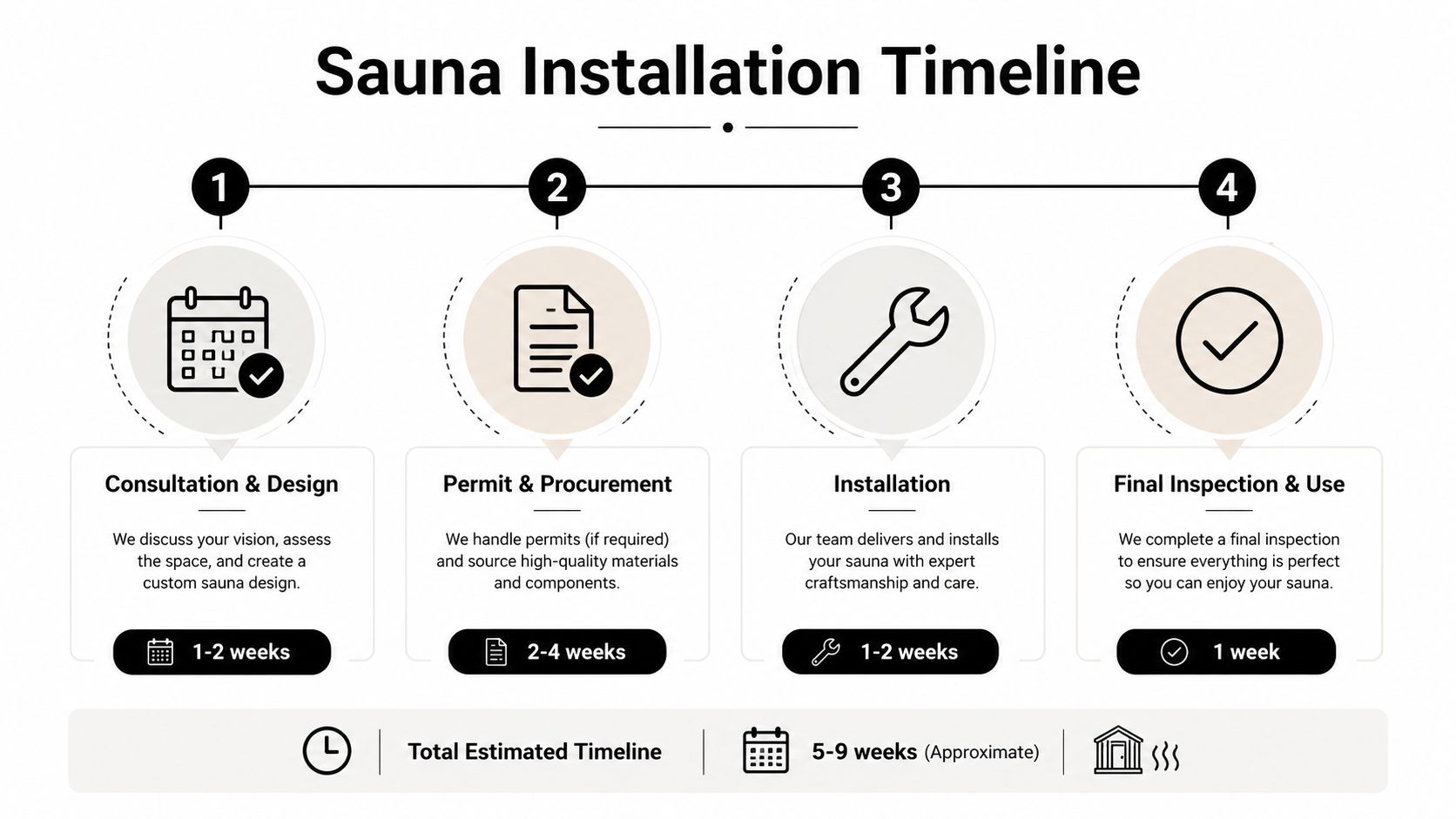
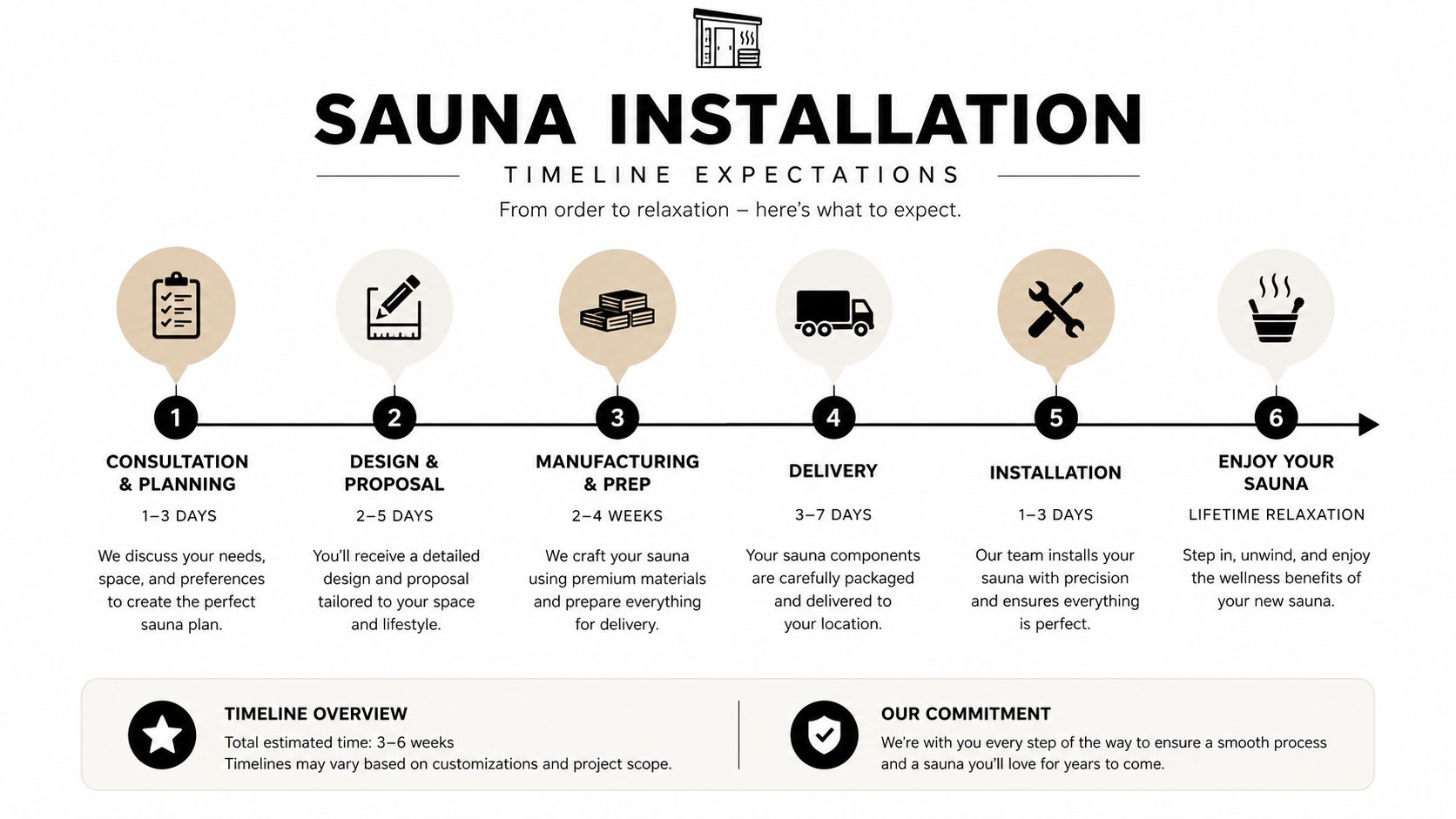
A basic kit installation can move quickly when the room, floor, and electrical service are ready. A custom project takes longer because design decisions, procurement, permit review, rough inspections, finish work, and final approval all have to occur in sequence.
The practical sequence is:
- Consultation and design: Confirm the sauna type, dimensions, heater load, room clearances, ventilation, and access route.
- Permit and procurement: Submit required applications, order the sauna, and coordinate electrical materials.
- Installation: Prepare the room, complete framing or flooring work, install the electrical rough-in, and assemble the sauna.
- Inspection and closeout: Complete rough electrical or framing inspections where required, address corrections, and schedule final inspection before use.
Cambridge, Newton, Arlington, and other municipalities don't always process applications at the same pace. A project can also slow down when the selected heater changes after electrical plans are prepared, when the panel needs evaluation, or when a custom unit arrives with different dimensions than expected.
Homeowners can keep the schedule more predictable by selecting the sauna model early, confirming the heater's electrical requirements before ordering, and asking who will pull each permit. Keep the access route clear, protect nearby finishes, and decide whether the sauna is part of a larger basement finishing project or a standalone installation.
Operating and Maintenance Costs Over Time
The purchase price doesn't tell the entire ownership story. Current guides commonly place home sauna energy expenses around $15 to $30 per month, as reported by The Sacramento Bee's sauna cost coverage. Actual use depends on the heater, session frequency, insulation, thermostat settings, and local electricity rates.
Infrared units generally have a lighter electrical demand and can heat the user differently from a traditional sauna. Traditional electric heaters require more substantial service but provide the high-heat and stone-heater experience many buyers specifically want. Choosing infrared solely because the cabin costs less can be a mistake if the homeowner wants traditional heat and humidity control.
Maintenance depends on location
An indoor sauna usually needs routine cleaning, bench care, ventilation checks, and inspection of electrical connections when other work is performed. Outdoor installations add exposure to moisture, weather, and temperature changes. Exterior wood may need periodic treatment, and outdoor electrical components require appropriate weatherproofing.
The lower purchase price isn't automatically the lower long-term cost. An efficient unit with suitable insulation may be easier to operate, while a poorly planned installation can waste energy or require corrective work. Ask for the expected maintenance responsibilities, warranty terms, replacement parts, and service process before choosing a model.
A sound ownership comparison should include:
- Energy use: Ask how the heater's load and warm-up behavior affect regular operation.
- Cleaning: Confirm which interior surfaces can be cleaned without damaging the wood.
- Electrical service: Keep documentation for the circuit, equipment, and inspections.
- Exterior upkeep: Plan for weather protection if the sauna sits outdoors.
- Warranty support: Understand whether service is handled by the manufacturer, dealer, or local contractor.
Massachusetts Permits and Next Steps for Homeowners
Massachusetts sauna projects involving new wiring fall under the state electrical code in 527 CMR 12.00, which is based on the 2023 National Electrical Code, according to Sirois Electric's Massachusetts sauna electrical requirements. That makes a new circuit a permitted electrical project rather than informal handyman work.
A dedicated 240V circuit is commonly recommended for traditional sauna heaters. Depending on the scope, the project may also require building, electrical, or plumbing permits. A plug-in infrared unit using an existing suitable outlet may follow a simpler path, but the local building department has final authority.
Massachusetts construction oversight can include:
- Building review: Required when framing, structural changes, room alterations, or other regulated construction is involved.
- Electrical permit: Commonly required for a new circuit, panel work, or other new wiring.
- Plumbing review: Relevant if the sauna is paired with a shower, drain, or other plumbing work.
- Inspections: Rough framing, electrical, and plumbing inspections may occur before finishes conceal the work, followed by final inspection and closeout.
Local zoning can matter for detached outdoor saunas, setbacks, lot coverage, accessory structures, and neighborhood restrictions. The Massachusetts building code, including 780 CMR, doesn't replace local zoning review. A contractor should confirm requirements with the building department, zoning office, and inspectors serving the property.
Before requesting quotes, gather the sauna model, heater specifications, preferred location, photos of the electrical panel, and a clear description of whether the project is indoors, outdoors, or part of a larger remodel. If sauna use is part of a broader wellness plan, homeowners may also explore practical hot and cold therapy guidance while evaluating the space.
For related Massachusetts remodeling work, our overview of building codes and permits for home additions explains why early code review prevents expensive redesigns.
Aureli Construction is a Massachusetts licensed general contractor serving Belmont, Brighton, Brookline, Burlington, Cambridge, Lexington, Medford, Melrose, Newburyport, Newton, Arlington, Reading, Somerville, Stoneham, Wakefield, and Wellesley. We coordinate the sauna scope, site preparation, electrical and inspection requirements, and related remodeling work so your quote reflects the actual conditions of the home.
Sauna Installation Cost Frequently Asked Questions
How much does a sauna installation cost in Massachusetts?
Many home sauna projects fall within $3,000 to $10,000 installed, while plug-in infrared units can start near $1,500 and fully custom installations can exceed $30,000. The final price depends on the sauna type, electrical requirements, location, site preparation, and finish work.
Does a Massachusetts sauna need an electrical permit?
A new 240V dedicated circuit usually requires an electrical permit. A plug-in 120V infrared sauna using an existing suitable outlet may not, but the local building department has final authority. Confirm the permit path before work begins.
Can I install a sauna in a finished basement?
Often, yes, but the room needs appropriate clearances, ventilation, flooring, electrical service, and moisture management. If the project changes framing, wiring, plumbing, or egress conditions, additional permits and inspections may apply.
Is an outdoor sauna more expensive?
It can be. Outdoor work may require a foundation or prepared pad, longer electrical runs, trenching, conduit, weatherproofing, and zoning review. Complete outdoor residential projects are often estimated at $6,000 to $18,000, based on Haven of Heat's installation cost guidance.
What should I ask contractors before hiring?
Ask whether the quote includes the sauna, delivery, assembly, electrical work, permits, inspections, ventilation, site repairs, and final cleanup. Request a written scope that identifies allowances and explains how unforeseen conditions or change orders will be handled.
Aureli Construction can evaluate your proposed sauna location, electrical capacity, access, ventilation, and Massachusetts permit requirements before installation begins. Visit Aureli Construction to request a free estimate and discuss a code-compliant sauna project in Greater Boston.