
In Arlington MA, a homeowner can think the permit is “just paperwork” until the kitchen remodel sits in limbo at the building department. We see that same frustration across Cambridge, Belmont, Newton, and Somerville, where a clean set of drawings still can't move forward if the submittal misses zoning checks, 780 CMR details, or a town-specific form the reviewer expects.
Permit expediting services exist for that exact mess. In practice, they're the front-end control that keeps a project from bouncing back and forth between the designer, the building department, and the owner while everyone loses time.
Table of Contents
- Why Greater Boston Homeowners Get Stuck in Permitting Limbo
- What Permit Expediting Services Actually Do
- Massachusetts Permitting Steps for Home Additions and Remodels
- Realistic Timelines and Costs for Permit Expediting in Massachusetts
- How to Hire the Right Permit Expediter in Greater Boston
- How Aureli Construction Handles Permitting for Greater Boston Projects
- Frequently Asked Questions About Permit Expediting
Why Greater Boston Homeowners Get Stuck in Permitting Limbo
A Cambridge homeowner usually doesn't lose weeks because the project is impossible. The delay starts when someone assumes the contractor will “just handle the permits,” then learns the plans need one more zoning check, one more code correction, or one more round with the building department before the file can even sit in review. That's where a kitchen remodel or home addition can stall, especially when the work touches structural changes, setbacks, or any part of the shell that falls under the Massachusetts State Building Code and 780 CMR.
The common failure point is not the application, it's the pre-work
Most homeowners picture permitting as a filing step. In reality, trouble usually shows up before submission, when nobody has verified the local rules closely enough. If a porch addition, dormer, or second-floor bump-out runs into zoning setbacks, or if a bathroom remodel needs a venting or plumbing correction that wasn't drawn correctly, the package gets kicked back and the clock resets.
Practical rule: the permit office rarely fixes a bad package for you. It just sends it back.
That's why permit expediting services matter. The good ones don't act like couriers. They function like a quality-control layer that checks the submittal before it reaches the reviewer, which is the only place you can really save time without cutting corners.
For homeowners in Belmont, Newton, and Somerville, that distinction matters even more because local review habits can differ from one town hall to the next. If you want a town-specific example of how a Boston-area permit package gets handled, our note on Newton MA building permits shows how local process details affect timing and corrections.
What Permit Expediting Services Actually Do
Permit expediting starts with the file, not the counter. A strong expediter checks zoning, code, and submittal requirements before anyone stands in line or uploads drawings, because the cheapest correction is the one caught before review. That's the practical difference between a real expediter and someone who only drops off forms.
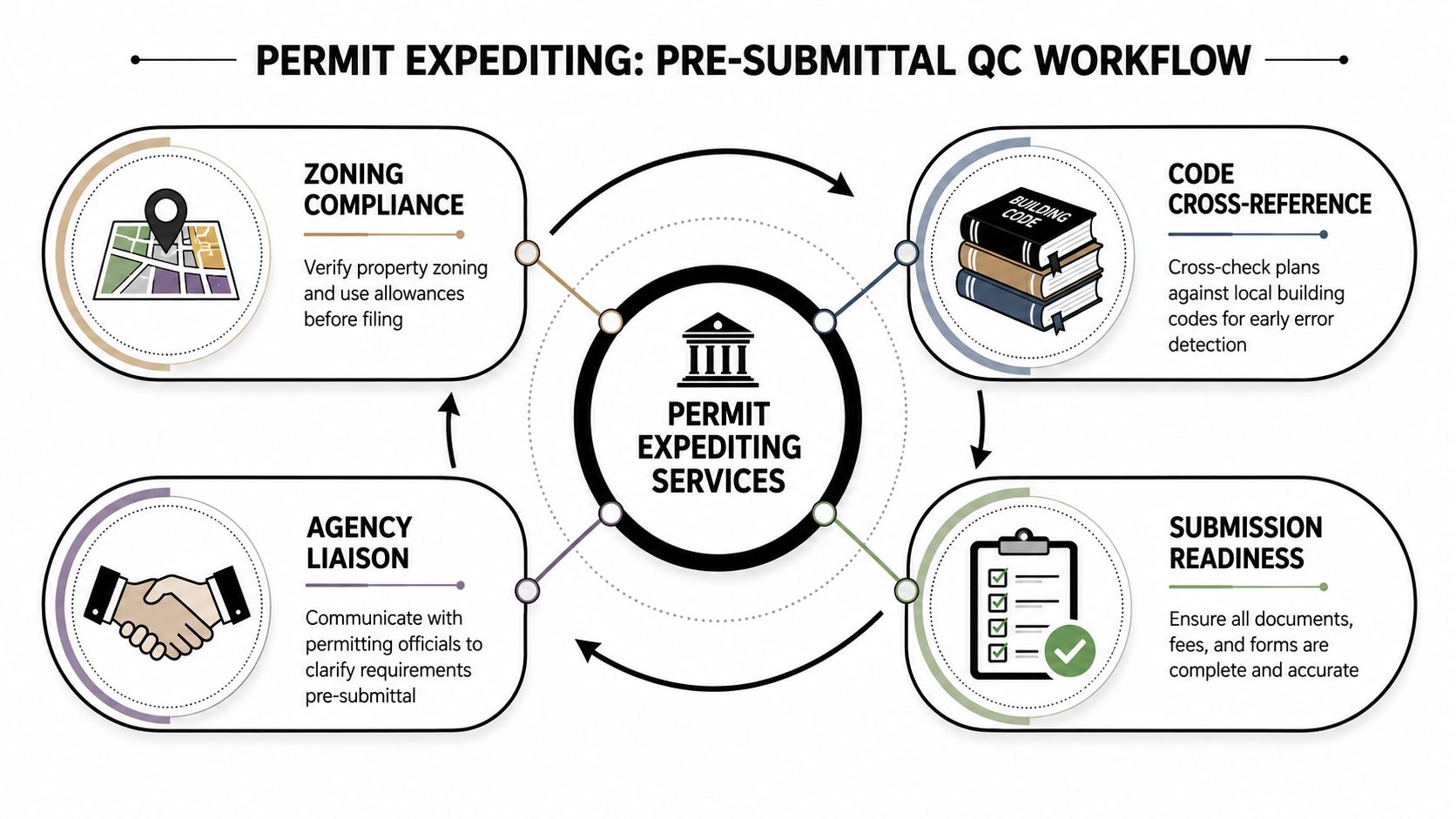
The workflow is pre-submittal quality control
Think of an expediter as the project manager for the permit package. They verify whether the drawings line up with the town's expectations, whether the scope needs building, electrical, plumbing, or mechanical permits, and whether the application is complete enough to survive the first pass. That front-end diligence is what cuts avoidable resubmittals, which is the reason approval times compress in practice.
A good expediter typically handles:
- Zoning checks: confirming the use, setbacks, and lot constraints before filing.
- Code cross-reference: comparing the plan set against the applicable code requirements.
- Application assembly: making sure forms, fees, and supporting documents are all there.
- Agency liaison work: speaking with reviewers or officials so questions are clarified before the file falls behind the queue.
The role is broader than a permit runner. A runner may carry paperwork, but an expediter is supposed to understand the approval path and prevent the common mistakes that create a second review cycle.
For a useful primer on the code side of that work, our guide on understanding building codes and permits for home additions pairs well with the process above.
Experienced expediting is less about speed tricks and more about not wasting your first review.
That's why the scope changes by project. A simple residential permit might only need a clean package and a quick over-the-counter review where allowed. A commercial or multi-agency project can demand much more coordination because every authority having jurisdiction adds another layer of review, another set of comments, and another chance for delay.
Massachusetts Permitting Steps for Home Additions and Remodels
The Greater Boston permit path is rarely one straight line. For a home addition, kitchen remodel, bathroom renovation, basement finishing job, or ADU, the permit package often moves through building review first, then zoning, then any special boards or outside agencies that have a say in the site. That's why local knowledge matters. A home in Cambridge can face a different sequence than the same type of project in Lexington or Wellesley.
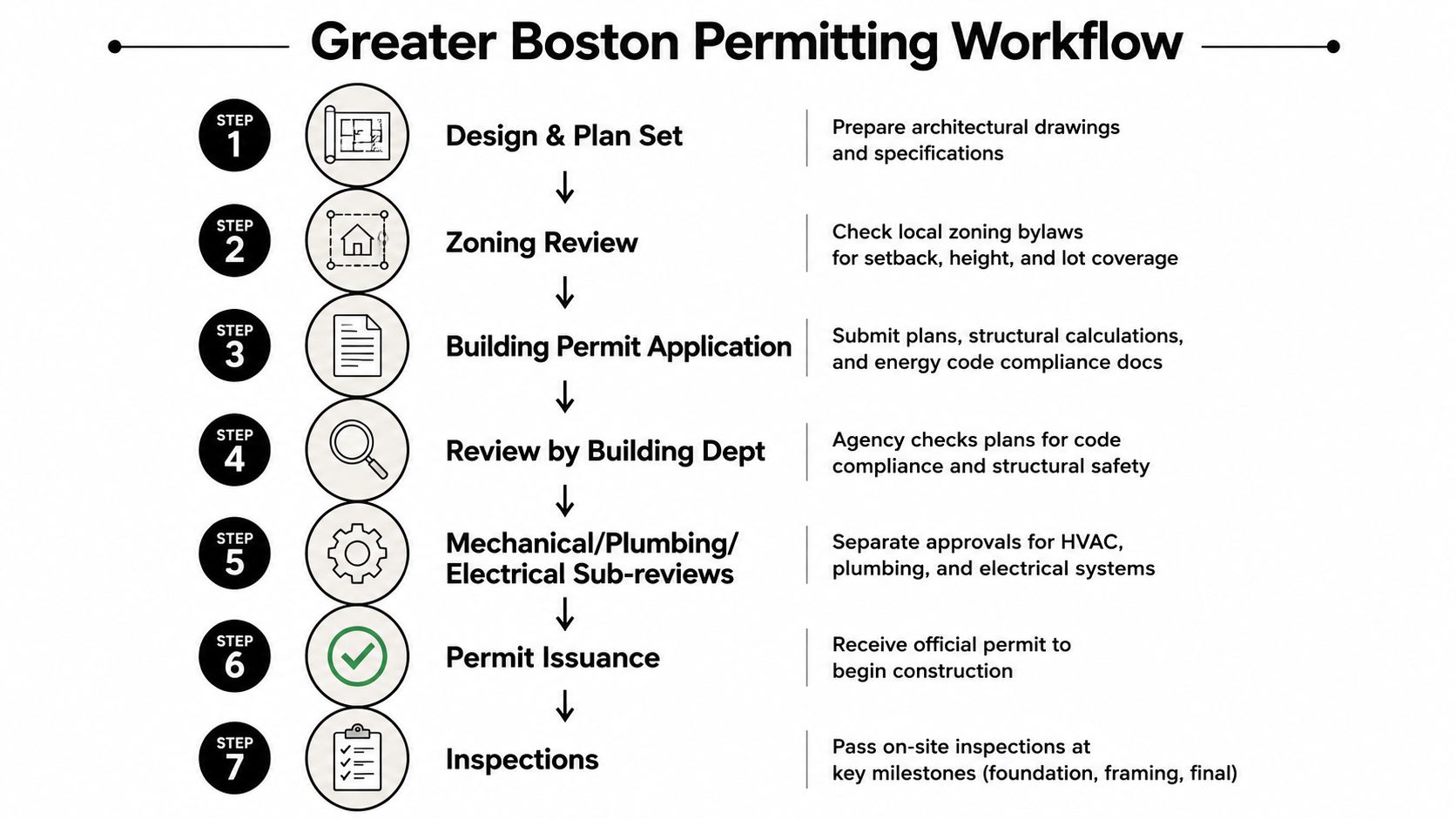
Building, zoning, and special reviews all matter
A building permit under 780 CMR covers the technical side of construction, but that's not the whole story. If the lot is nonconforming, the use changes, or the addition pushes a setback or height issue, zoning review can come into play through the local board or a special permit process. Near wetlands, a conservation commission may get involved. In historic parts of Cambridge or Brookline, the historic district commission can also shape the final scope and finish details.
Homeowners get surprised. The building department may be ready to review the structural package, but another board can still hold the project up if the zoning or site condition wasn't checked first. That's why permit expediting services are most useful when the project touches more than one department or board.
The inspection sequence is just as important. Rough framing, electrical, plumbing, and final inspections all need to pass before closeout, and in some projects occupancy can't happen until those sign-offs are complete. If the work is phased badly, the inspection list becomes a schedule problem instead of a formality.
For Massachusetts process detail, our page on the permitting process in Massachusetts lays out how these steps fit together.
The link below is a useful outside resource if you want a general view of control systems used in other industries. The concept of permit to work systems explained isn't the same as local building permitting, but the logic is familiar, work doesn't start until the right people have cleared the right steps.
A clean permit file is only half the job. The other half is knowing which review desk gets the next say.
This video gives a visual overview of the permitting sequence.
Realistic Timelines and Costs for Permit Expediting in Massachusetts
Permit expediting starts with the file, not the counter. In Greater Boston, that means the drawing set, zoning notes, and support letters have to be tight before anyone walks into the building department. If the project is small and the town is straightforward, a homeowner can often file without help. Once the job touches zoning relief, a historic district, or multiple departments, the value of an expediter goes up fast.
The economics are simple enough. If delay costs are low, expediting may not be worth the fee. If the project is tied to crews, financing, or a move-in date, the cost is easier to justify. Industry guidance puts permit expediting fees in a wide band, from about $500 to $15,000+ depending on project complexity and jurisdiction, with smaller residential work often at the low end and commercial or multi-agency work at the high end (Shovels, Permit Flow).
What the numbers usually look like
In Massachusetts, simple residential work is usually the least expensive to expedite. Add a restaurant review, health department sign-off, or a project that crosses multiple authorities, and the coordination work gets heavier because every added review stream creates another place for the file to stall. Market guidance also links expediting to shorter approval windows when the package is organized correctly, and independent commentary notes professional expediting can reduce approval times by 30% to 45% for complex developments, while unassisted residential permits in many municipalities can sit 4 to 8 weeks without help (PMarketResearch).
| Project Type | Typical Fee Range | Timeline Without Expediting | Timeline With Expediting |
|---|---|---|---|
| Simple residential permit | $500 to $2,500 | 4 to 8 weeks in many municipalities | Often compressed when the package is clean |
| Commercial single-site renovation | $1,500 to $5,000 | Longer review cycle because of more submittals | Faster once zoning and code items are coordinated |
| Restaurant or food-service permit | $2,000 to $7,500 | Usually slower because health and licensing coordination stack up | More efficient when all agencies are lined up early |
Fees also rise with review complexity. When a project has multiple authorities having jurisdiction, the administrative load increases and the correction cycle gets more likely too (Permit Place). In practice, that is where permit expediting starts to pay for itself, because the cost of a delayed start, contractor standby, or financing carry can be higher than the expediter's bill.
The same logic applies to construction sequencing. If your team is trying to reduce carbon footprint on site, a tighter permit schedule can keep material deliveries and labor from spreading out longer than they should. That matters on real jobs, where idle time and extra trips add cost whether anyone puts them on the permit sheet or not.
How to Hire the Right Permit Expediter in Greater Boston
The right expediter should be able to name the town, the review path, and the likely bottleneck before they quote the job. If someone can't explain how a project moves through Cambridge, Arlington, Brookline, or Newton, they probably don't have enough local depth for a hard permit. You want someone who understands the local building department, the zoning board of appeals process, and the way corrections come back.
Ask the questions that expose real experience
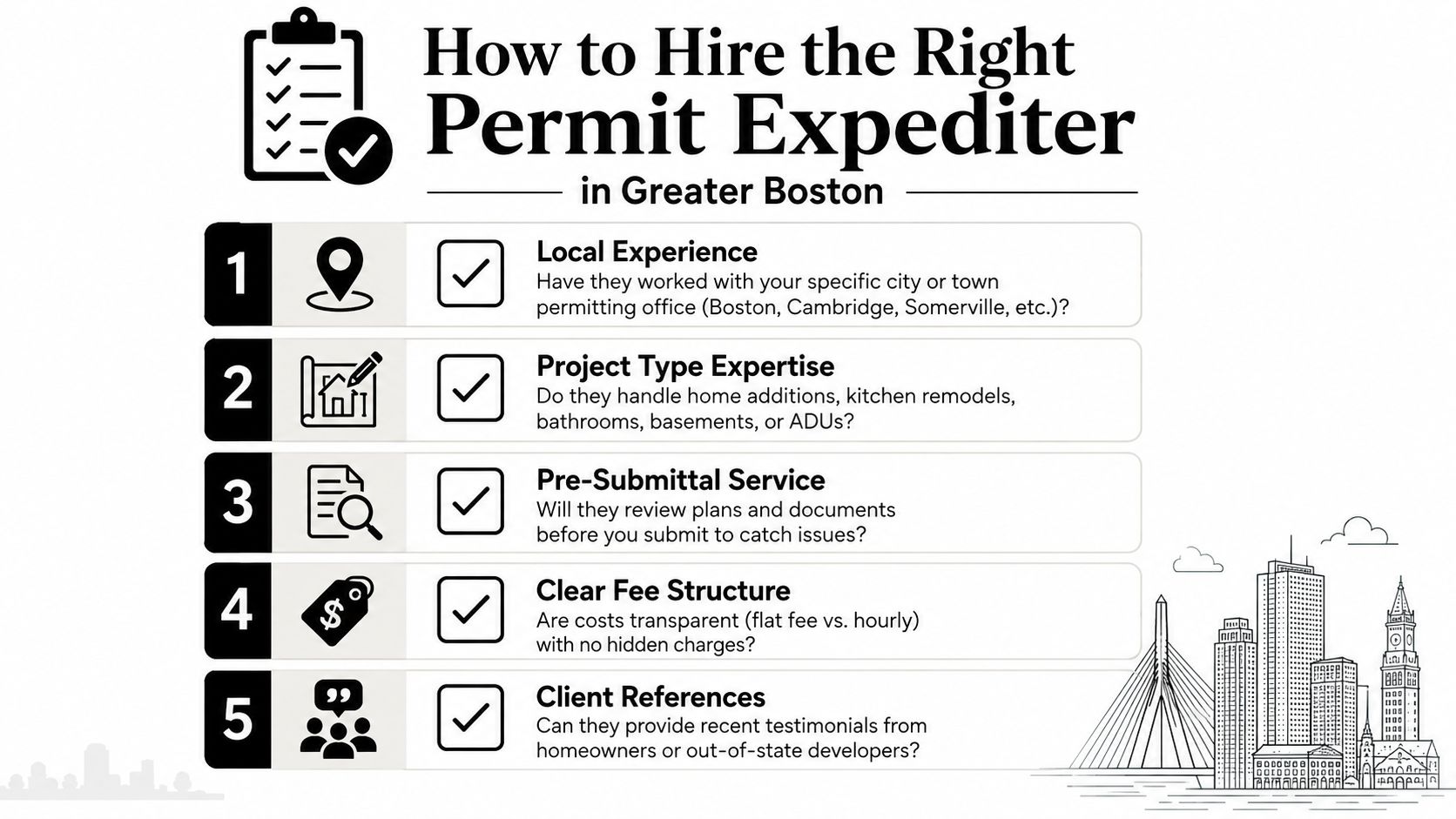
Use a short checklist before you hire anyone:
- Local track record: Have they handled projects in your exact town?
- Project type fit: Do they understand additions, ADUs, kitchen remodels, bathrooms, or basements?
- Code fluency: Can they speak to 780 CMR and local zoning without guessing?
- Fee clarity: Do they quote flat fee, hourly, or a hybrid, and what triggers extras?
- Response process: Who manages reviewer comments and resubmittals?
A strong expediter should also tell you when you don't need one. If the permit is routine, the jurisdiction is familiar, and your contractor already has a clean process, the extra layer may not be worth it. That's especially true for straightforward residential work where the approval path is predictable.
Red flags are easy to spot. Avoid anyone who promises a guaranteed approval date, won't name recent local projects, or acts vague about which office reviews your permit. In Massachusetts, those details matter because one town's informal expectations can be another town's hard requirement.
If they can't explain the first review cycle, they probably won't save you from the second one.
For homeowners, there's also a practical split between a standalone expediter and a design-build contractor that manages permitting in-house. A standalone expediter can be useful when your designer or engineer already has the drawings, but the package needs local navigation. A contractor with in-house permitting can be simpler when you want one team accountable for design, filing, revisions, and field coordination.
How Aureli Construction Handles Permitting for Greater Boston Projects
We handle permits in-house for most residential work because that keeps the project moving and keeps the responsibility in one place. Our team works across Belmont, Brighton, Brookline, Burlington, Cambridge, Lexington, Medford, Melrose, Newburyport, Newton, Arlington, Reading, Somerville, Stoneham, Wakefield, and Wellesley, MA, so we're used to the way local departments ask for drawings, corrections, and inspections. For homeowners, that usually means fewer handoffs and fewer “who's chasing the permit?” moments.
One team, fewer gaps
With more than 30 years in Greater Boston construction, we've seen how different building departments interpret the same scope. A kitchen remodel, bathroom renovation, basement finishing job, home addition, or ADU can all trigger different review points depending on the town, the zoning conditions, and the code path. Because we design and build under one roof, we can spot permit issues before submittal instead of learning about them after the file is already in review.
That integrated approach usually removes the need to hire a separate expediter for residential projects. It also helps with out-of-state developers and national brands that need Massachusetts permit expediting support, because the work is really about local coordination, paperwork, and communication with town officials. We've found that when those pieces are handled early, the rest of the job moves with less friction.
If you're comparing options for a home addition contractor Boston MA homeowners can rely on, the permitting side should be part of the conversation from day one. It's not an add-on. It's part of how the project gets built.
Frequently Asked Questions About Permit Expediting
Do all home improvement projects need permits in Massachusetts?
No, but many do. Structural changes, additions, electrical work, plumbing changes, and most ADU work usually trigger some form of permit review, and local zoning can add another layer.
How long does permitting usually take in Greater Boston?
It varies by town and scope. Simple work can move faster, while projects with zoning, conservation, or historic review take longer.
Can a homeowner pull their own permit?
Sometimes, but many projects are easier with a licensed contractor managing the process. If the work is complex, the review path is usually the challenge, not the form itself.
What happens if work starts without a permit?
The town can stop the job, require corrections, and hold up inspections. That usually costs more than getting the permit right at the start.
Ready to move from drawings to construction without getting stuck in town hall? Contact Aureli Construction for a free estimate at Aureli Construction. We handle design-build projects, permitting, and coordination for Greater Boston homeowners who want the job done cleanly the first time.