
A homeowner in Cambridge may start with a simple question: should you call a handyman or a contractor for a bathroom update? Replacing a mirror or repairing a loose cabinet door sounds straightforward. Moving plumbing, improving ventilation, opening a wall, or changing the room's layout is a different category of work.
That's the practical problem behind contractor vs handyman decisions across Belmont, Brighton, Brookline, Burlington, Cambridge, Lexington, Medford, Melrose, Newburyport, Newton, Reading, Somerville, Stoneham, Wakefield, and Wellesley. The dividing line usually isn't the size of the job. It's whether the work changes the structure, affects electrical or plumbing systems, requires a permit, or creates responsibilities under Massachusetts licensing and building-code rules.
Table of Contents
- The Real Difference Between a Contractor and Handyman
- Massachusetts Licensing and 780 CMR Building Codes
- Comparing Scope Insurance and Risk in Greater Boston
- Project Guide for When to Hire a Contractor or Handyman
- Home Remodeling Costs and Permit Fees in Massachusetts
- What to Expect When Hiring a Design-Build Contractor
- Frequently Asked Questions About Hiring Local Pros
The Real Difference Between a Contractor and Handyman
Homeowners often use a simple rule: small job means handyman, large job means contractor. That rule can work for painting a bedroom or fixing a sticking door, but it becomes unreliable as soon as the work affects the home's systems or legal status.
A bathroom renovation in Cambridge might involve a fixture swap, or it might involve new plumbing, a new circuit, waterproofing, exhaust ventilation, tile, framing, and inspection coordination. Both projects may be described casually as a “bathroom update,” yet they carry very different risks.
The useful question is this:
Practical rule: Ask whether the work changes structure, systems, or permitting status. Don't decide only by the project's square footage or apparent size.
A handyman is generally a sensible choice for minor, permit-exempt maintenance and repairs, such as patching drywall, adjusting doors, replacing hardware, painting, or handling limited cosmetic work. A contractor becomes the safer choice when the project involves a remodel, addition, structural framing, basement finishing, major plumbing, electrical changes, or coordination among several trades.
In Massachusetts, permit and licensing requirements can vary with the property and the exact work. The Massachusetts Home Improvement Contractor guidance makes clear that residential contractors working on existing, owner-occupied one- to four-unit properties must register as Home Improvement Contractors. The state also distinguishes that registration from a Construction Supervisor License.
For homeowners comparing bids, a detailed scope is more valuable than a low starting price. Estimating platforms such as Exayard construction estimating software can help organize quantities and project assumptions, but software can't determine whether your local building department requires a permit or whether a trade license applies.
The shortcut that often fails is hiring someone who promises to “handle everything” without explaining permits, insurance, inspections, or subcontractors. A licensed general contractor should be able to tell you where the project enters regulated work and who is responsible for each part.
Massachusetts Licensing and 780 CMR Building Codes
Massachusetts homeowners need to understand two separate credentials. Home Improvement Contractor registration relates to covered home-improvement contracting work. A Construction Supervisor License, commonly called a CSL, concerns the supervision of building work within its license scope. The state explicitly says these credentials are not interchangeable, so checking one does not replace checking the other.
That distinction matters on projects such as a Lexington home addition, a Medford basement conversion, or a structural kitchen remodel. The Massachusetts State Building Code, 780 CMR, governs permitted construction and gives inspectors the framework for reviewing work. It affects structural framing, fire safety, egress, ventilation, electrical coordination, plumbing work, and other conditions that a quick repair visit may never address.
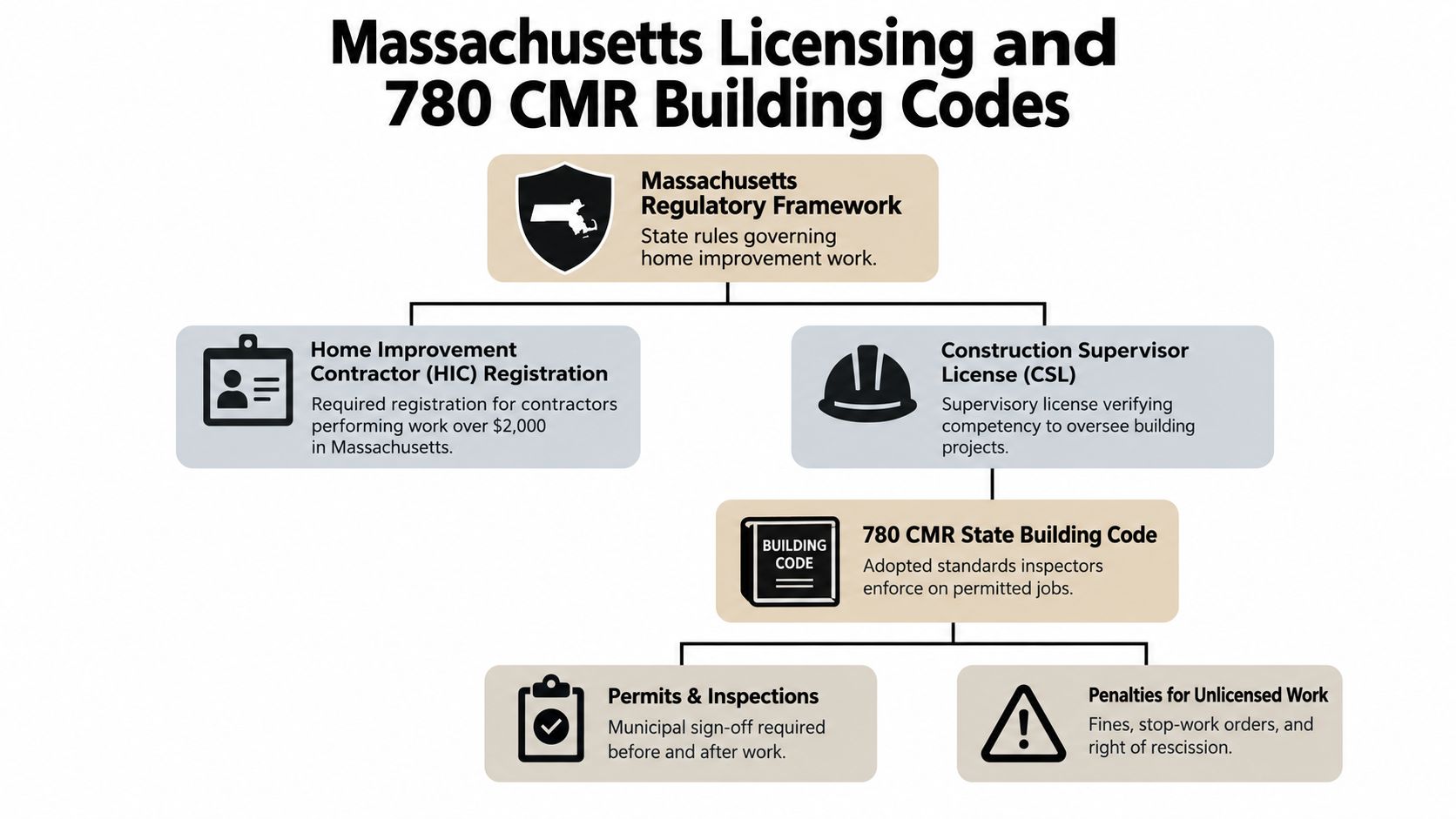
HIC registration and CSL licensing
A contractor working on an existing owner-occupied one- to four-unit residential property generally needs HIC registration under Massachusetts consumer rules. Certain projects also require a CSL, depending on the building work and the person supervising it.
Homeowners should ask prospective contractors:
- Registration details: Is the company registered as a Home Improvement Contractor where required?
- Supervisor credentials: Does the project require a Construction Supervisor License, and who holds it?
- Trade licensing: Are licensed electricians and plumbers handling electrical, plumbing, and gas work?
- Permit responsibility: Which party will submit applications, schedule inspections, and close permits?
The Massachusetts building-code and permit guidance for home additions is useful when a project changes the footprint, framing, or use of the home. Local building departments may also require zoning review, especially when setbacks, lot coverage, height, or use change.
Why the homeowner permit shortcut creates risk
Under 780 CMR, the owner of a one- or two-family dwelling may be allowed to secure their own building permit instead of using a licensed general contractor. That option doesn't transfer responsibility to the municipality or make the homeowner's role administrative.
The homeowner remains responsible for code compliance and the work of subcontractors. Municipal guidance also explains that homeowners can't pull electrical or plumbing and gas permits for that work, because those permits must come from the appropriately licensed trade contractor.
Massachusetts consumer guidance adds another serious consideration. The registered contractor is generally responsible for obtaining necessary permits, while homeowners who secure their own permits can lose access to Homeowners' or Guaranty Fund protections for covered work. A homeowner acting as their own contractor may also carry responsibility for compliance and potential injuries involving subcontractors.
That's why permit handling isn't a minor paperwork detail. It's part of the risk allocation built into the project.
Comparing Scope Insurance and Risk in Greater Boston
A handyman and a licensed general contractor can both be useful, but they solve different problems. The handyman route is often efficient for maintenance. The contractor route is designed for planning, coordination, compliance, and accountability across a larger scope.
| Feature | Licensed General Contractor | Handyman |
|---|---|---|
| Typical scope | Remodels, additions, structural work, basement finishing, multi-trade projects | Minor repairs, maintenance, cosmetic improvements |
| Permits | Coordinates building, electrical, plumbing, and other required permits through the appropriate parties | Usually limited to work that doesn't require permits or specialized trade licensing |
| Trade coordination | Manages designers, engineers, electricians, plumbers, inspectors, and subcontractors | Usually works independently or within a narrower repair scope |
| Code responsibility | Plans permitted work around 780 CMR and inspection requirements | Handles work that generally remains outside permit-triggering scope |
| Insurance questions | Should provide general liability and workers' compensation documentation | Homeowner should verify coverage before work begins |
| Contract structure | Written scope, allowances, schedule, payment terms, and change-order process | Often smaller work orders or repair estimates |
| Best fit | A kitchen remodel, addition, ADU, structural bathroom renovation, or finished basement | Drywall patches, trim repairs, hardware replacement, painting, and similar tasks |
Insurance is where an apparently inexpensive repair can become expensive. If an uninsured worker is injured or causes water damage, the homeowner may face a dispute over responsibility with the worker, the contractor, and their own insurer. Request a certificate of insurance and confirm that it covers the people who will work on the property.
Massachusetts also requires a written contract for covered home-improvement work estimated at $1,000 or more, with specific statutory terms, according to the state's HIC contractor resources. The dollar threshold is not a universal definition of a handyman job. It's a contract requirement for covered work.
A low quote doesn't protect you from failed inspections, concealed damage, incomplete permits, or trade work performed by someone without the required license. The responsible bid is the one that identifies the scope and the risk before work starts.
Project Guide for When to Hire a Contractor or Handyman
Use the repair-versus-remodel test before you call anyone. A repair restores an existing condition without materially changing the home's structure or systems. A remodel changes how the space works, how systems are routed, or how the building department evaluates the work.
Handyman territory
A handyman may be appropriate for:
- Surface repairs: Patching drywall, repairing trim, touching up paint, and replacing damaged hardware.
- Small carpentry work: Adjusting doors, installing shelves, or repairing non-structural cabinet components.
- Maintenance: Recaulking around a sink, replacing a like-for-like fixture where no permit or trade license is required, or addressing minor finish issues.
- Punch-list items: Handling cosmetic corrections after a larger project, provided the work stays within the person's legal scope.
Even here, ask what the worker is licensed and insured to do. “Handyman” is a description of service style, not a substitute for checking credentials.
Contractor territory
Call a licensed general contractor when you're:
- Moving plumbing: Relocating a sink, adding a kitchen island water line, or changing bathroom supply and waste lines.
- Changing electrical systems: Adding circuits, rewiring, moving a panel, or altering wiring for a kitchen or bath.
- Opening structure: Removing walls, changing beams, modifying framing, or enlarging openings.
- Finishing a basement: Planning habitable rooms, emergency egress, insulation, moisture control, stairs, and inspections.
- Changing the footprint: Building an addition, second story, or ADU that may require zoning review and a building permit.
For example, relocating plumbing for a Belmont kitchen island isn't just a cabinet installation. Finishing a basement in Somerville isn't just hanging drywall if the finished rooms need compliant egress, electrical work, insulation, and inspection approval.
For minor repairs, homeowners can review a homeowner repair services overview to understand the type of work commonly handled outside a full remodeling contract. Once the project becomes a coordinated renovation, bring in a contractor early, before materials are ordered or walls are opened.
Home Remodeling Costs and Permit Fees in Massachusetts
Greater Boston remodeling prices vary widely by existing conditions, finish selections, structural requirements, access, design work, and permit scope. Without a defined plan and site review, quoting a precise Massachusetts cost range would be misleading.
That's especially true for a Wellesley bathroom renovation, a Brookline kitchen remodel, or a full addition. A bathroom with accessible plumbing and a straightforward finish package is a different project from one requiring subfloor repairs, layout changes, upgraded ventilation, custom tile work, and electrical revisions.
The practical budgeting categories are:
- Design and investigation: Existing-condition documentation, architectural drawings, engineering when needed, and early review of zoning constraints.
- Construction: Demolition, framing, insulation, cabinets, tile, flooring, fixtures, painting, and finish carpentry.
- Trade work: Electrical, plumbing, heating, ventilation, and gas work performed by appropriately licensed professionals.
- Permits and inspections: Application costs, municipal review, required inspections, and final closeout.
- Contingency planning: Allowance for concealed rot, outdated wiring, damaged subfloors, or structural conditions discovered after demolition.
A handyman's hourly or task-based price may look lower because it excludes design, permit management, supervision, engineering, and trade coordination. That comparison isn't useful if the job requires those services.
The hidden cost of unpermitted work can include removing finished surfaces, correcting code violations, repeating work, delaying a sale, or resolving questions raised by a buyer's inspection. Massachusetts consumer guidance also warns that homeowners who pull their own permits may lose certain Homeowners' or Guaranty Fund protections and assume responsibility for compliance and subcontractor-related injuries. Those risks belong in the budget conversation before anyone gives you a starting price.
For a project that includes kitchens, bathrooms, additions, basements, or ADUs, request a written scope with allowances and a clear change-order process. A transparent estimate won't eliminate surprises, but it gives you a method for handling them.
What to Expect When Hiring a Design-Build Contractor
Hiring a contractor shouldn't mean handing over control of your home. A well-managed design-build process gives you defined decisions, documented costs, and a clear person responsible for coordinating the work.
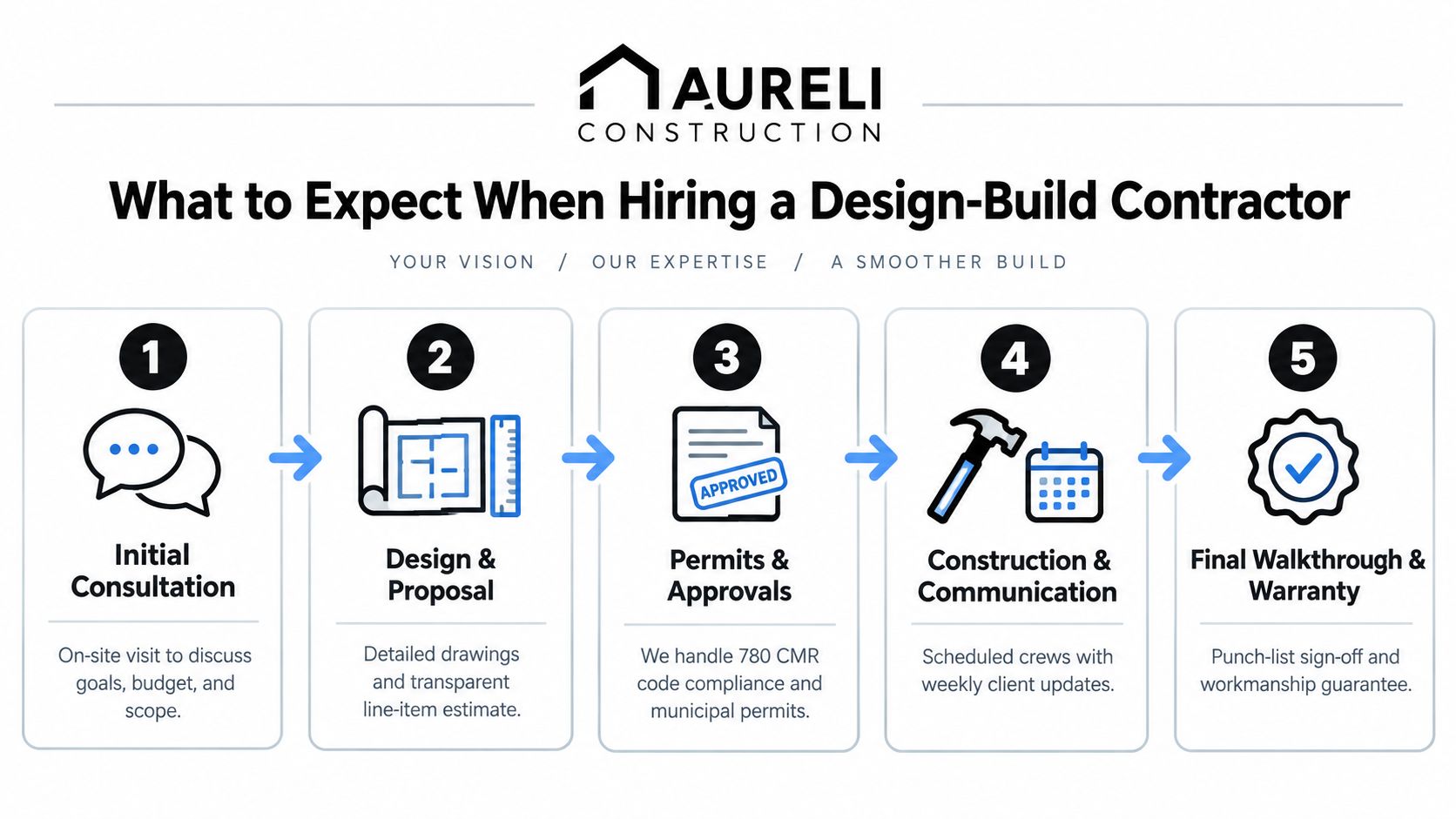
The early planning phase
The process starts with an on-site conversation about how you use the home, what isn't working, and what you want the finished space to accomplish. We review existing conditions, likely structural questions, access, utilities, and the practical limits of the property.
For an addition in Reading, zoning may affect setbacks, lot coverage, or the allowable building envelope. A project may need local zoning-board review, a special permit, or a variance before construction can proceed. Those questions should be raised before detailed pricing is treated as final.
Design permits and construction
A design-build contractor brings drawings, specifications, and a line-item proposal together before the construction phase. The design-build contractor guide explains why having design and construction coordinated can reduce gaps between the plan and the field work.
Our team at Aureli Construction is a Massachusetts licensed general contractor handling home additions, kitchen remodels, bathroom renovations, basement finishing, and ADU construction. We coordinate with local building departments across Greater Boston, including Belmont, Brighton, Brookline, Burlington, Cambridge, Lexington, Medford, Melrose, Newburyport, Newton, Reading, Somerville, Stoneham, Wakefield, and Wellesley.
The permit sequence depends on the project. Building, electrical, and plumbing permits may be separate. During construction, inspectors may review rough framing, rough electrical, rough plumbing, insulation, or other concealed work before walls are closed. Final inspections and required closeout steps follow before the project is considered complete.
Watch the process in context:
Communication and changes
Old homes can reveal conditions that no estimator could confirm without demolition. When that happens, the contractor should document the condition, explain the options, price the change, and receive approval before proceeding whenever practical.
That standard also applies to selections, substitutions, schedule changes, and owner-requested additions. Homeowners evaluating any construction professional can use a practical guide on how to hire a CT fence pro for broadly useful questions about scope, communication, and documentation, even though the project type is different.
Frequently Asked Questions About Hiring Local Pros
Is a handyman enough for a bathroom renovation?
A handyman may be suitable for cosmetic maintenance, such as patching drywall, replacing trim, or handling a limited fixture-related task that doesn't require a permit or specialized trade license. A full bathroom renovation usually involves several coordinated scopes, including plumbing, electrical work, ventilation, waterproofing, framing, and finish installation. Have the work reviewed before deciding based on the room's size.
Can I live in my house during a kitchen remodel?
Often, homeowners can remain in the house, but the answer depends on the project's footprint, dust control, access to cooking and plumbing, and how long essential utilities are interrupted. Establish a temporary kitchen, protected paths, work hours, containment expectations, and communication procedures before demolition begins.
How do permits and inspections affect the schedule?
Permit timing depends on the municipality, project documents, zoning questions, and the completeness of the application. Construction also needs coordination around rough and final inspections. A contractor should identify the expected approvals, explain which trades pull their permits, and avoid closing walls before required rough inspections.
What happens if hidden damage appears?
The contractor should stop long enough to document the condition and explain whether repair, redesign, or engineering is needed. Common examples include damaged framing, deteriorated subfloors, outdated wiring, or concealed plumbing problems. Don't approve a verbal change that affects cost or code compliance without written documentation.
How should I compare local contractors?
Check registration and applicable licenses, request insurance documentation, compare written scopes, ask who handles permits, and review the change-order process. The Greater Boston home addition company vetting checklist can help organize those questions before you sign.
Aureli Construction helps Greater Boston homeowners plan and build compliant kitchens, bathrooms, basements, home additions, and ADUs with coordinated design, permitting, trade work, and inspections. If you're deciding between a handyman and a contractor, Aureli Construction can review your scope and provide a free estimate for the right level of professional support.